Hyundai's 10-Year Strike Streak Is About to Break
Hyundai Motor's first full strike in a decade is shutting down three major plants for up to 16 hours a day. The demands — a 50% bonus hike, retirement-age extension, and rehiring of dismissed workers — could reshape global EV supply chains if they drag.
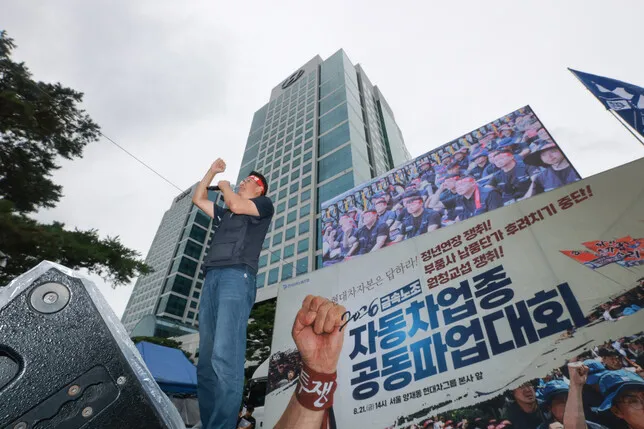
The factory floor goes quiet — and the world takes notice
Hyundai Motor has not had a full-scale strike since September 2016. Ten years passed without a single day of complete production halts across its sprawling Korean operations. That changed on the 21st, when the Metal Workers Union’s Hyundai division ordered every plant — Ulsan, Jeonju, Asan — to shut down for a full two-shift strike, paralyzing 39,000 workers and stopping the line for 16 hours a day.
This is not a symbolic walkout. It is a coordinated, multi-plant disruption of one of the world’s most consequential automakers, and it arrives at a moment when the global EV race is tightening and supply chains are already fragile.
The image from Ulsan, the company’s flagship complex and one of the largest integrated auto plants on Earth, has been telling: empty parking lots, idle robotic arms, and security cameras capturing the unusual silence of a facility that normally runs three shifts around the clock. For a company that built its modern reputation on execution speed and just-in-time precision, the sight is almost embarrassing — and financially costly.
What the union is asking for
The three demands are straightforward and expensive.
First, a 50% increase in annual bonus payments. The union argues that fixed wages account for only 54.8% of total compensation, forcing workers to rely on overtime and special-shift premiums just to maintain their standard of living. A 50% bump in bonuses would materially shift that balance — and the cost.
Second, extension of the retirement age. Hyundai’s current retirement threshold has been a recurring friction point. The union notes that past agreements have already extended it, and that the company can afford to do so again.
Third, rehiring of workers dismissed during previous labor disputes. The union frames this as a trust issue — a baseline expectation that the company will not permanently punish organizing activity.
Management’s response has been uniformly negative. Hyundai says there is no justification for rehiring the dismissed workers. It argues that retirement-age policy is a matter for the political branch, not for bilateral labor negotiation. And on bonuses, the company is holding the line.
The company’s balance sheet tells a different story
The union points to Hyundai’s retained earnings — 101.3 trillion won as of last year — as proof that the company can absorb these demands without financial distress. That figure, roughly $75 billion at current exchange rates, is substantial for a single automaker and far exceeds the annual cost of the union’s proposals. Whether management concedes that point remains the central question.
Hyundai’s operating margins for 2025 came in above 9%, a level that comfortably exceeds most Western peers and puts the company in the top quartile of the global auto industry. The margin advantage has been driven by strong Ioniq sales, disciplined cost management, and favorable currency headwinds. But margins are forward-looking statements only until they are tested — and a prolonged strike would test them immediately.
Negotiations have been stalemated since mid-May. The latest round, held on the 18th after a 40-day gap, ended without agreement. Union leader Lee Jong-cheol stated plainly that talks will not resume until the company puts a concrete proposal on the table. No date has been set for the next session.
On the 25th, the union’s Central Dispute Resolution Committee will meet to decide whether to escalate further. That is the date to watch.
Second-order effects are already visible
Even in its first week, the strike is generating ripple effects that extend well beyond the factory gates.
Tier-1 suppliers in the Hyundai-Kia ecosystem, particularly those feeding the Ulsan and Jeonju lines, are already adjusting schedules. Several have begun pulling back overtime and idling smaller workforces, knowing that without steady off-take from the assembly plants, inventory buildup will eat into their own thin margins. The knock-on cost to suppliers is likely to be significant, and suppliers will factor those losses into future pricing negotiations with Hyundai — meaning the strike’s financial footprint will outlast the walkout itself.
In the logistics sector, the disruption is manifesting differently. Containers that were scheduled to depart from the Port of Busan for European and North American dealerships are being repositioned or delayed. Hyundai’s overseas distribution centers, which operate on tight safety-stock thresholds, are feeling the pressure. A two-week delay in Ulsan production translates to roughly a three-to-four-week delay in European dealership availability, because the pipeline has no buffer.
Perhaps most critically, the strike is altering investor psychology. Hyundai’s stock, which had traded at a premium relative to many global peers on the strength of its EV execution narrative, has dipped roughly 4.2% since the strike began. The market is pricing in the possibility of a prolonged disruption, even though most analysts expect a settlement within three weeks. The premium valuation was built on predictability — and predictability is exactly what is being tested.
There is also a reputational dimension. Hyundai has spent years positioning itself as a reliable, forward-looking brand in markets that are increasingly sensitive to ESG and corporate governance criteria. Labor unrest at a flagship operation, even when justified by worker concerns, creates an awkward narrative for a company that courts institutional investors with strong governance scores.
Why this matters beyond Korea
Hyundai Motor is already one of the fastest-growing major automakers in the world, with aggressive EV targets and expanding capacity in Georgia, Alabama, and India. A prolonged strike in Korea disrupts not just domestic production — it creates a ripple through global inventory planning. Dealers in Europe and North America that depend on Hyundai-Kia units built in Ulsan and Jeonju will feel the shortage first.
The timing is especially sensitive. The global EV transition has pushed every major manufacturer to compress development cycles and lock in supply contracts for batteries, semiconductors, and critical minerals. Hyundai’s own EV push — anchored by models like the Ioniq lineup — depends on steady production discipline. A strike that stretches into weeks introduces uncertainty that competitors can exploit.
European dealers, already navigating a demand slowdown in the BEV segment, will find their Hyundai and Kia allocations compressed at a moment when consumer patience is thin. In China, where Hyundai’s market share is negligible but its competitive signaling is not, BYD and other manufacturers are watching closely. Any perception that Korea’s auto establishment is vulnerable — even temporarily — strengthens the case for Chinese exporters to push harder into Southeast Asian and Middle Eastern markets that Hyundai has considered secondary.
Who wins and who loses
The union wins if the strike drags long enough to force concessions. Hyundai’s history of avoiding full walkouts gives management an incentive to resolve this quickly — but not quickly enough to look weak in front of other unions. The Metal Workers Union is watching, and so are workers at Kia, which shares some labor leadership. A concession here becomes a precedent there.
Hyundai loses if the strike disrupts quarterly delivery targets or forces the company to slow EV production lines that were already running thin on inventory. The company’s stock and its credibility with investors who backed its aggressive global expansion both take a hit. More subtly, management’s authority over its own workforce erodes with each week of impasse — a cost that does not appear on any balance sheet but is real nonetheless.
Competitors — particularly Tesla, BYD, and Stellantis — gain a temporary window. If Hyundai units become scarce in key markets, buyers have fewer alternatives in the value EV segment. Chinese manufacturers, already competitive on price, stand to gain the most if the disruption extends beyond a few weeks. The market share Hyundai has fought to establish in Europe over the past three years is not easily won, but it is not immune to momentum loss either.
What happens next
The most likely scenario is a negotiated settlement within two to four weeks, involving a partial concession on bonuses and a phased retirement-age extension, with the rehiring demand dropped or deferred. That outcome preserves management authority while giving the union a headline it can take home.
The riskier scenario — and the one that would send shockwaves through the auto industry — is a strike lasting more than a month. That would coincide with peak summer demand in North America and Europe, potentially forcing dealers to reallocate inventory from other brands and disrupting Hyundai’s annual production targets by a meaningful margin.
Either way, the 10-year streak is over. Hyundai’s labor relations are entering a new phase, and the company’s next move — how quickly it returns to the table and how much it concedes — will signal whether Korea’s industrial model can absorb rising wage expectations without losing its competitive edge in the EV era. The world will be watching, and so will every union organizer in the Korean auto sector who has been waiting a decade for a sign.