Hyundai Atlas Robot Supply Chain Reveals Korea's Robotics Play
Hyundai's Atlas humanoid robot supply chain is mapped — and Korean suppliers just slid into slots Western competitors didn't see coming. The camera results alone rewrite the expected playbook.
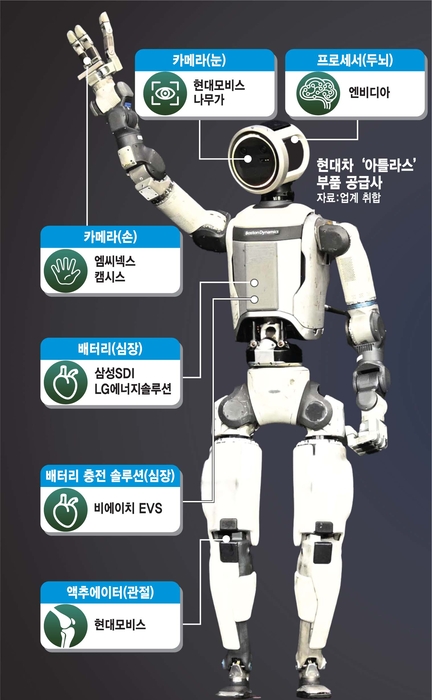
The camera result that should unsettle everyone
LG Innotek was the obvious pick for Atlas’s main camera. The company already worked with Boston Dynamics, the robot’s developer, and it had the established credential. It lost the job.
Modern Mobis — Hyundai Motor Group’s auto-parts arm — won it instead, pairing with Namuga, a camera-module maker best known for supplying Samsung Electronics smartphones. The result, reported by Electronics News on October 26, is a detail most international coverage of humanoid robotics has missed so far.
It matters more than it looks.
Who got what
The supply chain, as mapped by the report, is straightforward on paper but quietly significant in practice:
- Actuators — Modern Mobis, 100 percent. These are the robot’s joints and account for more than half of Atlas’s bill of materials. Modern Mobis will manufacture them at its US facility and ship them to Boston Dynamics. No other supplier is involved.
- Batteries — Samsung SDI and LG Energy Solution. Atlas uses 21mm cylindrical cells. Samsung SDI is the primary supplier; LG Energy Solution supplies from its Georgia plant. Neither company had to pivot aggressively — they already mass-produce this form factor for EVs.
- Charging — BH EVS, a subsidiary of BH Electronics. BH EVS was created in 2022 when it acquired LG Electronics’ vehicle wireless-charging division. The company is applying power-control expertise from car chargers to robot charging. Small name. Unlikely to appear in any pre-Atlas robotics coverage.
- Main camera — Modern Mobis and Namuga. As noted, this overwrote the expected LG Innotek assignment.
- Hand cameras — MCNEX and Camsys. Both companies built their reputations in mobile and automotive cameras and are now translating that capability to robotic perception.
- Processor — NVIDIA, with the Jetson Thor chip for low-latency AI inference. This one is expected — Jensen Huang and Hyundai Motor Group chairman Chung Euisun have met repeatedly to deepen the partnership.
Why the camera swap is the story
Robotics supply chains are still being written. Every component slot that a Korean firm fills today raises the cost of entry for a Western competitor tomorrow. Cameras are an especially important signal because perception is where the physical-AI advantage is being won or lost.
Boston Dynamics had a working relationship with LG Innotek. That relationship did not translate into the Atlas contract. Instead, Hyundai pulled in Namuga — a firm with deep experience inside Samsung’s smartphone camera supply chain — and positioned Modern Mobis as the prime contractor. The effect is vertical integration by proxy: Hyundai owns the robot, its joints, its eyes, and now its charging system. Boston Dynamics supplies the gait and the software stack. Everyone else is kept at arm’s length.
Hand cameras went to MCNEX and Camsys for the same reason the main camera went to Namuga: Hyundai is building a closed loop around perception hardware. These are companies that shipped hundreds of millions of mobile and automotive camera modules. They understand yield, volume, and cost. That translation to robotics is exactly the kind of move that reconfigures a supply chain without announcing it.
Batteries are the easier win
Samsung SDI and LG Energy Solution landing the Atlas battery job is less surprising and more structurally important. The 21mm cylindrical cell is a standard EV format. Both companies already produce it at scale. Samsung SDI’s role as the main supplier reflects capacity and track record, not a pivot.
What’s worth noting is geography. Samsung SDI’s supply position is domestic and Malaysian. LG Energy Solution’s is Georgian — the same state where Hyundai is building its robotics meta-plant. That means LG Energy Solution can feed the Atlas production line with minimal logistics friction. It also means the first wave of Atlas units leaving the Georgia plant will carry a battery that was manufactured down the road.
The 30,000-unit target changes the math
Hyundai plans to ramp Atlas to 30,000 units per year by 2028, produced at its Robotics Meta-Plant Application Center inside the Hyundai Meta-Plant America complex in Georgia. That is not a prototype run. It is an industrial-scale commitment.
At that volume, the supply chain choices made today lock in for years. Actuator suppliers, camera-module makers, and battery producers who secure their positions now will be incumbents when the next generation of humanoid robots appears. Companies excluded from this chain — LG Innotek on the camera side, for example — will need to rebuild relationships from scratch.
What this means for the global robotics supply chain
Western robotics firms typically build around US or European actuator and sensor suppliers. Hyundai is doing the opposite: it is wrapping Atlas in Korean manufacturing capability at every layer that matters.
The implication is not that Korea will dominate humanoid robotics. The implication is narrower and more immediate: Korea has moved from being a potential buyer of robotics components to being a supplier of them, and it is doing so inside a vertically integrated platform that controls its own distribution. That is the same pattern that played out in EVs and memory chips.
NVIDIA’s role as the processor supplier is the one Western anchor in this chain. But even that relationship is framed by the Hyundai-NVIDIA executive coordination that has been public for months. The hardware is American. The assembly, the actuation, the perception, the power — that is Korean.
What happens next
Watch three things.
First, whether Boston Dynamics retains independent camera and actuator suppliers for its commercial and research platforms, or doubles down on Hyundai-sourced components. The Atlas supply chain decision does not bind the rest of Boston Dynamics’ business — yet.
Second, whether Samsung SDI’s position as main battery supplier for Atlas extends to other Hyundai robot variants. If it does, the 21mm cylindrical cell becomes a standard robotics battery format, not just an EV one.
Third, whether any of the camera suppliers — Namuga, MCNEX, Camsys — begin supplying other humanoid robot developers. Hyundai is keeping these relationships internal for now. That discipline will determine whether this supply chain becomes a closed ecosystem or a springboard for broader Korean robotics-component exports.
The Atlas supply chain was not leaked. It was reported. The difference matters: no one is trying to hide this. Hyundai is simply showing that the Korean robotics supply chain is already built, and it is not asking for permission to exist.