Hyundai's Self-Evolving Robots Signal a Manufacturing Revolution
Hyundai and Kia are deploying AI-driven robots that auto-generate welding paths without human programming — a leap in autonomous manufacturing that could force heavy industries worldwide to adapt or fall behind.
The Factory That Programs Itself
A robot arm stretched toward a car body, hesitating at each weld point as if testing the air. Then it moved — smoothly, without pause. What just happened was a demonstration of technology that could quietly redefine how the world’s heaviest industries build things.
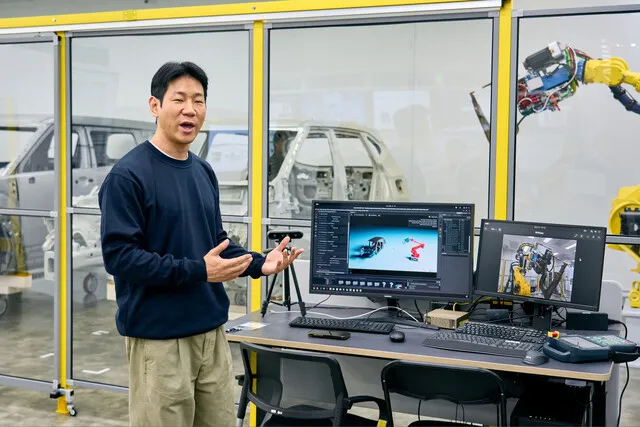
At Hyundai Motor Group’s Uiwang Research Center last week, engineers showed off a system that auto-generates robot movement paths without human input. For decades, the bottleneck in automotive welding wasn’t the robots themselves — it was the engineers who had to manually program the path each robot took between each of the 1,700-plus weld points on a single car body. That work was slow, expensive, and required deep institutional knowledge. Now artificial intelligence does it automatically.
The implication is straightforward but massive: when the company rolls this into volume production by 2027, Hyundai and Kia will shave significant time and cost out of their line setups and changeovers. Every new model variant, every reskilling of a production line — those moments of friction that currently require teams of specialists to reprogram hundreds of robots — become far cheaper and faster.
That is not incremental improvement. That is a structural shift in how factories scale.
The Software-Defined Factory
This single technology sits inside a much larger strategy that Hyundai calls the “Software-Defined Factory” — or SDF. The idea is to standardize data collection, management, and development environments across all Hyundai and Kia plants worldwide so that a manufacturing innovation developed in one facility can be rapidly deployed to another, anywhere in the world.
Historically, each factory built its own systems in isolation. Data and development capabilities were scattered. You could not simply copy a process improvement from Ulsan to a plant in America or Europe without rebuilding it from scratch.
SDF changes that calculus. The goal is not merely efficiency within a single plant — it is the ability to spin up optimized manufacturing processes globally at software speed.
That matters because the next decade of competition in automotive and heavy manufacturing will increasingly be decided by how fast companies can move innovations from lab to line to line again elsewhere. The company that treats manufacturing like a software problem rather than a mechanical one wins the scaling game.
Polaris and the Voice Interface
Another piece of the puzzle is Polaris, an AI agent built specifically for Hyundai and Kia’s manufacturing operations. In the demo, an operator simply said, “Tell me about yesterday’s body-paint-trim defects” — and Polaris interpreted the shorthand, pulled together analysis and visualizations, and produced a report.
In practice, this means engineers no longer need to jump between multiple disconnected systems to find what they need. Polaris aggregates and synthesizes. It started a pilot run at Hyundai’s Ulsan EV plant last September, and early results suggest it can compress what used to take hours of manual cross-referencing into seconds.
The deeper significance here is less about convenience than about the feedback loop between data and decision. When defect analysis, root-cause finding, and corrective action all happen faster, production lines course-correct more quickly. Downtime shrinks. Quality variance narrows. Across millions of units, that compounds.
The Human Question
Hyundai and Kia frame this as collaboration between humans and robots, not replacement. Dangerous, repetitive tasks go to machines. People focus on judgment calls, quality improvement, and process optimization. But the practical effect of this framing deserves scrutiny.
The job of a welding-path programmer at a major auto plant is not trivial. It requires deep knowledge of kinematics, fixture geometry, and process sequencing. When AI absorbs that work, what happens to the engineers who specialized in it? And what new skills do those roles evolve into?
This is the same question every heavy industry will face as AI-driven autonomy spreads. The answer will shape not only labor markets but also how much proprietary expertise stays inside a company versus becoming embedded in software platforms owned by whoever builds the AI layer.
What’s Actually Commercialized — And When
Not every technology unveiled at the event is ready for the shop floor. The company acknowledged a mix of operational maturity levels: some systems are in pilot, others are preparing for application, and several remain in early development.
One concrete timeline: automated door garnish installation, which currently requires workers to bend down and secure 19 clips by hand, is scheduled for deployment at Kia’s Gwangju Plant 1 by December 2027. An in-house vehicle inspection system using AI and proprietary optical technology will launch at Kia’s Hwaseong EVO Plant West in July 2026, replacing reliance on foreign-made inspection systems.
Hand-like robotic grippers capable of handling diverse components are still in development but are viewed as foundational for the next wave of assembly automation.
The Global Rollout
Hyundai and Kia are positioning Singapore’s Global Innovation Center as the proof ground for these technologies, with staged expansion to the MetaPlant America facility in the United States and the Ulsan EV plant, then outward to existing global factories. By 2030, the plan calls for advanced virtual-environment-based autonomous manufacturing systems centered on Singapore. After 2032, humanoid robots and full-scale autonomy will begin rolling into new greenfield plants.
That timeline signals ambition, not immediacy. The gap between a lab demo and a factory that runs autonomously at volume is wide, and history is full of autonomous manufacturing promises that stalled.
Why This Matters Beyond Korea
The technology Hyundai and Kia are showcasing does not belong to one company or one country. The combination of AI-driven path generation, unified data infrastructure, and voice-interactive analytics is replicable — and it is already attracting attention from heavy industries worldwide that face the same pressure to reduce downtime, improve quality consistency, and scale new models faster.
Automakers in Europe, China, and the United States will now have a living reference point for what a software-defined factory looks like in practice. The bar has moved. Companies that treat this as a local Korean story will underestimate it.
The real question for global manufacturing is whether Hyundai and Kia can execute on their timeline — and whether other players can build comparable software layers fast enough to stay competitive. The robots are ready. The software is the race.