Why the Hyundai-Siemens Shipyard Alliance Changes Everything
HD Hyundai and Siemens have opened a joint marine center in Busan aiming to cut shipbuilding times by 30%. What looks like a routine industrial partnership is actually a strategic bet on who controls the digital infrastructure of global shipping.
The Number That Should Wake Up Every Shipyard CEO
Fifty specialists from two continents. One shared floor in Busan. A target of 30 percent faster vessel construction and 30 percent higher productivity. That is the math HD Hyundai and Siemens are betting on at their new Global Marine Center, which opened at a ceremony in Haeundae on October 13.
The headline figure — a combined digital investment that has been discussed privately for months — does not make the press release. What does matter is what this partnership implies for an industry that still relies heavily on blueprints drawn by hand and schedules managed in spreadsheets.
What This Actually Is
The center brings together engineers from HD Hyundai’s shipbuilding division and Siemens’ Digital Industries software group. Their mandate is to fuse HD Hyundai’s decades of hull, electrical, piping, and interior design know-how with Siemens’ portfolio of AI platforms, product lifecycle management tools, and 3D modeling software.
The end state is what Siemens calls a digital shipyard — a facility where production processes and equipment operations are simulated in virtual environments before any steel is cut. Think of it as a flight simulator for building ships.
HD Hyundai’s stated expectation is aggressive: shorten construction cycles by nearly a third while boosting worker output by the same margin. If the company delivers even half of that, the competitive advantage would be real and lasting.
The Geopolitical Subtext
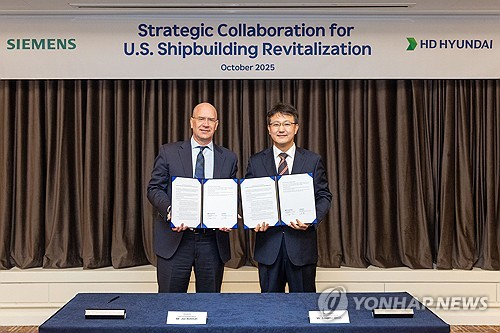
This partnership did not emerge in a vacuum. It follows a strategic framework agreement signed between HD Hyundai and Siemens in early November 2025, which was framed around modernizing American shipbuilding capacity. That earlier document read like a diplomatic signal — an attempt to deepen a Korean-German industrial tie at a moment when both Washington and Brussels are urgently seeking alternatives to Chinese manufacturing dominance in critical sectors.
The Busan center is the operational leg of that same strategy. While the November agreement planted the flag in American waters, this facility roots the partnership in Asia, where the world’s largest shipyards already sit. Hyundai Samho, Hanwha Ocean, and Samsung Heavy — all part of the HD Hyundai ecosystem — together account for roughly a third of global vessel construction by value.
Digitizing that scale is not a cost exercise. It is a power move.
Who Wins
Siemens wins first. The company has been investing heavily in industrial software for years, but its value proposition has always depended on scale. Every shipyard that adopts Siemens’ lifecycle management platform is a lock-in decision — data migrates slowly, retooling is expensive, and switching costs compound. Fifty engineers embedded at a major Korean yard is a beachhead that can expand across the Hyundai portfolio and beyond.
HD Hyundai wins second, and arguably more. Korean shipbuilders have been under pressure from rising labor costs and competition from China’s booming naval and commercial vessel sector. A genuine productivity leap — even a partial one — would restore a margin advantage that has been eroding. More importantly, it shifts the battlefield from low-cost labor to high-skill engineering, an arena where Korea still holds structural advantages over Chinese competitors.
The European Union wins in a quieter way. A successful Korean-German industrial partnership counters the narrative that decarbonization and digital transformation are exclusively American or Chinese domains. Shipping is one of the hardest sectors to decarbonize, and the firms that control the digital tools for designing fuel-efficient vessels will shape the energy transition for decades.
Who Loses
Chinese shipbuilders lose first, at least in the high-value segment. China dominates volume — roughly 60 percent of global tonnage by some measures — but much of that remains in lower-margin bulk carriers and tankers. The race for LNG carriers, premium container ships, and next-generation eco-vessels is where margins live, and that is exactly where a 30 percent efficiency gain changes the calculus.
Traditional Western shipyards — those in Germany, Italy, and elsewhere that have been shrinking for decades — lose second. If HD Hyundai can deliver advanced vessels faster and cheaper through digital integration, the remaining European yards face an even steeper climb without access to similar platforms.
Shipping companies lose third, in an unexpected way. Greater efficiency for shipbuilders could tighten vessel supply and push delivery prices up in the short term. The long-term gains from smarter, cleaner ships are real, but the transition period favors those who already have orders in the pipeline.
What Happens Next
The next twelve months will reveal whether the 30/30 targets are achievable or aspirational. Digital transformation in heavy industry rarely follows a smooth curve — integration friction, workforce resistance, and legacy system incompatibility are the usual obstacles. HD Hyundai and Siemens will need to demonstrate early wins within the Busan center before expanding the model to other facilities in the Hyundai portfolio.
The more consequential timeline is three to five years. If the digital shipyard concept proves scalable, it could reshape the entire Korean shipbuilding ecosystem. Companies that do not adopt similar platforms risk being left behind in a market where speed and precision are becoming the primary differentiators.
There is also the question of what happens to the American angle. The November 2025 agreement with Siemens referenced modernizing U.S. shipbuilding — a sector that has struggled since its mid-century decline. Whether the Busan model can be replicated across the Pacific, or whether it stays anchored in Korea, will signal how far this partnership extends.
The Real Bet
What HD Hyundai and Siemens are really betting on is that the future of global shipping belongs to the firms that can design, build, and maintain vessels through integrated digital systems rather than through isolated engineering silos. That bet, if it pays off, would make the Busan center one of the most important industrial facilities in the maritime sector — not because of what it builds, but because of what it teaches the rest of the industry to do.