Apple's iPhone Duo: Why Being Late to Foldables Could Be Its Strength
After a week with Apple's iPhone Duo alongside Samsung's Galaxy Z Fold 8, the late entrant reveals unexpected advantages — and exposes what the early leader has been forced to sacrifice for thinness.
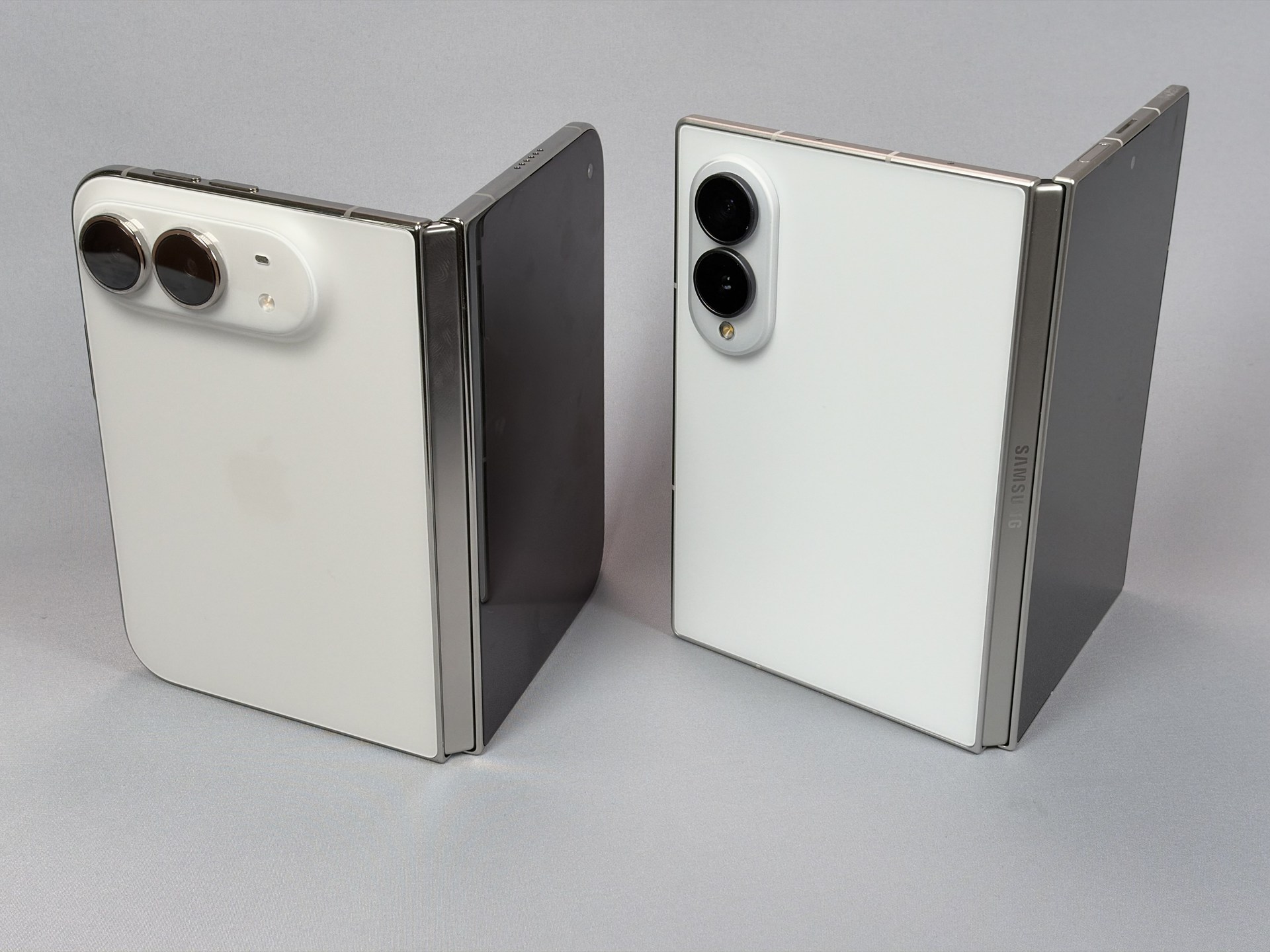
Apple didn’t come to foldables empty-handed
Apple’s iPhone Duo arrived late to a market where Samsung had already spent eight generations refining its Galaxy Z Fold line. On paper, the latecomer looks disadvantaged. It’s thicker. Heavier. The screen-splitting multitasking lacks the polish of a product that has been iteration upon iteration.
But a week of daily switching between the two machines reveals something the spec sheets don’t capture: Apple’s delays aren’t just excuses. They’re the reason certain features still exist on the Duo that Samsung abandoned entirely.
The most immediate difference is physical. The iPhone Duo closes to passport size — roughly 1cm shorter than an actual Japanese passport, and notably wider at 84.1mm compared to the iPhone 18 Pro’s 71.9mm. Holding it one-handed means supporting the weight with your pinky finger. The Galaxy Z Fold 8, at 201g, is more than 50g lighter. In the pocket and in the hand, the gap is unmistakable.
Samsung chose thinness. Apple chose substance.
What Samsung sacrificed for slimness
Galaxy Z Fold 8 has no flex mode — the ability to stop the hinge at an intermediate angle and use the device as a makeshift stand. Apple included it. Samsung dropped the under-display camera years ago, citing image quality concerns. Apple put one on the Duo anyway, naming it deliberately “FaceTime Camera” to signal exactly how far below its own expectations the technology sits.
The outer 12-megapixel selfie camera on the Duo produces sharp, detailed portraits. Switch to the under-display camera mid-video-call and the image softens considerably. Apple knows this. The marketing label is essentially an apology.
Yet for all its compromises, the Duo’s hardware approach opens doors Samsung cannot currently walk through. Pen input lands later this year, a feature the Fold line has never carried. The thicker chassis isn’t just about accommodating components — it’s about keeping capabilities that a thinner body requires you to delete. That extra 50 grams also buys a slightly larger battery capacity, and in my testing, the Duo lasted nearly two hours longer on a single charge during mixed-use scenarios that included extended video playback on the inner display.
Eight years of refinement you can feel
Switch from the Duo to the Fold 8 and the difference in software maturity is immediate. Split-screen app pairing — the ability to lock two apps side by side and save the combination — works on both devices. But on the Galaxy, rearranging that layout, dragging pairs to the home screen or taskbar, feels instinctive. You can tell someone at Samsung spent hours on what should be trivial gestures.
That accumulation of micro-polish is what eight generations buys you. It’s invisible in a single moment but obvious the moment you try the Duo’s implementation and notice the friction. Dragging a split screen on the Duo occasionally requires a second attempt. App launch transitions between folded and unfolded states register a perceptible delay, particularly when moving from the home screen to a multi-window configuration.
Samsung’s flexibility is worn smooth by repetition. Apple’s is still catching up to the physical reality of the device.
The Apple ecosystem play
Where the Duo truly differentiates itself is in the way Apple’s own apps respond to the hinge. Open the Apple TV app halfway and content plays on the outer screen. Tip it to about 120 degrees and the upper half shows video while the lower half becomes a remote. Fully open it and everything fills the inner display. The device reads its own geometry and reconfigures accordingly.
This is the kind of integration that only happens when one company controls both the hardware and the operating system. Samsung achieves software-hardware alignment, but Apple’s vertical control allows it to engineer responses to physical states rather than simply reacting to them. The difference matters in moments like taking a photo: the Duo can be placed face-down on a table in flex mode and operated entirely from the back screen, turning a random surface into a tripod. That workflow simply doesn’t exist on the Fold 8 in any equivalent form.
The app gap — and why it might close fast
Here is where the late-mover narrative hurts the Duo most. iOS 27.1 optimization remains incomplete. Apps that haven’t been adapted for the larger, wider canvas retain their traditional portrait layout — you’re forced to rotate the device 90 degrees and zoom in to make anything useful of the extra screen real estate. Web pages land in an awkward no-man’s-land, too narrow for a comfortable desktop experience and too wide for a proper phone one.
Samsung’s Fold lineup spent eight years working with Google and third-party developers to establish display conventions for foldables. The Duo starts from zero.
However, the timeline for catching up may be far shorter than the eight-year gap suggests. Pre-order demand for the Duo has been strong. That demand signals to developers that foldable-optimized apps are worth the investment — and Apple’s existing relationship with its developer community gives it leverage Samsung never possessed. The question isn’t whether apps will eventually adapt. It’s how many months it takes, and whether Samsung can solidify its lead during that window.
There’s also a second-order effect at play: Apple’s introduction of pen support changes the calculus entirely. A foldable with stylus capability opens a category of productivity and creative workflows that neither Samsung’s current Fold nor most competing Android devices offer. That single addition could compress the optimization gap faster than any software update cycle alone would manage.
What this means for the foldable market
Samsung proved foldables could be made. They never proved they could be mainstream. The Duo’s arrival changes that calculation overnight. Apple’s brand alone pulls foldable into conversations it was previously excluded from. Retailers who were hesitant to stock foldables now have a second nameplate to justify shelf space. Consumers who dismissed the category as gimmicky are suddenly having the conversation with a brand they trust.
For Samsung, the threat is real but not existential. The Galaxy Z Fold 8 remains the more refined daily driver — thinner, lighter, sharper, more app-ready. But Apple’s entry introduces a competitive pressure that benefits consumers. If the resulting price competition forces foldables toward accessibility, everyone wins except the shareholders of companies that assumed a premium niche could remain uncontested.
The Duo is not the best foldable yet. It may never become one in the pure hardware race. But it is the first foldable that forces the entire industry to reckon with whether the market was ever big enough for just one player to define the category. Samsung opened the door. Apple just proved there was a room inside worth building.