Iran's Inner Fracture Meets America's Economic D-Day
Bessent's 'economic D-Day' targets Iran's lifelines just as the regime's hardliners and negotiators are splitting over how to respond. The move sends shockwaves through global oil markets and forces allies like South Korea into an impossible calculus.
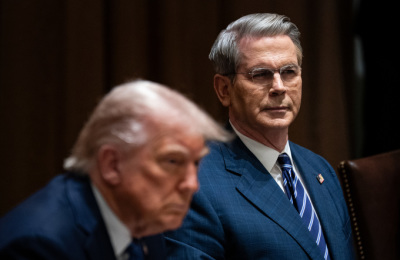
The D-Day That Isn’t About Bombing
Scott Bessent didn’t use the word invasion. But his framing of the coming sanctions wave makes the military metaphor impossible to ignore. In a Financial Times op-ed published on August 23, the US Treasury Secretary announced that at dawn on August 24, the United States would unleash what he called the largest single-target financial offensive in history against Iran. Not a probe. Not a calibration. A full-spectrum economic assault designed to sever every financial lifeline propping up the Iranian regime.
Bessent went further, asserting that US military force and the Trump administration’s pressure campaign had already substantially neutralized Iran’s military capabilities and nuclear program. What remained, in his words, was the endgame — cutting off the money so completely that the regime either folds or triggers a military response it cannot survive.
The implication for global markets is immediate and brutal.
Pascal’s Wager Turned Inside Out
Bessent’s op-ed drew on Blaise Pascal’s famous wager — the argument that it is rational to believe in God because the potential reward is infinite and the cost finite. But Bessent flipped it. His version warns nations and companies that have been quietly facilitating Iranian trade: the risk of ignoring US sanctions now outweighs any benefit from maintaining those relationships. The cost of defiance, he argued, is not finite — it is exile from the American-led financial system.
This is the mechanism that makes this sanctions package different from previous US pressure campaigns. Past rounds targeted Iranian entities directly. This one targets the entire ecosystem of facilitators — the third-country banks, the free trade zones, the shipping networks, the currency exchanges that have kept Iranian oil moving even under prior sanctions regimes. Bessent explicitly warned what he called “helper nations,” telling them to reconsider the calculus of appeasement.
The clear target is China, but also smaller economies with meaningful Iranian trade ties — India, Turkey, Malaysia, and potentially Gulf state intermediaries. None of them have publicly signaled they intend to comply, which means the next 72 hours will test whether US secondary sanctions have actually hardened into enforceable reality or remain largely rhetorical.
Tehran’s Divide — and the Gamble Inside It
What makes this moment especially volatile is not just what Washington is doing, but what is happening inside Iran right now. The Iranian political class has long contained a fault line between hardliners who see confrontation with the West as ideological necessity and pragmatic officials who have kept channels open for negotiation, however limited.
Before Bessent’s announcement, that divide was already visible in how different factions responded to previous sanction waves. Hardliners tended to frame economic pressure as proof of Western hostility that justified acceleration of the nuclear program and expansion of regional proxy networks. Pragmatists — who have grown fewer in number but still exist within the bureaucratic apparatus — argued for calibrated concessions to relieve economic suffering.
Now they face a choice with no safe answer. Concede to US demands, and hardliners will accuse them of surrender. Resist, and the economic pain intensifies immediately. The regime’s calculus is further complicated by Bessent’s explicit warning that any Iranian military escalation — against US forces or Gulf neighbors — would trigger a swift and decisive response from Trump. That changes the risk profile for every faction inside Tehran.
Hardliners who have bet on deterrence through regional proxies now face the prospect that the United States has moved past containment into a strategy of enforced regime compression. For pragmatists, that may be the moment to push for backchannel negotiations — but doing so publicly could get them purged.
Oil Flows Already Shaking
The most concrete global impact will hit energy markets. Iran produces roughly 3 to 3.5 million barrels per day of crude before sanctions, and a significant portion of that has been flowing through shadow networks primarily to China. The International Energy Agency estimates that Iranian smuggled oil reached nearly 1.6 million barrels per day in recent months — a figure that represents a meaningful share of global seaborne crude supply.
If Bessent’s announcement translates into enforceable secondary sanctions, that volume faces disruption. Not overnight — shadow networks are resilient and adapt quickly — but the signal alone will move markets. Buyers who have been operating with plausible deniability will reassess whether the profit margin on Iranian crude still justifies the risk of being cut off from the US financial system.
South Korea, which imports crude from multiple Middle Eastern sources including Iran through third-party traders, sits in an awkward position. Seoul has not officially purchased Iranian oil in recent years, but Korean refineries have indirectly received Iranian feedstock through Singapore and other trading hubs. The question for Korean policymakers is whether Washington expects Seoul to actively police those indirect channels or merely to avoid direct engagement.
Japan and South Korea, both heavily dependent on Middle Eastern energy, have historically walked a careful line between US alliance expectations and their own energy security needs. Bessent’s direct language — warning helper nations explicitly — signals that the administration sees that balancing act as no longer acceptable.
What Happens Next
Bessent said a press conference on August 24 would lay out the specific sanctions measures. Until those details are published, the full scope remains unclear. Will the measures target Iran’s central bank? Its oil export network? The Revolutionary Guard’s economic empire? The designation of specific individuals? Each layer adds enforcement teeth or remains symbolic.
What is clear is that the Trump administration has chosen a moment of maximum pressure — claiming military superiority, invoking existential economic threat, and forcing allies into a binary choice. The risk is that Iran’s leadership, feeling cornered, calculates that limited military provocation is cheaper than slow economic suffocation. That is the scenario Bessent himself flagged, and it is the one that could turn an economic operation into something far more dangerous.
For global markets, the message is simple: the era of manageable Iranian sanctions evasion may be ending, and the energy and financial systems built around that assumption need to adjust quickly.