Iran Lifts Missile Range Cap — The New Target Horizon
Iran’s IRGC abolished its 2,000-km ballistic missile self-restraint, formally expanding the targeting envelope toward Europe and the Indian Ocean. The move shifts deterrence math for allies, accelerates regional arms racing, and signals a doctrinal pivot that predates reliable long-range delivery.
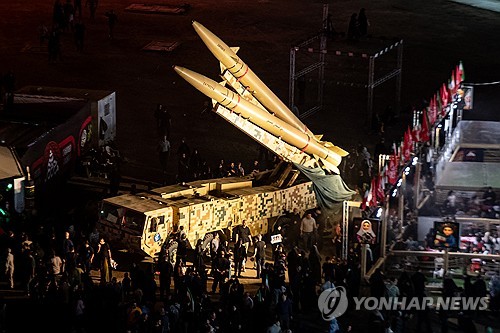
A Self-Lifted Ceiling
Iran’s Islamic Revolutionary Guard Corps (IRGC) announced Friday that it has abolished its own 2,000-kilometer range limit on ballistic missiles. The declaration arrived just days after Supreme Leader Ayatollah Ali Khamenei directed the military to strip geographical constraints from its targeting list and explicitly include American and Israeli assets anywhere on the planet. The sequence mattered: the political mandate preceded the institutional announcement by roughly a week, signaling that this was not a spontaneous escalation but a carefully staged doctrinal recalibration.
The significance lies less in what changed overnight than in what it reveals about Tehran’s strategic posture. Iran has spent decades oscillating between overstating and understating its missile capabilities depending on the audience and the moment. Announcing a lifted range limit now serves dual purposes. It projects resolve to regional adversaries while offering domestic reassurance that the regime’s retaliatory options are broadening rather than narrowing under economic pressure. The psychological architecture of deterrence is being redrawn before any new hardware necessarily crosses the finish line.
From Regional Threat to European Reach
Under the former 2,000-km assumption, most Iranian ballistic missiles already covered substantial swaths of the Middle East. Israel, Jordan, Syria, Iraq, Kuwait, the UAE, Bahrain, Qatar, and large parts of Saudi Arabia and Oman sat comfortably inside the envelope. The Shahab-3 family of derivatives and the Kheibar Shekin could reach deep into Gulf territory without stretching the old ceiling. What the new declaration changes is the formal acknowledgment that flights extending beyond that threshold are no longer off-limits by self-imposed constraint.
That opens previously constrained target sets. Parts of southern Europe—Greek islands in the eastern Aegean, the southwestern Turkish coastline near Antalya, and the island of Cyprus—fall within an extended range bracket. Incirlik Air Base in south-central Turkey, home to American F-16 squadrons and critical munition stocks, sits approximately 2,200 kilometers from Tehran, placing it just beyond the old boundary. That margin may seem small, but it is precisely the kind of incremental reach that forces defensive planners to recalculate everything from interceptor coverage to basing decisions.
Beyond the immediate neighborhood, the Red Sea approaches, the Strait of Hormuz shipping corridors, and key Indian Ocean logistics nodes become plausible considerations for longer-range systems currently under development. Diego Garcia, the British Indian Ocean Territory hosting a joint UK-US facility, sits roughly 3,000 kilometers from central Iran—a distance that places it firmly outside the previous range paradigm and into the realm of aspirational capability.
European Union capitals remain well beyond practical strike distance today, but the political and psychological impact of claiming the capacity does not require actual delivery proof. The message alone stretches deterrence calculations across the continent and gives Iranian diplomats leverage in any future negotiation where missile range figures enter the conversation.
US Bases Already in Sights, Now With a Wider Net
American forces in the Gulf have operated under the shadow of Iranian missiles for years. Forward operating sites in Qatar at Al Udeid, Bahrain at the Fifth Fleet headquarters, the UAE at Al Dhafra, and Kuwait sit between 1,000 and 1,800 kilometers from Iran’s core launch corridors. Those ranges were never dependent on whether Tehran honored its self-imposed 2,000-km cap. Known arsenals already threaten them.
What the IRGC declaration shifts is the legal and doctrinal space available to integrate longer-range systems once they reach operational status. It also removes whatever residual ambiguity existed about whether Iranian leadership considers distant theaters legitimate targeting domains. Previously, the 2,000-km figure was framed publicly as voluntary restraint; dropping that framing gives commanders and defense industrial designers a broader mandate to pursue systems whose exact specifications may never be fully disclosed. That opacity itself becomes a tool—the uncertainty surrounding range claims forces adversaries to plan for worst-case scenarios rather than best-case assumptions.
Israel and the Regional Arms Race
Israel has constructed one of the world’s most layered air-defense architectures specifically because Iranian drones and shorter-range missiles have repeatedly probed its skies. Systems like Iron Dome, David’s Sling, and Arrow intercept each tier of incoming threat, but every additional kilometer of Iranian range forces expansion into higher, more expensive interceptor categories. Longer-range Iranian deliveries would push the United States to extend reinforcement commitments further down its supply chains and complicate forward deployment cycles.
Every missile flight test beyond the 2,000-km threshold also functions as a technology proving ground. Guidance refinements, propulsion staging improvements, and reentry vehicle survival data gathered during extended flights feed directly into future payload-delivery programs, including any eventual nuclear-capable trajectory. The testing cycle itself becomes a capability accelerator even when the declared purpose is purely conventional.
Regional rivals are watching with growing alarm. Saudi Arabia has accelerated its indigenous Missan missile program and purchased advanced THAAD batteries. The United Arab Emirates has integrated Arrow-3 systems and expanded barak-8 deployments. Turkey has pursued its own Som jet-propelled cruise missile and long-range drone programs. The IRGC declaration raises the probability of a qualitative arms race—not merely more launches, but deeper investments in penetration aids, maneuverable warheads, decoy systems, and possibly cooperative technical development among non-state proxy networks sharing Iranian engineering knowledge across Lebanon, Yemen, Iraq, and Syria.
Doctrine Versus Delivery
A critical reality check remains necessary. Removing a published range limit does not instantly produce missiles capable of reliably reaching new distances. Iran’s ballistic missile program has achieved notable milestones over two decades, but testing reliability, accuracy, and resilience at extended ranges remain insufficiently demonstrated. Past declarations of operational capability have occasionally fallen short of full-scale exercise validation or combat performance. Propulsion burns that look clean on paper can degrade significantly under real atmospheric conditions during transcontinental flight.
Still, the doctrinal pivot carries weight regardless of hardware readiness. By formally retiring the 2,000-km boundary, Iran signals that its strategic planning horizons have widened permanently. That encourages adversary risk-assessment models to price in scenarios previously considered unlikely. Insurance premiums for maritime transit rise. Fleet deployment schedules adjust. Defensive postures harden across multiple capitals—even before a single new projectile clears a launch rail. The gap between declared intent and verified capability becomes a persistent source of strategic friction rather than a temporary bluff.
What Comes Next
Expect visible follow-through through a series of longer-range test flights over the coming months. Iran will likely select trajectories that avoid triggering immediate escalation thresholds while still showcasing measurable reach gains. Each test sends calibrated signals to Washington, Tel Aviv, Riyadh, Abu Dhabi, Ankara, and European capitals about progress and patience. The timing of those demonstrations—whether clustered rapidly or spread thinly—will itself reveal how much operational urgency drives the program versus how much performative signaling remains the priority.
International responses may include renewed sanctions enforcement mechanisms, diplomatic pushes for UN monitoring frameworks, or quiet bilateral security arrangements between Gulf states and European defense ministries. China and Russia will watch closely, weighing whether Iranian missile advancements create opportunities for deeper strategic coordination or simply add another volatile variable to an already crowded region.
Meanwhile, Iran’s economy continues to face structural constraints—currency volatility, sanctions enforcement, and competing budgetary demands—that limit the pace of sustained development even as asymmetric incentives favor rapid innovation in combined missile and drone warfare tactics. The regime appears willing to absorb economic pain for strategic gain, but resource limits eventually intersect with ambition.
The removal of the range limit is ultimately less a weapons announcement than a posture announcement. It tells adversaries that Tehran no longer polices its own strategic ambitions publicly and invites them to prepare for a wider, less predictable threat horizon. Whether that horizon translates into tangible force multiplication or remains primarily deterrent theater will determine how seriously the region absorbs the change—and how quickly other actors move to counterbalance it.