Iran's Red Lines on Enrichment and Hormuz
As US officials insist Tehran has no enrichment rights, Iran's hardline stance on both the Strait of Hormuz and uranium enrichment reveals where its true leverage lives—and why talks remain frozen.
The Enrichment Wall
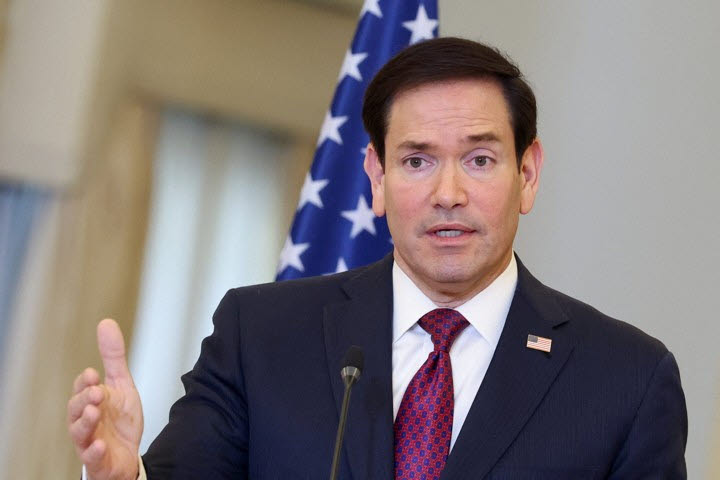
Marco Rubio did not mince words. At a press conference in Athens alongside his Greek counterpart last week, the US secretary of state laid out a position that has become increasingly rigid: Iran had multiple chances to reach a deal and squandered them. The line that followed was blunt and repeated without qualification — Iran cannot have nuclear weapons. Period.
The framing mattered. By characterizing past diplomatic efforts as failures on Iran’s side rather than stalls on America’s, Rubio subtly shifted the burden of proof. In subsequent remarks, he refused to elaborate on what thresholds would constitute an acceptable arrangement, leaving Iranian negotiators to guess at the boundaries of US flexibility. That ambiguity is itself a tool. It forces the other side to make concessions in the dark, unsure of how far they can go before crossing a line that hasn’t been drawn.
JD Vance reinforced the message days later, insisting any agreement must include a meaningful reduction in Iran’s uranium enrichment capacity. The two statements, coming from separate offices within the same administration, signal coordination on a core demand that has hardened over the past several months. Vance’s language — particular the emphasis on “reduction” rather than “elimination” — suggests the administration is still calibrating between maximalism and pragmatism. But the direction is unmistakable: the bar has moved higher.
Tehran’s response was equally unequivocal. A senior Iranian official told CNBC that no negotiations are currently taking place and that Iran would never surrender its enrichment rights. The caveat — that the technical details of enrichment could be discussed later — was a narrow escape hatch, not an opening. Iranian officials have carefully distinguished between the principle of enrichment, which they treat as sacred, and the mechanics of it, which they leave deliberately vague. That distinction is one of the few areas where a negotiated path might theoretically exist, but neither side has shown interest in testing it.
What this means in practice is a deadlock built on mutually exclusive premises. The US requires a reduction Iran will not accept. Iran demands recognition of its enrichment rights the US will not grant. And beneath both positions sits a war that has raged for more than seven months under American leadership — a conflict that has made every diplomatic gesture look like weakness to different audiences at home and abroad.
Who Controls Hormuz
The most revealing exchange in Rubio’s remarks was not about enrichment at all. It was about the Strait of Hormuz.
Rubio claimed Iran has lost control of the strait, pointing to continued tanker traffic and oil shipments approaching pre-war volumes. The implication was deliberate: Tehran’s greatest leverage — the ability to choke global energy flows — is largely theoretical. By asserting American and allied naval forces have reasserted dominance over the waterway, Rubio aimed to deflate one of Iran’s most potent bargaining chips before any future negotiations begin.
Iran has done nothing to suggest it agrees. Billboards in Tehran’s Revolution Square declared the strait permanently closed. Iranian forces have escalated attacks on tankers transiting the waterway, prompting commercial vessels to sail under US naval protection. The pattern since April has been relentless: threaten, strike, renegotiate the terms of passage, repeat. Each incident is calibrated to send a signal without triggering a response that would force Iran into a wider war it cannot sustain.
The strategic calculus is clear but fragile. Iran knows the strait is its most credible card. Opening it completely removes the pressure; keeping it partially disrupted maintains it as leverage. But the calculus carries second-order risks that neither side fully wants to examine. Every attack on a tanker increases the probability of a miscalculation — a strike that kills too many crew members, a missile that falls short of its intended target and hits a civilian asset. The insurance premiums for shipping through Hormuz have tripled since the conflict began. Several major insurers have quietly withdrawn coverage for certain routes, forcing shippers to find alternative arrangements that are slower and more expensive. The economic toll is accumulating even if the physical flow of oil has not collapsed.
For Iran, the question is whether the leverage degrades with each incident. If another attack triggers a broader confrontation Iran cannot win, or if American escorts prove effective enough to drain the threat of its sting, then the entire strategy loses value. But if the disruptions continue to impose costs on global markets without provoking a decisive military response, Tehran’s position strengthens. That tension — between maintaining pressure and avoiding escalation — defines Iran’s current posture and makes it unpredictable.
Rubio’s assertion that Iran has lost control may reflect American operational confidence more than reality. It could also be an attempt to reshape the narrative before the next round of whatever negotiations eventually resume. Either way, Hormuz remains the silent term in every equation both sides are calculating.
The Enrichment Question That Everything Depends On
The word enrichment does far more work in these negotiations than its technical definition suggests. For Iran, the right to enrich is tied to sovereignty, dignity, and a domestic narrative that frames nuclear capability as a non-negotiable achievement. It is also intertwined with the regime’s broader claim to resistance against Western domination — a narrative that has sustained political legitimacy for decades. Any president who accepts a deal that formally renounces enrichment rights invites accusations of capitulation from hardliners who already control significant levers of power. The risk is not abstract. It is institutional.
For the United States, enrichment is the threshold question — the line that separates an acceptable arrangement from an unacceptable one. The Trump administration’s demand for a meaningful reduction in enrichment capacity is a direct rebuke of the JCPOA framework, which allowed Iran to maintain a civilian enrichment program under strict limits. That earlier deal was considered a high watermark by some diplomats and a dangerous concession by others. Rubio’s refusal to specify what level of enrichment the US would accept is not an oversight. It is a negotiation tactic: by keeping the boundary undefined, Washington forces Tehran to make the first concession and reveals how far Iran is willing to go.
But the tactic carries its own risks. If Iran perceives the undefined boundary as a trap rather than an invitation, it has every incentive to close ranks further and accelerate its enrichment activities rather than negotiate from a position of ambiguity. The pattern in previous crises suggests Tehran often interprets maximum pressure as a signal that the US is willing to accept outcomes short of regime change — a bet that has sometimes paid off and sometimes collapsed dramatically.
What Happens Next
Three outcomes are plausible, and none of them are comfortable.
The first is continuation of the current trajectory: low-intensity conflict around Hormuz, periodic strikes, no diplomacy. This is the path of least resistance for both governments in the short term. Rubio can point to sanctions pressure and shipping continuity. Iran can point to American military exposure and regional instability. But continuation is not static. Each month of unresolved tension compounds the economic costs, raises the probability of miscalculation, and hardens domestic positions on both sides. The longer the stalemate continues, the more difficult a negotiated exit becomes.
The second is a negotiated settlement built on ambiguity — the time-honored Middle East approach. Both sides declare victory. Enrichment continues at reduced levels. Hormuz remains nominally open but intermittently disrupted. The deal lasts until the next crisis. This scenario is historically common because it allows leaders to sell agreements at home that they could not justify with full transparency. But it is also inherently unstable. Ambiguity postpones conflict; it does not resolve the underlying contradictions. The JCPOA lasted roughly a decade before unraveling, and its successor would face even steeper challenges given the current level of mutual distrust.
The third is escalation. A major attack on a tanker kills enough crew members to trigger a direct US-Iran military confrontation. Hormuz closes for real. Oil prices spike. The war expands beyond its current contours. This outcome remains unlikely in the sense that neither side actively seeks it, but unlikely does not mean impossible. The structural conditions for escalation — miscommunication, provocation, domestic political pressure — are all present and intensifying.
A fourth possibility deserves mention: external shock. A development outside the direct US-Iran dynamic — a regional realignment, an economic crisis in Iran, a shift in Chinese or Russian policy — could suddenly reopen spaces that now appear sealed. The history of Middle East diplomacy is littered with deals that seemed impossible until the conditions changed overnight. But counting on external shock is not a strategy. It is a gamble.
The odds of each outcome shift with every incident in the strait and every statement from Washington or Tehran. But one thing is already clear: neither side is preparing for compromise. They are preparing for the next move in a game where the board keeps changing, and the stakes keep rising. The real question is not which scenario will play out but how quickly one of them becomes irreversible.