Japan Just Gave 180,000 Civil Servants AI Agents. The World Is
Japan's Digital Agency is deploying AI agents to 180,000 government workers — the largest institutional rollout of its kind globally. What happens next could define how democracies manage AI workforce transformation.
The numbers are staggering. The playbook is new.
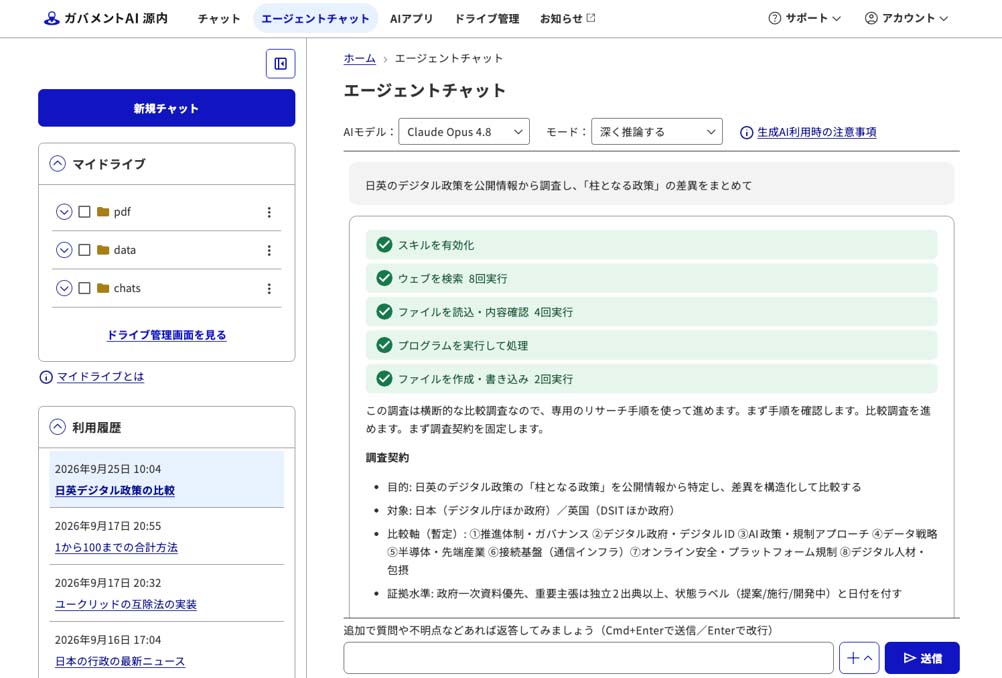
Japan’s Digital Agency announced on the 20th that it is rolling out AI agent functionality to approximately 180,000 government workers through its Minamoto (源内) platform. This is not a pilot. It is not a chatbot bolted onto an existing intranet portal. It is a structured environment where civil servants can create, run, and manage autonomous AI agents — machines that receive natural-language instructions and then execute multiple tasks end-to-end, producing files, documents, and operational outputs without constant human intervention.
The Digital Agency calls it the world’s first government-scale AI agent deployment. Even if that claim invites scrutiny from other nations currently experimenting along similar lines, the scale alone makes this a consequential event. No democracy has ever attempted to integrate autonomous AI agents into the daily workflow of 180,000 public employees while simultaneously publishing a formalized governance and safety framework.
Two tiers, one strategy
Minamoto’s agent rollout comes in two layers, each targeting a different level of operational complexity.
The first layer, Agent Chat, launched starting the 20th. It functions similarly to tools like Claude Cowork — civil servants can build lightweight agents that handle multi-step workflows through conversational prompting. A bureaucrat might instruct an agent to pull data from three internal systems, cross-reference the results, draft a policy memo, and save it as a formatted document. The agent executes all of that; the human reviews the output.
The second layer, Minamoto Workshop, targets deeper integration. Described by the Digital Agency as equivalent to Claude Code, it allows direct access to arbitrary internal sites, supports Deep Research functionality, handles file manipulation, runs commands, and can even prototype applications. The rollout here is targeted for around December.
Together, the two tiers create a ladder — entry-level agents for routine administrative work, and more powerful environments for complex, technical tasks. That distinction matters. It signals that Japan is not trying to replace workers but to create a gradient of augmentation that matches the actual hierarchy of government job functions.
The governance framework is the real innovation
The deployment would be notable on its own. The governance framework makes it significant.
Simultaneously with the agent rollout, the Digital Agency published the Minamoto Governance, Security, and Safety Standards — formally called the Gabbatement AI Minamoto Governance, Security, and Safety Criteria. The document assigns specific responsibilities to three roles: users, administrators, and developers. It does not leave safety as an afterthought or a corporate policy document. It is a rule set designed for government employees who will actually use these tools daily.
The framework was developed in collaboration with the AI Safety Institute (AISI), an organization tasked with evaluating and advancing AI safety methodologies. That partnership gives the standards an institutional anchor beyond the Digital Agency itself — a signal that Japan intends this to be durable policy, not a press release.
Why the open-source commitment changes everything
Perhaps the most unexpected move comes in February 2027, when the Digital Agency plans to release Minamoto as open-source software under version 2.0. The announcement explicitly states that local governments and private-sector companies will be free to use, modify, and redistribute the platform.
This is a strategic decision with international implications. Japan is not building a closed, proprietary government AI system that locks in a single vendor. It is constructing a publicly owned infrastructure and then offering it to the world. Municipalities in Japan that currently lack the budget or expertise for AI adoption will gain access to a proven, government-vetted platform. Other countries looking for a template — particularly those in Asia, Europe, and beyond — will have a working reference model instead of abstract policy recommendations.
The open-source move also creates accountability. If the governance standards prove inadequate, the code and policies will be visible to anyone who wants to dissect them. That transparency is uncommon in government AI projects globally.
Who wins, who loses, what happens next
The winners are immediate and structural. Civil servants gain capabilities that were previously available only to specialized IT staff or external consultants. The Digital Agency positions Japan as a leader in institutional AI adoption rather than a follower. AISI gains a high-visibility real-world testing ground for its safety frameworks. Municipal governments and private companies will eventually benefit from the open-source release.
The question mark is the workforce itself. Deploying agents to 180,000 workers raises the same anxiety that accompanies every wave of workplace automation: who gets reassigned, who gets upskilled, who feels displaced? The Japanese government has not publicly addressed workforce transition plans alongside this deployment. That silence is itself a signal — or a risk.
Labor relations in Japan’s public sector operate differently than in Western democracies. Union pushback tends to be procedural rather than confrontational, but procedural resistance can still delay implementation for years. Whether the Minamoto rollout encounters friction depends largely on whether workers perceive agents as tools that augment their work or as precursors to headcount reductions. The governance standards address safety. They do not address employment security.
Internationally, the timing is notable. Several governments — including those in the European Union and the United States — are currently debating or piloting AI agent deployments in public administration. Japan’s decision to move at this scale while simultaneously publishing governance standards and open-source commitments gives those debates a concrete reference point. Other democracies will now measure their own approaches against a working example rather than a theoretical one.
The deeper question is whether Japan’s model translates. The Minamoto framework was designed for a bureaucratic culture with specific norms around hierarchy, documentation, and risk aversion. It may not map cleanly onto systems with different institutional incentives. But the fact that a template now exists — complete with open-source code, published standards, and a deployment track record — changes the calculus for every government considering this path.
Japan did not just deploy AI agents. It deployed a blueprint.