Japan Just Won the Race to Mars' Moon — And the West Almost Missed It
Japan's MMX mission launches tomorrow, marking humanity's first attempt to bring back samples from a Martian moon. While Western coverage frames this as Tokyo catching up, the reality is far more ambitious — and strategically significant.
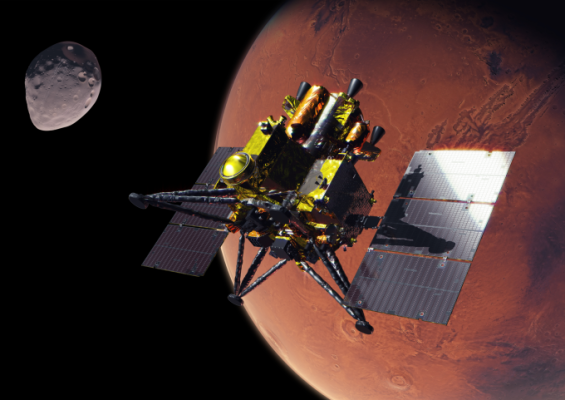
Japan’s Quiet Triumph Over Mars’ Moon
Tomorrow at 4:41 a.m. from Japan’s Tanegashima Space Center, an H3 rocket will carry the most strategically important sample-return mission ever launched by any nation. Not the United States. Not China. Japan.
The MMX (Martian Moons eXploration) probe represents humanity’s first attempt to bring back material from a Martian moon — Phobos — and it should reframe how the world understands Japan’s role in space. For decades, Western space journalism has treated JAXA as a follower, a polite participant in American-led missions. MMX shatters that narrative. Japan is not catching up. It is leading.
Why Phobos Changes Everything
The science at stake is profound. Phobos, the larger of Mars’ two moons, is roughly 27 kilometers at its longest dimension — small enough to fit inside your thumb, but potentially enormous for our understanding of the Red Planet’s history.
Two competing theories dominate planetary science regarding Phobos and its sibling moon, Deimos. One holds that they formed from debris ejected when a massive object struck early Mars. The other argues they are captured asteroids, grabbed by Mars’ gravity from somewhere in the outer solar system. Until now, neither hypothesis has had the smoking gun: actual material from Phobos to analyze in laboratories on Earth.
Here is what makes this mission extraordinary: JAXA estimates that approximately 0.1 percent of the material collected from Phobos’ surface could originate from Mars itself. Tiny percentage? In planetary science, that fraction is staggering. Material blasted off Mars’ surface by ancient impacts has likely fallen onto Phobos over billions of years, accumulating in its regolith. If you can extract even 10 grams of Phobos soil — and that is exactly what MMX aims to collect — you may hold samples of ancient Martian crust that predate anything ever returned by Perseverance or sample-return attempts from Soviet Luna programs targeting different bodies entirely.
Beating Everyone to the Finish Line
Let us address what English-language coverage rarely does: the geopolitical dimension. China has announced plans for a Phobos sample-return mission, tentatively targeted for the early 2030s. NASA is exploring Mars Sample Return concepts, but those focus on Jezero Crater, not Phobos. Europe’s involvement in MMX through CNES and DLR is significant but secondary to Japanese leadership. No other spacefaring nation is closer to actually delivering Martian moon material to Earth.
Japan built this capability deliberately. The Hayabusa and Hayabusa2 missions to asteroids Itokawa and Ryugu proved that Japanese engineers could land on, navigate, and return from small bodies in deep space — a skill set that translated directly into the Phobos challenge. This is not serendipity. It is strategic investment paying off over decades.
The Mission Timeline: A Marathon, Not a Sprint
MMX will spend roughly five years on its journey. It enters Mars orbit in August 2027, then spends months mapping Phobos — its surface topography, internal structure, gravity field, and mineral composition. These data are not merely preparatory; they are themselves world-class science, filling gaps in our understanding of Martian satellite dynamics that no previous mission has addressed.
In early 2029, the French-German designed Idefix rover descends to Phobos’ surface. It operates for approximately 100 days, surveying terrain and soil characteristics while identifying optimal landing sites for the main probe. This deployment strategy mirrors Hayabusa2’s MASCOT rover but pushes into territory no previous mission has touched.
Then comes the critical moment. MMX descends to Phobos’ surface — a body with gravity only one-two-thousandth of Earth’s — and lands at two separate sites. The low gravity creates genuine risk: without specialized shock-absorbing landing gear, the probe could bounce off Phobos entirely and drift into interplanetary space. JAXA has engineered four landing legs specifically for this environment.
At the first site, the probe collects material. It lifts off again, navigates to a second location, and repeats the process. NASA provides a high-pressure gas injection system that sweeps surface dust and particles into collection chambers. Japan contributes its own mechanism, designed to dig approximately two centimeters below the surface to access potentially less-weathered material. Combined, these systems aim to return more than 10 grams — a modest mass by asteroid-return standards, but potentially中包含 vastly more Martian material than any sample ever analyzed from another world.
Return to Earth: A Global Affair
After departing Phobos, MMX performs a close flyby of Deimos — the smaller, more distant moon — gathering additional data before beginning its return journey. In 2031, the sample capsule separates and lands in Australia. From there, it travels to Japan for analysis.
This landing site choice reflects long-standing international cooperation patterns but also signals Japan’s confidence in hosting the most technically complex return sequence ever attempted from beyond the Moon. No nation has returned samples from a Martian moon before. No nation has even attempted it.
The Bigger Picture: What This Means for Human Mars Exploration
Kawakatsu Yasuhiro, JAXA’s MMX project manager, stated plainly that Phobos samples will inform whether humans could one day use Martian moons as staging points for surface exploration. This is not rhetorical inflation. If Phobos proves accessible and scientifically rich, it becomes a logical destination for crewed missions — a way to test technologies, study Mars without atmospheric interference, and establish infrastructure far from the planet’s harsh surface.
Japan’s message through MMX is clear: the future of human Mars exploration may not begin with landing on the Red Planet itself. It may begin with orbiting its moons, learning their secrets, and building forward from there.
Why Western Audiences Should Care
American and European space media routinely cover JAXA achievements as footnotes to NASA and ESA programs. MMX demands a different frame. Japan independently designed, built, and is launching a mission that no other nation has matched in ambition or proximity to completion. The H3 rocket itself — still early in its service life — carries this payload with national systems at its core.
The samples will arrive in Japanese laboratories, studied by a consortium that includes American, European, and French scientists, but led by Japanese institutions. The data releases will shape planetary science for decades. The technical precedents — landing on low-gravity bodies, digging beneath regolith, surviving Phobos’ bizarre environment — will inform every subsequent mission to Mars and its satellites.
This is not Japan catching up. This is Japan pulling ahead in a direction the rest of the space world was not fast enough to pursue first.
The world’s attention will turn to Phobos in 2031, when the capsule touches Australian soil. But the real victory for Japanese space exploration may have already been won tomorrow morning — when a rocket lifts off carrying the first probe destined to touch a Martian moon and bring something back home.