Jensen Huang's Robot Demo Ignites a Mini-Robot Frenzy
A single stage demo at GTC sent pre-orders for an open-source mini-robot past 20,000 units—surpassing annual shipments from the largest humanoid competitors. The numbers reveal a commercial inflection point in embodied AI that goes beyond marketing hype.
The 20,000-unit shock
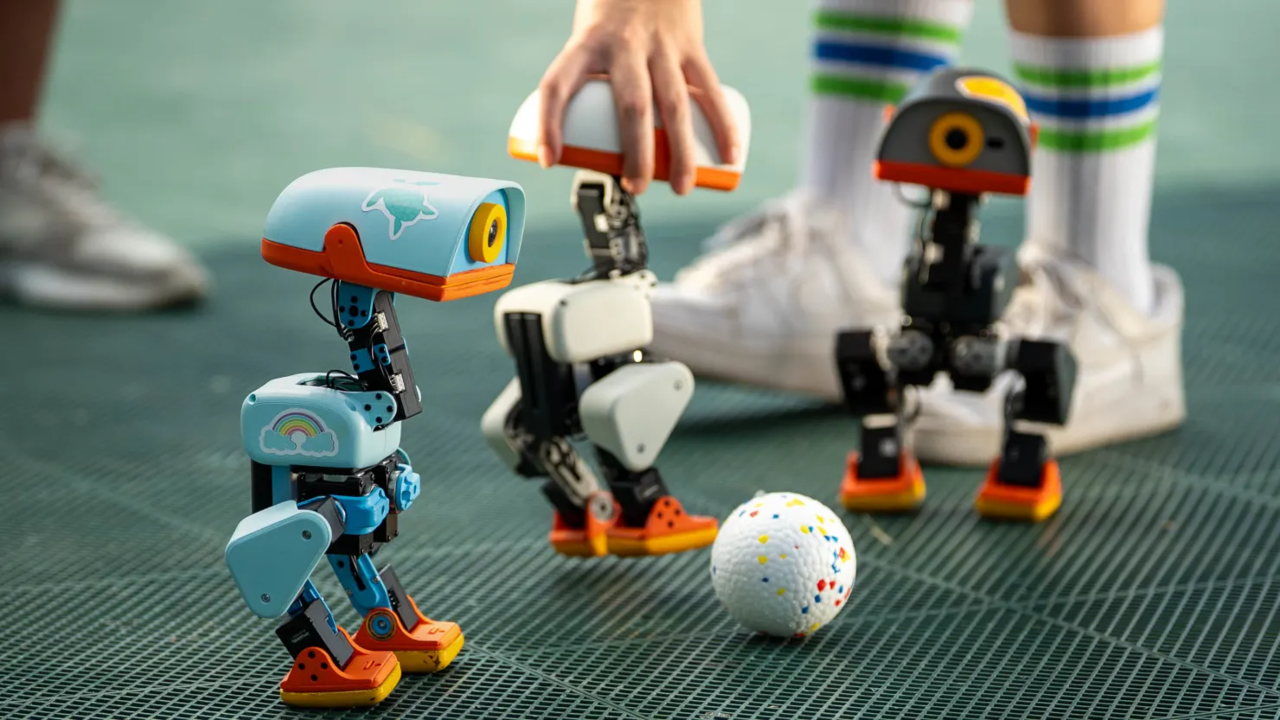
Jensen Huang didn’t just demo a robot at GTC this year—he accidentally proved an entire category was ready for prime time. The micro-duck stood 25 centimeters tall, weighed 800 grams, and sold for $399 before shipping and tax. After Huang asked it to do a somersault on stage in Berlin, pre-orders for the device crossed 20,000 cumulative units.
That number is not a trick of timing. It is the sum of reservations placed since August. But it still carries weight. Twenty thousand units for a single developer-focused robot model, even as pre-orders, is larger than the entire annual shipment records of two of the industry’s most prominent humanoid companies combined.
Unitree delivered just over 5,500 humanoid robots to customers last year. Agibot shipped 5,168 in the same period. If every Microduck pre-order converts to a shipment, this one product alone outpaces both companies’ annual outputs. Even against first-half 2026 global humanoid shipments—estimated at roughly 19,100 units by Smart Analytics Global—Microduck’s cumulative reservations are nearly identical to an entire six-month market total.
What makes this figure remarkable is not just its magnitude, but what it represents: a consumer willing to pay $399 upfront for a robot that exists primarily as an open learning platform. This is not impulse buying—it is commitment from a community that has historically been skeptical of hype-driven hardware launches.
The audience Huang didn’t know he was courting
The demo itself was charming. Microduck waddled across the stage, made little electronic chirps, sat down, feigned sleep, fell over, and then—on Huang’s cue—rolled into a full somersault. The robot used NVIDIA RTX Spark for its simulation-to-reality pipeline, which was the genuine technical story beneath the spectacle.
What made the moment commercially explosive was not the somersault. It was the context. Microduck is an open-source bipedal robot built by Pollen Robotics, a company Hugging Face owns since NVIDIA acquired the AI platform in September. The company’s CEO Clem Delangue publicly called it the “Jensen Huang keynote effect” and predicted the robot could become 2026’s best-selling robot.
That prediction is not reckless. The robot’s appeal rests on a specific design choice: it is built for people who want to teach it new movements, not just watch it perform preset ones. Users can train novel behaviors in simulation through reinforcement learning and then transfer those skills to the physical robot. The software, simulation environment, and training tools are all open. Creators can share their custom motion libraries with other users.
This is a fundamentally different product strategy from the industrial or research humanoid robots that dominate headlines. Those machines target factories and labs. Microduck targets tinkerers, educators, hobbyists, and small teams building custom robotic applications at home.
The open-source approach has already generated a growing ecosystem. Within weeks of the GTC demo, GitHub repositories dedicated to Microduck motion libraries saw thousands of new commits. Educators began publishing lesson plans that use the robot to teach reinforcement learning concepts to high school and undergraduate students. The platform has become, inadvertently, a low-cost entry point into embodied AI that was previously accessible only to well-funded labs.
Why this matters beyond the sticker price
$399 is an accessible price for a bipedal robot with real programmable capabilities. But the significance of 20,000 pre-orders is not about revenue—it is about signal. It shows that a substantial population of developers and enthusiasts is willing to commit money upfront to a robot that exists primarily as a learning and experimentation platform.
The broader humanoid market is growing fast. Smart Analytics Global projects total annual shipments will approach 60,000 units in 2026, with Agibot and Unitree together accounting for roughly 14,000 of those in the first half alone. The consumer robot market as a whole—excluding humanoid machines—saw 34.2 million units shipped globally last year according to the International Federation of Robotics, dominated by vacuum robots and lawn mowers.
Comparing Microduck’s 20,000 pre-orders directly to any of those figures would be misleading. A $399 education robot and a $50,000 warehouse humanoid serve completely different markets. But the directional insight is clear: there is appetite for affordable, programmable embodied AI outside of industrial settings. And that appetite was quantified in real purchase commitments, not surveys or press interest.
The second-order implications are significant. For the first time, a consumer robotics product has demonstrated that the open-source model—typically associated with software—can generate hardware demand at scale. This challenges the conventional wisdom that consumer robotics requires either massive marketing budgets or proprietary ecosystems to succeed. Microduck’s success suggests that community-driven development, combined with accessible pricing and genuine programmability, can create a sustainable commercial model.
What happens next
The race now is fulfillment. Pre-orders do not equal deliveries. Pollen Robotics has to manufacture, ship, and support 20,000 units—many of which will arrive months after the initial commitment. The company has not disclosed its production timeline or capacity constraints. If fulfillment drags, the momentum from the GTC demo could evaporate quickly. Enthusiasts who cannot receive their robots in time may lose interest or switch to alternatives.
There is also the question of what comes after the initial novelty wears off. Microduck’s open ecosystem is its moat. If the community builds compelling motion libraries and shared learning tools, the robot becomes more valuable over time. If development stalls, it becomes a toy that collects dust on a shelf. The somersault was entertaining. The real test is whether people can teach it something genuinely new.
Supply chain constraints represent another challenge. The robot’s components—motors, sensors, computing hardware—must be sourced at volume while maintaining quality. Any production delays could erode customer confidence. Pollen Robotics will need to communicate transparently about timelines and proactively manage expectations.
For NVIDIA, the implications extend beyond one robot. The company acquired Hugging Face partly to strengthen its position in the AI agent and embodied intelligence stack. Microduck’s success demonstrates that the combination of open software, accessible hardware, and powerful simulation infrastructure—everything NVIDIA is building toward—can generate real consumer demand. The question is whether the company can replicate this model at higher price points and more capable form factors.
The broader robotics industry faces a choice: continue competing primarily on capability and price for industrial applications, or invest in creating accessible platforms that engage consumers and developers. Microduck’s 20,000 pre-orders suggest there is genuine demand for the latter approach. The robots that defined 2026 may not be the most capable ones—they may be the most engaging ones.
For the wider robotics industry, the lesson is simpler: the audience for embodied AI is larger and more commercially engaged than many analysts assumed. The 20,000 pre-orders are a blunt but honest measure of that demand. Whether Microduck becomes the robot that defined 2026 or a footnote depends on execution. But the signal from Berlin was unmistakable.