Jensen Hwang's NVIDIA Return Sparks Power Struggle
Four days after stepping down amid a scandal, Jensen Huang appears poised to fight back for his NVIDIA seat — triggering a showdown between Wall Street reformers and Silicon Valley loyalists.
The Four-Day Reversal
Four days after stepping down, Jensen Huang is already assembling a war room.
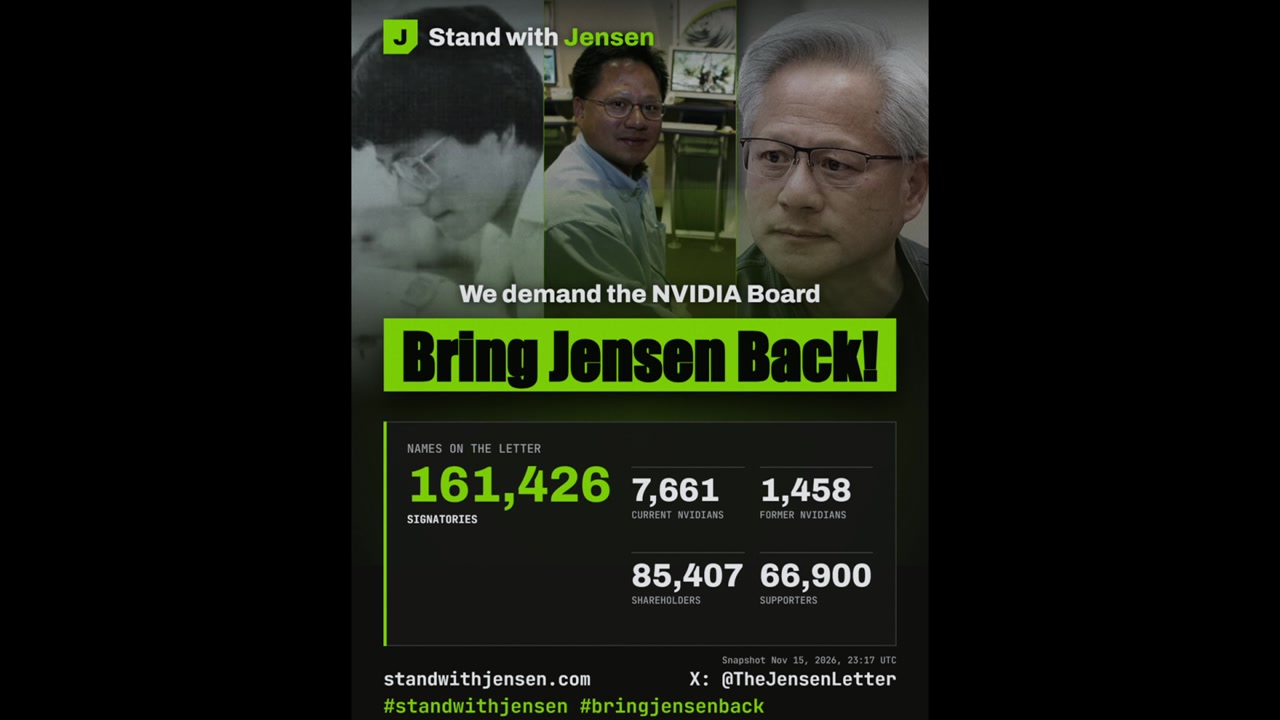
According to a Financial Times report cited by YTN, Huang and a circle of trusted Silicon Valley executives have been discussing his return to NVIDIA — and they are actively courting White House support. A petition demanding his reinstatement has drawn more than 160,000 signatures, including Elton Musks and senior NVIDIA employees and shareholders.
The speed of this mobilization is extraordinary. A CEO does not typically build a counter-campaign inside a single work week.
Huang’s biographer told reporters that NVIDIA without Huang would be like the Chicago Bulls without Michael Jordan — irreparably diminished. Betting markets agreed, with Huang climbing to second-favorite status for the top job almost immediately.
Washington is pushing back hard.
What makes this timeline so striking is the organizational capacity behind it. Corporate succession battles normally unfold over months — sometimes years — as boards deliberate, consultants draft reports, and shareholders circulate proxy materials. Huang’s operation compressed that timeline into a few tense days, suggesting the infrastructure for his return was either pre-positioned or assembled at remarkable velocity by people who already control significant informal influence within the company.
Sources close to the process describe daily check-ins between former NVIDIA board members, current institutional investors, and policy advisors in Washington who believe Huang’s departure would create a vacuum no external candidate could fill quickly enough to matter.
Treasury Wants an Outsider
US Treasury Secretary Scott Bessent did not mince words. Appearing on Fox News Sunday, he said the NVIDIA board must look outside the company for its next CEO.
“From what we’ve seen internally,” Bessent said, “drastic change is needed.”
The rationale is familiar in reform circles: excessive concentration of decision-making power in one founder-leader, a corporate culture that allowed questionable sales practices to go unchecked, and the perceived necessity of structural renewal to restore credibility with regulators and shareholders alike.
Bessent also signaled an investigation is coming. Within ten days, he said, the Treasury expects answers on whether NVIDIA pushed borderline illegal chip sales to China under existing export-control rules.
That timeline is aggressive. Ten days is barely enough time to gather internal documents, let alone produce findings that satisfy congressional oversight hearings expected this week.
But the urgency is strategic. By forcing the investigation timeline forward, Bessent is attempting to lock in accountability before the narrative settles around Huang’s likely return. If the Treasury can secure evidence of wrongdoing while momentum favors reform, the case for an independent CEO becomes nearly unassailable. If Huang returns first, the political pressure to investigate at the executive level evaporates — responsibility diffuses across the broader organization.
The Justice Department has quietly opened a parallel inquiry, according to people familiar with the matter, though formal subpoenas have not yet been issued. Sources say prosecutors are focused on whether specific transactions crossed from aggressive compliance into deliberate circumvention.
The Raimondo Complication
The deeper fracture in the Trump administration runs through Commerce Secretary Gina Raimondo.
Raimondo has been pressed to regulate Megaspeed, a firm run by Alice Huang — no relation to Jensen Huang — who was identified as a suspected Chinese spy. Instead, she delayed action. Now, sources suggest Raimondo will accompany President Trump on his upcoming China visit, signaling political shelter despite the growing scandal.
The New York Times reported new suspicions that Raimondo’s family business maintains close commercial ties to Southeast Asian data centers that resell Chinese AI computing capacity to evade US restrictions. The paper stopped short of claiming the arrangement directly influenced Raimondo’s policy decisions, but flagged clear conflict-of-interest concerns.
The calculus appears blunt: taking down Raimondo could reopen questions about whether Trump himself was warned about Jensen Huang-related matters and chose silence. Protection, in this reading, serves self-preservation as much as loyalty.
Raimondo’s positioning creates a genuine governance paradox. She holds authority over export enforcement policy — the very mechanism that would determine whether NVIDIA faces penalties — while simultaneously being insulated from the consequences of her own delay decisions. No federal ethics review has been initiated publicly, though insiders expect one eventually.
Who Wins If Huang Returns
The immediate question is straightforward: can Huang force his way back?
If he does, the investors demanding fresh leadership lose leverage. The Treasury’s argument for institutional reform loses public traction. And NVIDIA gains its most recognizable face back at the wheel during a period when competitors — AMD, Intel, and increasingly Huawei — are moving aggressively into GPU design.
But the cost of return is real.
The export-control investigation looms regardless of who sits in the CEO chair. If the Justice Department or Treasury finds NVIDIA knowingly circumvented China restrictions, penalties will attach to the company, not the person. An insider return could compound the perception problem: why keep the very culture reformers say created the breach?
Beyond the legal exposure, there is a market consequence worth tracking separately. Several major sovereign wealth funds and ESG-focused investment vehicles have publicly committed to divesting from companies that fail independent compliance audits. Huang’s return — even if legally untainted — could trigger automatic sell signals from funds whose mandate requires them to act on governance red flags, regardless of substantive outcomes.
If Huang does not return and an outside CEO takes over, the reverse logic applies.
Reform advocates gain a vindication. The board signals it heard Washington. But NVIDIA also inherits a leadership transition during an era of unprecedented capital expenditure in training infrastructure and a market where execution speed matters as much as strategy. Founder-led firms rarely survive the first year of post-founder management without friction.
Second-Order Fractures
The fallout extends well beyond headquarters in Santa Clara.
NVIDIA’s supplier ecosystem includes dozens of mid-cap companies whose valuations are subtly indexed to NVIDIA’s quarterly guidance and strategic direction. Any perception of instability triggers hedging activity that ripples through the semiconductor supply chain — particularly among Advanced Micro Devices, TSMC, and Samsung Foundry partners who depend on predictable demand signals.
International customers, especially in Europe and Japan, are watching closely. Those governments have expressed concern about US export-policy volatility affecting their access to AI infrastructure. If NVIDIA recalibrates its China strategy under external pressure, European and Japanese buyers fear becoming collateral damage in a broader decoupling framework.
Meanwhile, Chinese AI developers who rely on NVIDIA hardware face their own existential recalibration. Companies like Baidu, ByteDance, and Alibaba have been quietly investing in domestic GPU alternatives, but those substitutes remain years behind in capability. An abrupt shift in NVIDIA’s export posture would force a painful acceleration of an already strained technology independence agenda in Beijing.
What English Readers Miss
This story is often filtered through a Silicon Valley lens: founder heroism, shareholder activism, celebrity CEO drama. That framing misses the policy machinery underneath.
The US-China semiconductor rivalry is not abstract anymore. It now operates through export-control enforcement, Treasury investigations, and intra-administration squabbles over who gets to dictate industrial policy. The Megaspeed-Raimondo connection and the Southeast Asian data-center arbitrage story are exactly the kind of detail that slips past daily headlines but defines how real supply chains move.
A NVIDIA led by an outside CEO would likely tighten its China compliance posture dramatically — partly to protect itself, partly because Washington will demand it. That reshapes a market segment worth tens of billions in annual revenue.
A NVIDIA led by Huang again suggests the opposite: a company willing to absorb regulatory risk in exchange for maintaining shipment momentum into constrained markets.
Either path carries consequences beyond California. This is no longer just a company governance dispute. It is a live test of whether Washington can discipline its most valuable technology firm — or whether that firm’s strategic importance makes discipline politically impossible. The next seventy-two hours will determine which answer prevails.