KAIST's AGI Institute Signals Korea's Entry Into the Sovereign AI Race
KAIST has launched Korea's first dedicated AGI research institute, aiming to build AI that can think and adapt beyond narrow tasks. The move marks a strategic pivot from hardware dominance to foundational intelligence research—a quiet but significant shift in the global AI competition.
The announcement came quietly, buried under headlines about diplomatic maneuvering and court verdicts. But KAIST’s decision to establish Korea’s first dedicated AGI research institute represents a structural shift in how a middle-power technology state positions itself in the age of artificial intelligence.
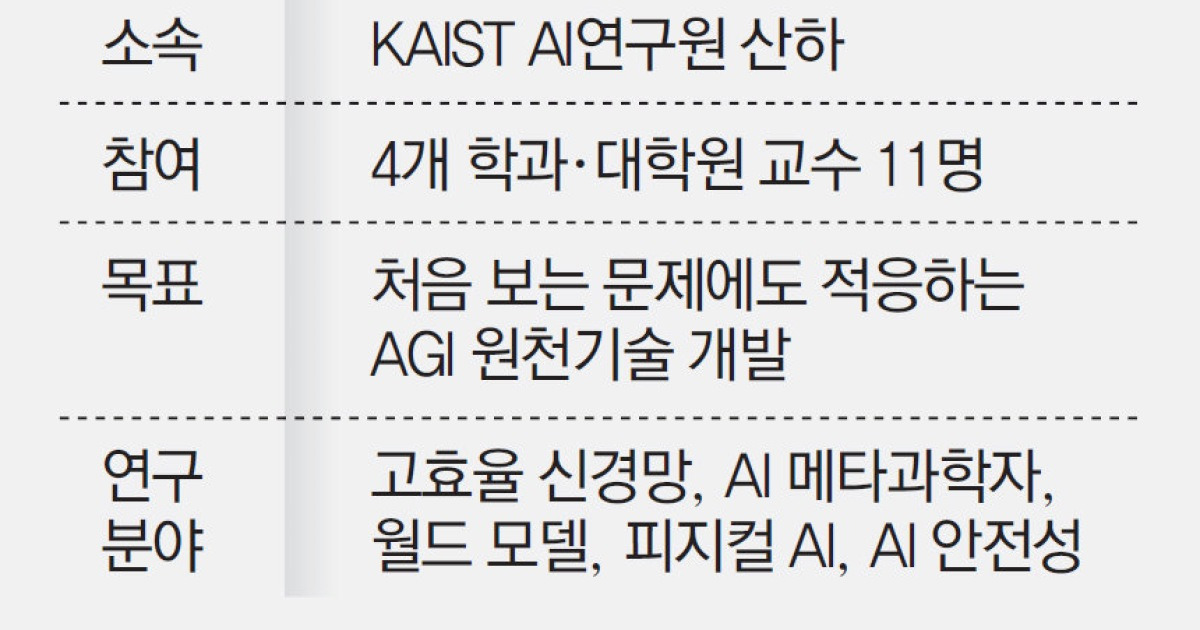
On September 18, the Korea Advanced Institute of Science and Technology formally launched its AGI Research Center under the umbrella of its AI Research Institute. Eleven professors from the Department of Computer Science, AI Computing, the Kim Jae-chul Graduate School of AI, and the Department of Electrical and Electronic Engineering will participate. Professor Kim Tae-kyun of the computer science department serves as founding director.
The stated objective is straightforward in concept but audacious in execution: develop artificial intelligence capable of independent judgment and adaptation when confronted with novel problems and environments—not merely pattern-matching across familiar training distributions, but genuinely reasoning through situations it has never encountered.
This is a departure from the trajectory that has defined South Korea’s technology sector for decades. The country built its economic miracle on being exceptionally good at manufacturing—chips, displays, batteries, semiconductors. Samsung and SK Hynix dominate global memory chip markets. LG and Samsung Display lead in panel technology. The Korean playbook has always been: identify what the world needs, scale production, optimize cost, capture market share.
AGI research is not that playbook. It is something else entirely.
“Continuing to expand AI data centers has limits,” Professor Kim said at the launch. “What matters for next-generation AI competition is developing foundational technologies that allow AI to adapt to new problems even in resource-constrained environments.”
The funding profile tells the story. The institute will receive 100 billion won over five years for next-generation neural network development, funded by the Ministry of Science and ICT. An additional 187.5 billion won is allocated for AI meta-scientist research. The center is also participating in a two-year, 34 billion won project led by LG Electronics focused on world models and robotics-based physical AI. Total investment runs approximately 600 billion won.
Five research pillars have been identified: high-efficiency neural networks that deliver performance without massive compute; AI meta-scientists that can formulate their own hypotheses and discover knowledge autonomously; world models that predict real-world change; physical AI that perceives and acts in three-dimensional space like a robot; and AI safety systems designed to keep advanced intelligence aligned with human intent.
The five domains are deliberately interconnected. An AGI system that cannot model the physical world cannot safely operate robots. A robot that cannot predict the consequences of its actions cannot be trusted in human environments. Safety research is not an add-on; it is foundational to everything else the institute will attempt.
The timing is notable. On September 17—one day before KAIST’s announcement—Google DeepMind launched its own AGI research institute, explicitly charged with studying the safe development of artificial general intelligence and its societal and economic implications. The coincidence is unlikely to be accidental. Korea is positioning itself alongside the institutions already treating AGI as a formal research agenda rather than a speculative footnote.
What makes this significant is what it signals about Korea’s self-conception in the global AI hierarchy. The country is not attempting to build a competing foundation model. It is not investing billions in training infrastructure designed to match OpenAI, Google, or Anthropic. Instead, it is pursuing what scholars call “sovereign AI capability”: the ability to understand, develop, and control advanced AI systems without depending on foreign platforms or proprietary black boxes.
This is a strategy more suited to a mid-tier technology power than to a superpower. China and the United States will compete on foundation models and compute scale. Korea recognizes it cannot win that race. But it can compete on the underlying research—the kind of work that determines how AI systems think, learn, and behave rather than simply how much data they consume.
The institutional design reflects this calculus. Eleven professors from four departments suggest an interdisciplinary approach rather than a siloed computer science initiative. The participation of LG Electronics in the robotics project signals industry engagement, however limited. The involvement of the Kim Jae-chul Graduate School of AI—a recently established entity—indicates that Korea is building its AGI infrastructure from the ground up rather than retrofitting existing programs.
There are reasons for caution. Korea’s AI ecosystem has historically relied on importing models and frameworks rather than inventing them. The country’s semiconductor strength has created a dependency mindset: produce the hardware, let others provide the intelligence. Moving from that posture to one where Korean researchers are designing the cognitive architectures themselves requires cultural and institutional change that funding alone cannot guarantee.
Professor Kim’s emphasis on efficiency over scale is both a practical assessment and a strategic statement. Korea does not have access to the computational resources that American labs command. It cannot replicate the GPU clusters that power GPT-4 or Gemini. What it can do is make AI systems that work well with less—a necessity-driven innovation path that happens to align with the broader industry trend toward more efficient models.
The DeepMind announcement reinforces rather than diminishes Korea’s move. If the world’s leading AI lab is establishing a dedicated AGI institute, then AGI research is no longer speculative. It is a legitimate field requiring sustained investment. Korea’s timing suggests it intends to be present at that table rather than observing from the gallery.
The next twelve months will reveal whether this is substantive strategy or rhetorical positioning. Research institutes are easy to announce. Finding professors willing to pivot from publication-driven careers toward long-horizon AGI problems is harder. Securing breakthrough results within five years is harder still. But the decision to try—to treat AGI as a distinct research category requiring dedicated institutional support—is itself a signal that Korea understands the competitive landscape has changed.
The world is no longer divided between those who build AI platforms and those who consume them. A third category is emerging: those who build the underlying capabilities that determine how AI systems think, learn, and act. KAIST’s AGI institute is Korea’s entry ticket to that category.
Whether Korea can convert that entry into genuine competitive advantage remains an open question. But the attempt itself marks a moment worth watching.