KATSEYE Takes Billboard 200 #1 — And Signals a K-pop Shift
KATSEYE's 'WILD' debuts at #1 on the Billboard 200 with 170,000 units, the strongest first-week showing for a girl group since 2015. The result is quietly reshaping the K-pop industry's success formula.
The number K-pop desks should watch
KATSEYE has done something that looks simple but isn’t. Their third EP, “WILD,” has topped the US Billboard 200 with 170,000 album-equivalent units in its first week — the largest opening for any girl group since Billboard restructured its chart methodology in December 2015.
Pure album sales alone accounted for 145,000 of those units, earning a concurrent #1 on the Top Album Sales chart. Streaming and download numbers were comparatively modest at 24,500 SEA and 500 TEA. This is a buying audience, not just a streaming one.
The distinction matters because it reveals who actually bought this record and why. These are not casual listeners converting to fans through TikTok snippets or K-pop fandom mobilization. These are consumers who found a product that fit into an existing purchase habit — the physical album as artifact, the vinyl as object, the merch bundle as experience. The buying behavior here mirrors what we see with Taylor Swift, Olivia Rodrigo, or Billie Eilish, not what we typically see with K-pop releases in the US market.
Why this is bigger than a chart position
KATSEYE is the fourth K-pop girl group to reach #1 on the Billboard 200, joining BLACKPINK, NewJeans, and TWICE. But the comparison ends at the number.
These three predecessors were all products of the traditional K-pop trainee system — forged through years of agency grooming, debuting in Korea, and then expanding outward. KATSEYE came from the opposite direction.
They were assembled through “The Debut: Dream Academy,” a joint audition project between HYBE and Geffen Records, Universal Music Group’s flagship label. The members were discovered and shaped for a global market first. They debuted in 2024 and reached #4 on the Billboard 200 with their prior EP “Beautiful Chaos.” Their second consecutive top-ten finish made them the first act in that format to climb the chart twice in such quick succession.
This is not a Korean group that conquered America. This is an American-format group that carries K-pop infrastructure behind it — and that inversion is what is making Korean music desks sit up.
The people behind the sound
“WILD” features the title track “Hootie Frutti,” written by a roster that reads like a Western pop writer’s room: Ed Sheeran, Rhian Teasdale, Omari Grandison, Blake Slatkin, and HYBE chairman Bang Si-hyuk. The latter’s involvement confirms that this is still an HYBE-produced project, but the songwriting credits tell the real story.
The traditional K-pop model routes international songwriters through Korean producers and A&R. KATSEYE’s creative chain runs the other way — Western writers feed into HYBE’s machinery. The sound lands closer to Western pop than to the K-pop mainstream sound that dominates Seoul’s airwaves.
That sonic positioning is likely why the pure album sales are so high. Buyers who don’t necessarily follow K-pop found a record that sounds like something they already own.
Listen to “Hootie Frutti” closely and you hear a production decision that diverges from the K-pop mainstream: the vocal arrangement privileges individual timbre over group unison, the chord progression avoids the bright major-key lift that characterizes most idol pop, and the bridge drops into a half-time groove rather than building to a key change. These are choices that signal to Western radio programmers and playlist curators before they signal to K-pop fans. The group’s six members — Manon, Daniel, Lara, Sophia, Megan, and Yeonjun — each carry a distinct sonic fingerprint in the mix, and that differentiation is engineered rather than accidental. It is the sound of a group built for a market that rewards individuality within collectivity.
Who wins, who loses
The winner here is the HYBE-Geffen partnership model. Their audition-based global formation strategy just produced the strongest girl-group debut in a decade. The question now is whether this becomes replicable or remains a one-off built on exceptional timing and resources.
The loser, at least in the near term, is the traditional rookie pipeline. Several established HYBE boy groups have been posting weaker US figures than expected this cycle. When a group formed through an international reality show outsells de facto homegrown rookies on American soil, the internal narrative at Seoul agencies will shift — and budgets will follow.
For smaller Korean labels, the signal is more complex. KATSEYE’s success proves there is room beyond the existing hierarchy, but it also raises the bar. The resources required to replicate this — a major US label partnership, top-tier Western songwriters, global marketing — are not accessible to anyone outside the top two agencies.
What this doesn’t address, and what is worth noting, is the member selection architecture. The Dream Academy process was not a traditional Korean talent search. It was a global casting call broadcast across YouTube, Instagram, and TikTok, targeting adolescents and young adults in North America, Europe, and parts of Asia who had no prior connection to K-pop. The eventual six members represent a geographic spread — the US, Canada, France, Australia, and Korea — and that diversity is visible in the group’s visual identity and marketing materials. For Korean music desks evaluating this as a replicable model, the question becomes: can you find six singular voices through a global audition and then build a K-pop product around them? KATSEYE says yes. Whether other agencies can execute the same workflow at scale is an open question.
Second-order effects already in motion
The chart result has triggered consequences that extend beyond the Billboard numbers. Streaming platforms have re-categorized KATSEYE’s catalog in ways that matter — their tracks now appear in Western pop editorial playlists alongside artists who were never going to share a stage with them in the traditional K-pop framework. This is not symbolic. Editorial placement drives algorithmic recommendation, and algorithmic recommendation drives long-tail revenue.
Merchandise sales channels are adjusting too. Physical album bundles that previously required fandom-specific knowledge — photobook tiers, random photocards, lightstick configurations — are being simplified for a market that treats the album as a product category rather than a fan ritual. The “WILD” release structure reflects this: fewer tier options, clearer value propositions, reduced decision fatigue for buyers who are new to the format.
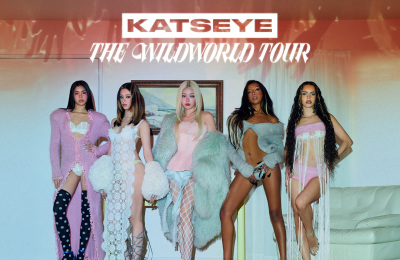
Tour routing decisions are shifting as well. The “THE WILDWORLD TOUR” starts in Dublin, not Seoul. European capital cities fill the itinerary before North American dates arrive. This is the inverse of the traditional K-pop tour pattern, and it signals where the revenue base currently sits. For venue bookers and promoters, the implication is that K-pop groups with this formation model may command different routing sequences than their trainee-system counterparts.
What happens next
KATSEYE announced a world tour — “THE WILDWORLD TOUR” — starting September 1 in Dublin, moving through European capitals and North American cities. If the album momentum holds, ticket demand will likely exceed initial projections.
The broader industry implication is worth tracking over the next twelve months. If HYBE can duplicate this formula with another audition-formed act, the K-pop industry’s definition of what constitutes a viable product changes fundamentally. The current system invests in long trainee development, Korean-language releases, and domestic debut cycles. KATSEYE’s model skips several of those steps.
It remains to be seen whether the 170,000-unit debut is sustainable or a moment. “Beautiful Chaos” moved far fewer units. The climb from #4 to #1 in under a year is steep.
But the direction is clear. The gate that once controlled K-pop’s path to American numbers is now open, and the group walking through it didn’t come from Seoul.
What this means for the rest of the industry
There is one more dimension worth tracking. The “WILD” result forces a reassessment of what the Billboard 200 measures when a K-pop group tops it. For years, the assumption was that K-pop’s US chart success reflected diaspora mobilization — Korean Americans, second-generation immigrants, and expatriate communities purchasing physical albums in volume. KATSEYE’s buyer profile disrupts that assumption. The sales data points to a mainstream pop audience that would not necessarily self-identify as K-pop consumers.
This distinction matters for how the industry measures future success. If the next K-pop group to top the Billboard 200 follows KATSEYE’s formation model rather than the traditional one, the revenue structure shifts: less reliance on fandom physical sales, more on Western-style touring, less on Korean-language content dominance, more on English-language accessibility. The group composition itself becomes a strategic variable rather than a cultural constant.
For Korean agencies watching from Seoul, the practical implication is simpler. The path that once required years of trainee development, Korean market proof-of-concept, and gradual international expansion now has an alternate route — a global audition, a Western label partnership, and a direct launch into the American market. Whether this route is replicable at scale depends on HYBE’s ability to find enough groups with KATSEYE’s specific combination of vocal differentiation, visual appeal, and songwriting pedigree. But the existence of the route itself changes the conversation.
The gate is open. The group that walked through it was never meant to come from inside.