Kerch Bridge Strike: Russia’s Logistics Cost Curve Bends
Ukraine’s latest strike on the Kerch Bridge isn’t just tactical—it reshapes Russia’s logistics cost curve, forces ammunition prioritization, and may quietly redefine allied air-defense sharing.
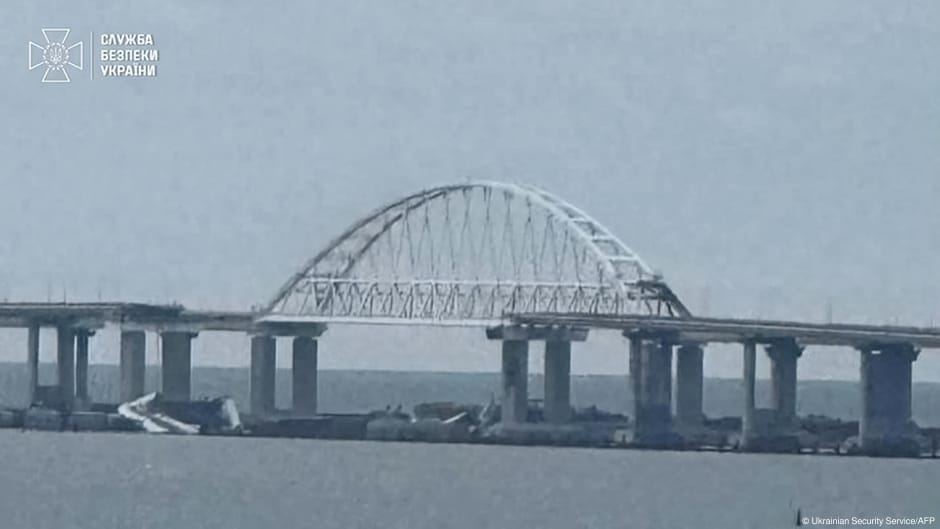
The Bridge Is Not the Target
Ukraine didn’t strike the Kerch Bridge to destroy concrete and steel. It struck to impose a cost curve Russia can no longer absorb.
The highway span collapsed into the sea on the night of November 17. Rail traffic restarted days later, a PR gesture that ignored physics. The strait below remains clogged with rubble. Vessels cannot pass. Not now. Not for months.
Russia calls it a terrorist attack. Ukraine called it a return trip—the war, as President Volodymyr Zelenskyy put it, coming back to where it began.
But the real story isn’t the wreckage. It’s what the wreckage reveals about Moscow’s logistics bill, Kyiv’s ammunition ledger, and the quiet recalibration happening among allies who still debate how far to lend their air-defence systems.
A Month of Phases, Not a Single Strike
The Security Service of Ukraine described seven distinct phases over roughly four weeks. First, neutralize the Russian air-defence envelope over the Strait of Kerch. Then, attack the bridge.
That sequence matters. It signals a shift from opportunistic raids to systematic denial. Ukraine is no longer hoping to slip through; it is clearing the path.
The weapon mix also tells a story. Kyiv relied on homegrown systems—the FP-5 Flamingo loitering munition and the R-360 Neptun anti-ship missile—rather than Western long-range strikes. That choice was deliberate. It preserves sensitive alliance inventory for higher-priority targets while proving Ukraine can degrade Russian rear-area assets without triggering escalatory red lines.
British reporting suggested Ukraine avoided SpaceX’s Starlink network for the operation, a detail that underscores Kyiv’s push for operational independence even as it depends on Western hardware elsewhere.
The Logistics Cost Curve Bends
Russian officials and pro-Kremlin bloggers insisted the bridge is “purely civilian.” That reading collapses under basic geography.
Crimea has no other land link to mainland Russia. Every barrel of fuel, every box of ammunition, every conscript shipped north passes over those two spans. When the highway fell, Russia didn’t lose a road. It lost its fastest, highest-capacity artery into an occupied peninsula it vowed to keep supplied indefinitely.
Oleksandr Kovalenko of the Information Resistance Group noted the direct consequence: resource shortages will weaken both Russian attacks and defences. Fewer supplies mean fewer launches from Crimean drone pads in Hvardiisk, Cape Chauda, and Balaklava. Fewer Iskander-M, Zircon, and Oniks missiles rolling through the strait. Fewer glide bombs arcing toward Odesa and Mykolaiv.
Russia can reroute some traffic through the Krasnodar region’s road network, but capacity drops sharply. Detours add days, not hours. Fuel convoys slow. Maintenance cycles lengthen. The cost per delivered ton rises steeply—and then steeply again.
That is the real damage. Not the collapsed arch, but the arithmetic behind it.
Shipping: A Chokepoint Frozen
The Kerch Strait navigational channel is 120 metres wide and no more than five metres deep in places. Dredging has kept it open for centuries, allowing river-sea vessels from the Don and Volga basins to reach the Black Sea.
Debris from the bridge has erased that possibility. The channel sits blocked. River-sea ships cannot leave the Sea of Azov. Small craft from the Black Sea Fleet and the Caspian Flotilla based at Novorossiysk are trapped inland.
This is not merely a military inconvenience. It is an economic stranglehold on southern Russia and the self-proclaimed republics of Donetsk and Luhansk, which rely on Azov-port exports to move grain, coal, and metals. The blockade will linger until Russia removes millions of tonnes of wreckage—a task complicated by the fact that Ukrainian forces can now target floating cranes and repair barges, as pro-Kremlin commentators themselves acknowledge.
Andrii Korezkyj of the Kyiv University of Transportation estimates reconstruction will take one and a half to three years. Even then, he doubts Moscow will risk rebuilding so close to the front line without facing further interference.
Ammunition Priorities Shift Westward
Ukraine’s restraint in using only domestic weapons sends a message to partners in Brussels and Washington: Kyiv is practicing scarcity.
Every Patriot missile, every SM-2, every Storm Shadow spared today is one available for a future Russian air campaign or a surprise thrust along the front. By chaining high-value Western systems to lower-priority targets, Ukraine would erode its own defensive depth. By reserving them, Kyiv preserves leverage—and keeps allies engaged.
The Neptun and Flamingo arsenal is finite, too. Producing more requires industrial scaling that Ukraine cannot yet achieve alone. Still, each successful strike validates the concept: deny the rear, stretch the supply line, force the enemy to choose between feeding the front and feeding itself.
Allies watching this calculus will adjust their own transfer policies. If Ukraine can consistently punish Russian logistics with homegrown munitions, the political case for sharing longer-range air-defence interceptors grows stronger. The bridge strikes are quietly building that case.
Air-Defence Sharing Gets a New Benchmark
NATO governments have wrestled for months over how far to extend their umbrella. Some worry about drawing their systems into direct combat. Others fear that limiting range leaves Ukrainian territory vulnerable to saturation strikes.
The Kerch operation offers a practical answer. Neutralizing Russian air defence over the strait required coordinated electronic warfare, reconnaissance, and precision strike—not necessarily long-range SAMs deployed on Ukrainian soil. It showed that denying airspace can be achieved through layered, cost-effective means rather than expensive platform commitments.
That distinction matters for allies hesitant to send SAMP/T or爱国者 batteries deeper west. If Kyiv can suppress Russian air operations over critical corridors using drones, cruise missiles, and stand-off effects, the threshold for deploying costly layered-defence systems lowers. Partners may conclude that shared air-denial capability is more valuable than shared surface-to-air missiles.
Symbolism and Summit Pressure
Vladimir Putin personally oversaw the bridge’s construction after the 2014 annexation. Its collapse arrives just before his scheduled meetings in Shenzhen with Chinese President Xi Jinping and U.S. President Donald Trump. Dmitry Peskov pledged reconstruction “even better than before.” History suggests that promise is easier made than built.
Online memes trivialize the event. Behind them sits a stark reality: Russia’s most visible symbol of territorial control now lies at the bottom of the strait, and its replacement is years away.
For Kyiv, the strike proves that the front line extends far beyond contact zones. For Moscow, it confirms that Crimea is no longer a secure rear area but a logistically fragile asset requiring constant protection.
What Happens Next
Russia will attempt repairs. It will divert traffic. It will try to resume limited rail service while dredging debris. Each measure raises costs and reduces throughput.
Ukraine will monitor the strait. It will target repair vessels if they appear. It will keep the cost curve climbing.
Allies will watch the ammunition drawdown. They will adjust transfer schedules accordingly. The bridge strikes may become the quiet benchmark for how much logistical pressure Kyiv can sustain without exhausting Western stockpiles.
The Kerch Bridge was never just infrastructure. It is a mirror. What it reflects is how far Russia’s war economy has stretched—and how much further it can bend before it breaks.