Kim Jong-un's Army Reset Reveals Real North Korean Power Dynamics
North Korean leader Kim Jong-un presided over a third company commander conference in Pyongyang, emphasizing grassroots military loyalty. The move signals deeper power consolidation strategies amid persistent health speculation.
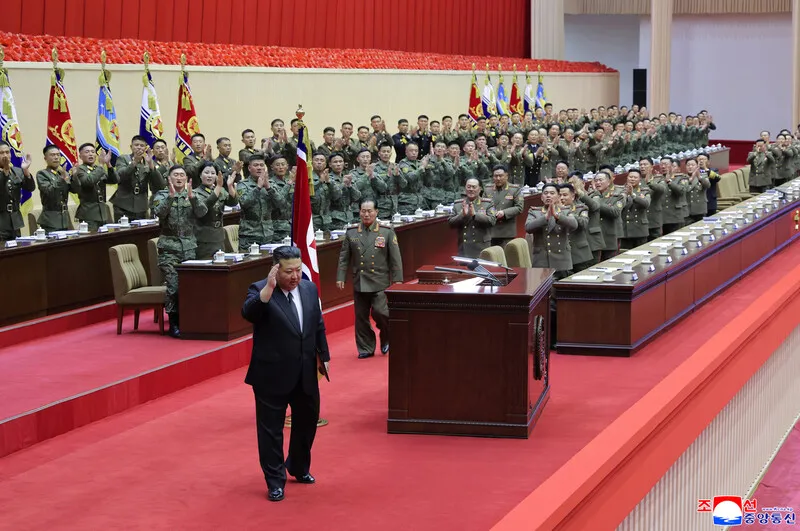
The Company Commander Conference No One Is Talking About Correctly
North Korean leader Kim Jong-un spent two days in Pyongyang this week presiding over what state media described as the “Third Company Commander Conference” of the Korean People’s Army. International coverage quickly reduced the event to another death-rumor countermeasure — a leader proving he’s still alive by appearing at a military gathering. Western headlines led with his weight, his stair-climbing footage, and whether this appearance carried the same urgency as previous high-profile events staged to dispel speculation.
This framing misses something more important: the specific choice of audience. Company commanders sit at the grassroots of military hierarchy. They are the officers who directly control soldiers, who enforce discipline in barracks, who determine whether orders actually reach the ground. By convening this level of commander, Kim is signaling where he sees his authority genuinely resting — not in the marble halls where marshals convene, but in the foxholes and dormitories where the army actually functions.
What Company Commanders Reveal About Power
The conference’s stated theme — “Building a Strong Military in the New Era and the Duties of Company Commanders” — carried unmistakable subtext. Central News Agency reported Kim emphasizing that company units represent the “cells” of military strength and that strengthening these cells is essential to advancing what officials call a “military revolution in our style.”
This language warrants closer attention than the standard “consolidating power” interpretation. Kim is not addressing generals or marshals. He is addressing officers who typically rotate through commands every two to three years, who serve as the interface between propaganda and reality in military units, and who can either execute orders or quietly resist them. Company commanders in North Korea’s system bear particular responsibility for political reliability — they run study sessions, monitor dissent, and ensure that ideological conformity translates into operational obedience. Focusing on them directly suggests Kim views political enforcement at the unit level as the weak link in his chain of command.
The 140-kilogram leader’s recent physical descriptions — running up stairs during inspections, maintaining close medical supervision — reinforce an image of vitality that contradicts Western speculation. But the real story lies elsewhere: in the organizational logic of focusing military attention at the most basic command level. In authoritarian systems, regime survival depends less on the loyalty of top generals, who have everything to lose, and more on the thousands of mid-level and junior officers who hold the monopoly on organized violence. Company commanders are the actual gatekeepers of that monopoly.
Why This Timing Matters
South Korea’s National Intelligence Service confirmed on October 23 that health concerns about Kim are unfounded, noting his obesity creates cardiovascular risk but that he shows no functional abnormalities. This announcement came one day after the conference closed. The coordination between military messaging and intelligence validation suggests a deliberate information strategy rather than reactive damage control. Both agencies — one domestic, one foreign — are pushing the same narrative: Kim is well, the military is stable, and any alternative reading is baseless.
The broader diplomatic context adds urgency. Reports indicate probability estimates below 10 percent for a potential Kim-Trump meeting during November’s APEC summit. Chinese President Xi Jinping recently communicated to Kim about mutual support and protection in bilateral relations, language that carries weight precisely because it signals Beijing’s awareness of succession uncertainties. These signals suggest Pyongyang is positioning itself while preparing for multiple scenarios — including uncertainty about Kim’s longevity that officials cannot openly acknowledge. The military conference, therefore, functions as both a domestic reassurance mechanism and an external signal to allies and adversaries that the apparatus remains intact regardless of who ultimately inherits power.
The Succession Question Nobody Addresses
Company-level focus reveals something about succession planning without naming it directly. If Kim were simply proving he remains alive, prime general officers. Instead, he chose the foundational tier of military command. This matters because company commanders represent the generation of officers who will remain in place after any transition, who maintain institutional continuity regardless of leadership changes. They are the permanent infrastructure upon which any new leader must build.
The emphasis on “our style” of military revolution carries implications beyond rhetoric. It suggests standardization of doctrine at levels that previously received less institutional attention. Uniform training, consistent political instruction, standardized operational procedures — these are exactly the kinds of reforms that strengthen central authority while reducing regional autonomy within the military. When Pyongyang dictates how a company commander in a remote border garrison conducts political study or responds to orders, it is eroding the informal networks that regional commanders have historically cultivated. This is institutional centralization dressed in revolutionary language.
Second-order effects are already visible. Military analysts tracking personnel rotations have noted an acceleration in company-level transfers over the past eighteen months, suggesting the conference may have catalyzed a broader reshuffling designed to break entrenched local loyalties. Officers who built personal relationships with regional commanders — the kind of relationships that can become liabilities during a succession crisis — are being moved, rotated, and replaced with individuals whose primary accountability runs through Pyongyang’s chain of command rather than through local patronage networks.
Who Wins and Who Loses
The winners are clear: Kim’s central authority receives reinforcement through direct engagement with subordinate officers who typically operate with substantial independence. Company commanders gain visibility and access that elevates their status within military hierarchies. In a system where proximity to the leader is the primary currency of advancement, being summoned to Pyongyang for a two-day conference is a career accelerant that dozens of company commanders will leverage in future promotion cycles.
The losers are less visible but equally important: mid-level battalion and regimental commanders who might prefer to maintain their own direct relationships with top leadership. Regional military districts that have historically exercised considerable autonomy in training and political work face potential standardization that concentrates decision-making in Pyongyang. The conference’s directives, once implemented, will flow through these intermediate layers rather than around them, reducing their role as independent power brokers and converting them into transmission belts for central policy.
Western analysts focused on survival narratives miss the institutional dimension entirely. Kim is not merely demonstrating vitality. He is restructuring the relationship between center and periphery in the military apparatus that underpins his regime — a task that matters more in the long term than any single photo opportunity.
What Happens Next
Military conferences of this type typically produce directives that shape budget allocation, promotion cycles, and operational priorities for the coming year. The specific emphasis on company-level strengthening suggests continued investment in political reliability at the grassroots rather than purely capability-focused modernization. This aligns with broader patterns in North Korean military spending, where political security apparatuses receive disproportionate funding relative to conventional capability improvements.
Observers should watch for subsequent promotions, personnel changes, and policy implementations that reflect the conference’s directives. The language used about “our style” military revolution may prove more significant than any single policy outcome, indicating a doctrinal direction that prioritizes ideological cohesion alongside operational effectiveness. A follow-up conference at the battalion or regimental level would confirm that the centralization drive extends downward through the entire command structure, not merely upward for symbolic purposes.
The convergence of internal military restructuring and external diplomatic uncertainty creates a moment worth monitoring beyond the death-spectacle cycle that dominates coverage. Kim’s choices reveal more about where power sits in North Korea than any health speculation ever could — and the answer is clearer at company level than at any other rung on the ladder.