Kim Ju-ae's Stage Presence Is a Succession Play — and a Diplomacy Signal
North Korea's intelligence service says Kim Jong Un's daughter has reached the 'de facto successor designate' stage. Her sudden media blitz isn't just domestic theater — it's a signal to Washington about Pyongyang's timeline.
The Daughter Is Coming Into View
North Korea’s National Intelligence Service delivered a quiet bombshell to lawmakers this week: Kim Ju-ae has reached what it called the “de facto successor designate” stage.
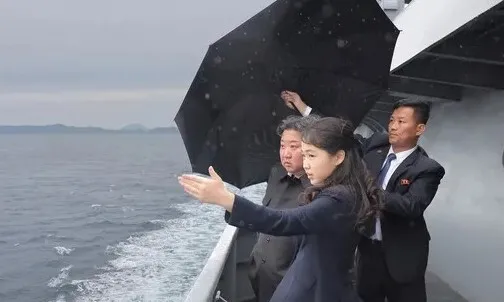
The assessment came during a closed briefing to the National Assembly Intelligence Committee, but the substance is anything but obscure. Kim Ju-ae has been appearing alongside her father with increasing frequency over recent months — most recently visiting a naval destroyer for a sea trial in early June, according to Korean Central News Agency coverage. Her sudden visibility isn’t accidental. Seoul reads it as preparation for a public, a deliberate imprinting of the next leader onto North Korea’s political consciousness.
The more consequential part of the briefing wasn’t about Kim Ju-ae at all. It was about Kim Jong Un’s calculus regarding the United States.
The Summit Is Possible, Seoul Says — At Any Time
NIS Director Yoon Tae-young told the committee that a North Korea–US summit between Kim Jong Un and Donald Trump could happen whenever Trump wants it. There are no confirmed concrete contacts yet. But, NIS said, there are “signs of dialogue.”
That phrasing matters. In intelligence work, “signs” without “confirmed contacts” means the channels are warming but haven’t hardened into something actionable. Pyongyang is testing the waters. Trump has repeatedly signaled he wants to talk to Kim. The question on Washington’s side has been whether Kim is reciprocating in any substantive way or simply keeping the possibility alive as leverage.
South Korea’s own overtures, meanwhile, have gone nowhere. President Lee Jae-myung’s August 15 Independence Day address proposed discussions among the Korean War’s parties to formally end the conflict. NIS said there has been no direct dialogue contact at the agency level on that front.
The asymmetry is stark: the US track has movement; the inter-Korean track does not. That tells you where Pyongyang’s priority lies.
Why the Succession Timing Can’t Be Ignored
Here is the non-obvious implication: Kim Ju-ae’s rise and the potential US summit are happening on the same timeline for a reason.
A successor designation is never just about the family. It is about institutional readiness. Kim Jong Un is ensuring that if he makes a dramatic deal — or something goes wrong — the regime has a lined-up figure ready to absorb the shock. The public appearances, the naval ship visit, the media coverage: all of it builds Kim Ju-ae’s legitimacy in parallel with whatever diplomatic outcome is in the offing.
This is also a message to the North Korean elite. The military and party apparatus need to know the succession is settled before they gamble on a high-stakes agreement with America. A fractured leadership behind a big diplomatic hand is a recipe for collapse. Kim Jong Un is closing that door.
The Ukraine Factor: A Conditional Restraint
Another detail from the briefing deserves attention. NIS assessed that North Korea’s chances of sending additional troops to Russia’s war in Ukraine are “significantly low” during a dialogue phase with Trump, but remain “fluid” depending on how situations evolve.
In other words: the prospect of North Korean soldiers fighting in Europe is being held in abeyance, not abandoned. If the US summit talks stall or break down, that restraint could evaporate quickly. The linkage between diplomacy and military escalation is explicit — Pyongyang is using the threat of Ukrainian deployment as a quiet card in its negotiations with Washington.
The reorganization of North Korea’s intelligence apparatus backs this up. The Reconnaissance General Bureau has been upgraded to the Reconnaissance and Information Directoratelike structure, and Ri Chang-ho, its chief, now holds a dual role processing battlefield intelligence from Ukraine. This isn’t routine bureaucratic reshuffling. It is an organization adapting to an active war it didn’t start but is deeply entangled in.
What Washington Should Be Reading
American policymakers tend to treat North Korea through a narrow lens: denuclearization talks, missile tests, human rights. Seoul’s intelligence community is watching a wider board. The succession question, the Ukraine linkage, the intelligence documents NIS claims to have acquired — including party internal papers and missile design blueprints — all suggest Pyongyang is playing a multi-layered game.
Kim Ju-ae’s emergence is the most visible thread. But the real signal is the synchronization: a successor is being prepared while summit prospects are kept alive while Ukrainian deployment remains on the table. Pyongyang is building options, not committing to one path.
For Washington, the lesson is simple but uncomfortable. If you want to understand where North Korea is heading, stop looking only at what Kim Jong Un says and start watching who stands beside him.
The Domestic Risk Lurking Inside NIS
There is one troubling footnote in the briefing. Lawmakers raised concerns that NIS’s own task force on countering North Korean influence operations has engaged in spying on civilians. Yoon told the committee that personnel actions could follow from the special inspection, but the mere existence of the allegation inside an intelligence briefing about North Korea is a reminder that Seoul’s own democratic institutions are under strain.
A service distracted by domestic controversies will be less effective at reading Pyongyang’s signals. That matters when the signals are this layered.
What Happens Next
If the US–North Korea track moves forward, expect Kim Ju-ae’s visibility to continue climbing — she will be the face of continuity whenever a deal is signed. If it stalls, the Ukraine variable becomes more dangerous, and North Korea’s military posture will shift accordingly.
Either way, the era of Kim Jong Un’s personal monopoly on succession planning is ending. The question is whether the world is ready for the successor before she is ready for the throne.