Korea's AI Home Bet: Why LG and Samsung Are Waging a Quiet War
At IFA 2026, LG and Samsung unveiled aggressive AI home strategies that go beyond smarter appliances. They're betting that context-aware AI agents — integrated with messaging, e-commerce, and media — are the only moat strong enough to block Western cloud-native rivals.
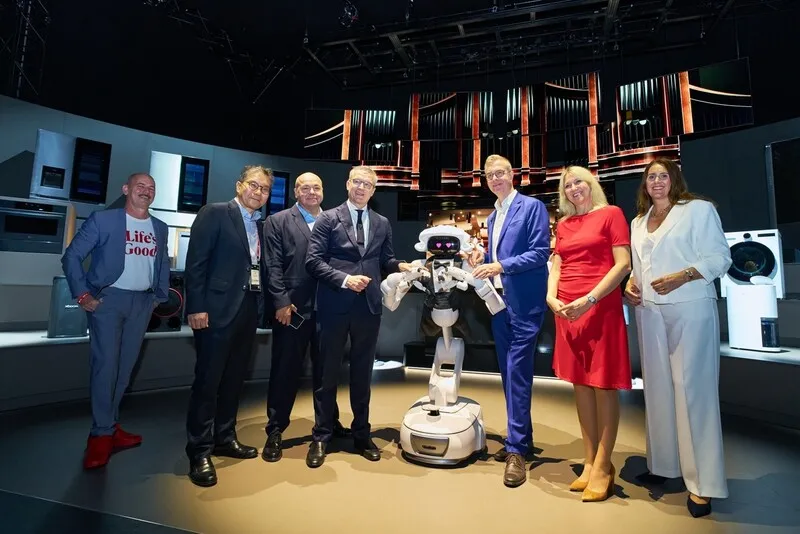
The floor was already occupied
Chinese companies effectively commandeered the narrative at IFA 2026 in Berlin, rolling out humanoid robots and next-generation AI ecosystems that turned heads. Into that room walked LG and Samsung — the two Korean appliance giants — and they made a deliberate choice not to compete on robotics theater. Instead, they played a longer, quieter game: turning every household appliance into an AI agent with memory, context, and the ability to act before you ask.
This isn’t incremental hardware improvement. It’s a strategic repositioning.
The zero-labor home
LG’s pitch centers on what it calls the “Zero Labor Home” — a domestic environment where chores, scheduling, and even grocery management dissolve through proactive AI. The mechanism is strikingly specific: an executory AI agent monitors your KakaoTalk and Telegram messages, learns your schedule, and pre-conditions your apartment before you walk through the door. If you’re ten minutes away, the air purifier and air conditioner switch on automatically. No app to open, no voice command to issue.
The company’s No Beom-jun, who leads AI home solution development at LG’s Home appliance (HS) division, framed it bluntly at a Berlin tech briefing: the AI understands context, proposes actions, and only executes with your permission. That permission model matters — it’s the difference between a smart home that feels helpful and one that feels like surveillance.
But the more commercially significant move is the e-commerce layer LG is reportedly exploring. When the AI suggests a recipe and you’re missing ingredients, it could push a direct purchase through an integrated e-commerce platform. That’s a revenue model, not a feature. It turns the refrigerator into a transaction point.
Samsung’s conversational approach
Samsung took a different architectural path. Instead of background agents, it pushed forward-looking conversational AI — its Vision AI Companion — baked directly into 2026 TVs. Watch a soccer match and ask where the stadium is; the TV answers in real time with the venue name, location, and seating capacity. It’s a demo designed to feel like magic, but the underlying bet is equally strategic: Samsung wants to own the living room screen as the default interface for AI interaction in the home.
The AI Promoter was the other headline device — an interactive AI avatar paired with a 115-inch micro RGB TV that responds to natural language requests. Asked for a big-screen movie experience in a bright room, it recommends the product directly. This is a virtual showroom, not a gimmick: Samsung is testing whether AI-guided sales can replace or supplement the physical retail experience entirely.
Why this matters beyond Berlin
The non-obvious story here is who these companies are really building against. It’s not Haier or Midea — important as they are. It’s Amazon and Google.
Western cloud-native platforms have spent years building smart home ecosystems that require you to install their hubs, adopt their assistants, and surrender your home data to their servers. LG and Samsung’s approach flips that script: the AI lives inside your appliances, understands your routines through the messengers and devices you already use, and proposes actions locally before anything reaches a cloud. The Zero Labor Home concept is essentially a Korean rebuttal to the Amazon Echo — a claim that the best smart home isn’t a speaker in the corner, but a network of appliances that know you well enough to act.
There’s a timing risk. Chinese robotics companies already filled the IFA floor with humanoid embodiments of the future. LG and Samsung are betting that the near-term winning move isn’t a robot that folds laundry, but a system that prevents you from needing to fold it in the first place. That’s a different kind of automation — diffuse, invisible, and arguably more commercially viable over the next five years.
Who wins and who loses
Consumers win on convenience, at least in the short term. The KakaoTalk-integrated scheduling, the recipe-to-cart pipeline, the conversational TV — these are genuinely useful features that don’t require buying a new ecosystem from scratch.
But the real question is competitive. If LG and Samsung successfully embed AI agents across their appliance fleets and tie them to messaging platforms and e-commerce partners, they build a data moat that Amazon and Google can’t easily replicate. The Western giants control the cloud and the voice assistant; the Koreans control the hardware in your kitchen and your living room. Neither side wants to be the commodity.
Western cloud-native competitors lose if Korean appliances become the default entry point for home AI — because then Amazon Alexa and Google Assistant are reduced to voice skins on someone else’s hardware. Chinese robotics firms lose attention share if the market settles on invisible agents rather than visible robots. Korean consumers may lose privacy if the context-awareness that makes these systems useful requires continuous surveillance of messages, schedules, and habits.
What happens next
Watch whether LG’s e-commerce integration actually launches this year, and whether Samsung’s Vision AI Companion extends beyond the TV into other appliance categories. The strategy only works if AI agents can speak across devices — a refrigerator that talks to a TV that talks to a washing machine. That interoperability is the true test, and neither company has fully demonstrated it yet.
Also worth tracking: how deeply these systems integrate with Korean messaging platforms like KakaoTalk. That’s a domestic advantage Western rivals can’t replicate in Korea, but it may look like a walled garden elsewhere. If LG and Samsung want global scale, they’ll need agents that work with WhatsApp, iMessage, and WeChat — not just the apps dominant in Seoul.
The Zero Labor Home is a compelling vision. The question is whether it arrives as a revolution in everyday life, or as a series of impressive Berlin demos that never quite leave the showroom.