Korea Asks Chip Giants to Fund Their Own Power Grid
KEPCO wants Samsung and SK Hynix to prepay 25 trillion won in electricity bills to finance the grid upgrades their expansion demands. It's a shift in who pays for the energy cost of the AI boom.
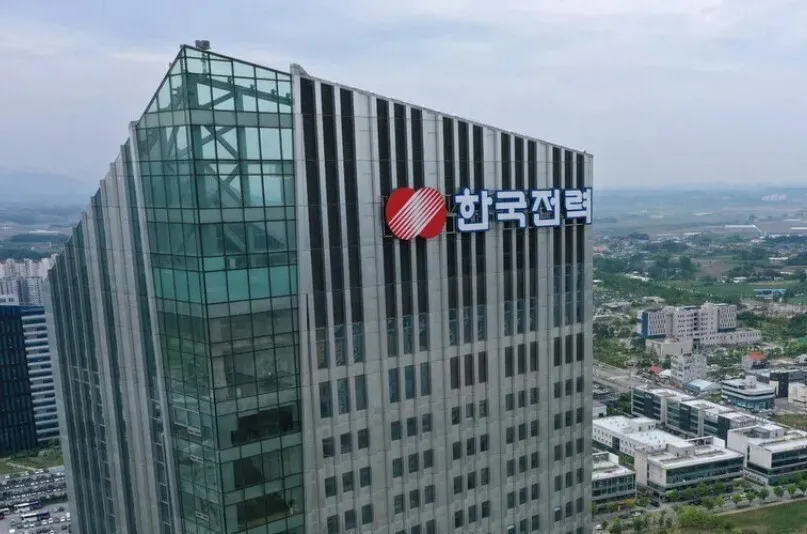
The Utility Is Asking the Customer to Pay First
Korea Electric Power Corp. has done something unusual for a state-backed monopoly: it has asked its two largest industrial customers to front the money for the grid upgrades those customers require. KEPCO proposed that Samsung Electronics prepay 20 trillion won and SK Hynix 5 trillion won — five years of electricity bills in advance — with the cash directed toward building the transmission and substation infrastructure needed to serve expanding semiconductor clusters and AI data centers.
The numbers are striking when you put them beside what these companies actually paid last year. Samsung’s electricity bill came to 4.1 trillion won. SK Hynix’s was 900 billion won. KEPCO’s 5-year projection for 2027 through 2031 scales those figures into the 25 trillion won total, then layers on an interest mechanism above the government bond rate, payable as a discount against future bills. Samsung and SK Hynix would essentially be lending KEPCO money at a rate the utility sets, while gaining supply certainty for the fabs and data halls they are racing to fill.
A Balance Sheet in Distress
The proposal only makes sense against the backdrop of KEPCO’s deteriorating finances. Its debt rose from 205.6 trillion won at the end of last year to 210.7 trillion won by June, with 2.1 trillion won in interest costs already absorbed in the first half alone. The utility benefits from a temporary exemption that allows it to issue bonds up to five times its capital and reserves — a threshold set to revert to two times by the end of next year unless lawmakers extend it. Without the prepayment program, KEPCO faces a structural squeeze: more borrowing capacity exhausted just as its investment needs accelerate.
The 12th Electricity Supply and Demand Basic Plan, released last month, quantifies the pressure. By 2040, peak electricity demand from semiconductors and advanced industries is projected to climb by 20.6 gigawatts. AI data centers add another 7.9 gigawatts. Those are not marginal increases. They represent a material reorientation of Korea’s power grid, built around the geography of chip fabrication and compute clusters in places like Yongin and the Honam region.
Who Wins, Who Loses
Samsung and SK Hynix stand to gain operational security. Their expansion plans — new fabs, expanded clean rooms, liquid cooling systems for AI training clusters — all depend on uninterrupted, high-capacity power. If KEPCO struggles to finance the grid, those projects stall. A prepayment deal buys them priority access to wired capacity, which is the scarce resource, not electricity itself. Korea has sufficient generation; it lacks the lines to move it from where it is produced to where the fabs sit.
But the concession carries cost. Samsung would be locking in 20 trillion won of capital for five years at terms it does not fully control. SK Hynix, smaller in absolute terms but already operating on tighter margins in a cyclical downturn, would commit 5 trillion won — roughly half its annual electricity spend — toward infrastructure it did not ask to build. The interest discount is a partial offset, but the real expense is opportunity cost: capital deployed here cannot fund R&D, equipment orders, or shareholder returns elsewhere.
KEPCO wins a direct funding stream without issuing bonds, sidestepping the debt ceiling that will bite in 2028. Taxpayers and ratepayers who normally absorb the cost of grid expansion also benefit, at least temporarily. The broader question is whether this arrangement becomes a template.
The Template Risk
If KEPCO can secure prepayments from Samsung and SK Hynix, the logic extends to any large power consumer. AI data center operators — domestic and foreign — are already negotiating land and water access in Korea. Power allocation will be the next battleground. A prepayment model shifts the financing burden from the utility, and ultimately from the public balance sheet, onto the private companies driving demand. It is a rational response to a fiscal constraint, but it also normalizes a structure where grid investment follows customer capability to pay, not systemic need.
This matters beyond Korea. The country is home to two of the world’s largest memory chipmakers and a growing data center market fueled by domestic and allied AI investment. How Korea finances the energy infrastructure for that growth — and who pays — will influence supply chain decisions globally. Companies evaluating where to site advanced fabrication will factor in not just labor and regulation, but whether they must also underwrite the grid.
What Happens Next
KEPCO has confirmed the proposal is still under discussion. The participation amount, term length, and interest rate have not been finalized. Samsung and SK Hynix have not publicly responded. Any deal will require regulatory approval and likely legislative action if it touches the bond limit framework.
The timeline is tight. KEPCO’s temporary debt exemption expires at the end of next year. Grid construction for the Yongin and Honam clusters cannot wait for a legislative fix. The prepayment program is, in effect, a bridge — both financially and politically — between the current fiscal architecture and whatever replaces it.
What is clear is that the old model, in which the state utility absorbed infrastructure costs and recovered them through regulated rates across a broad customer base, is fracturing under the weight of AI-era demand. The 25 trillion won prepayment is not just a financing arrangement. It is a signal that the companies powering the next round of computing growth are being asked to pay for the wires that carry it.
Whether that is fair, sustainable, or replicable elsewhere remains undecided. But the direction is set.