Why Korea's Auto-Parts Strike Is a Wake-Up Call for Global EV Supply Chains
A strike at a Hyundai Motor subsidiary parts plant is already halting production lines at Hyundai's massive Ulsan complex. As China tightens battery export controls, the incident exposes how fragile the EV supply chain has become.
Just-in-Time Breaks Under Labour Pressure
A four-hour partial strike at a subcontractor plant inside Hyundai Motor’s supplier ecosystem has already cut output at Hyundai’s Ulsan mega-plant. The disruption is not dramatic in scale — yet — but it is a symptom of a system that has grown brittle. Just-in-time manufacturing, the backbone of Korean auto competitiveness, leaves no room for supply shocks. When a single parts sub-tier falters, the whole line stalls.
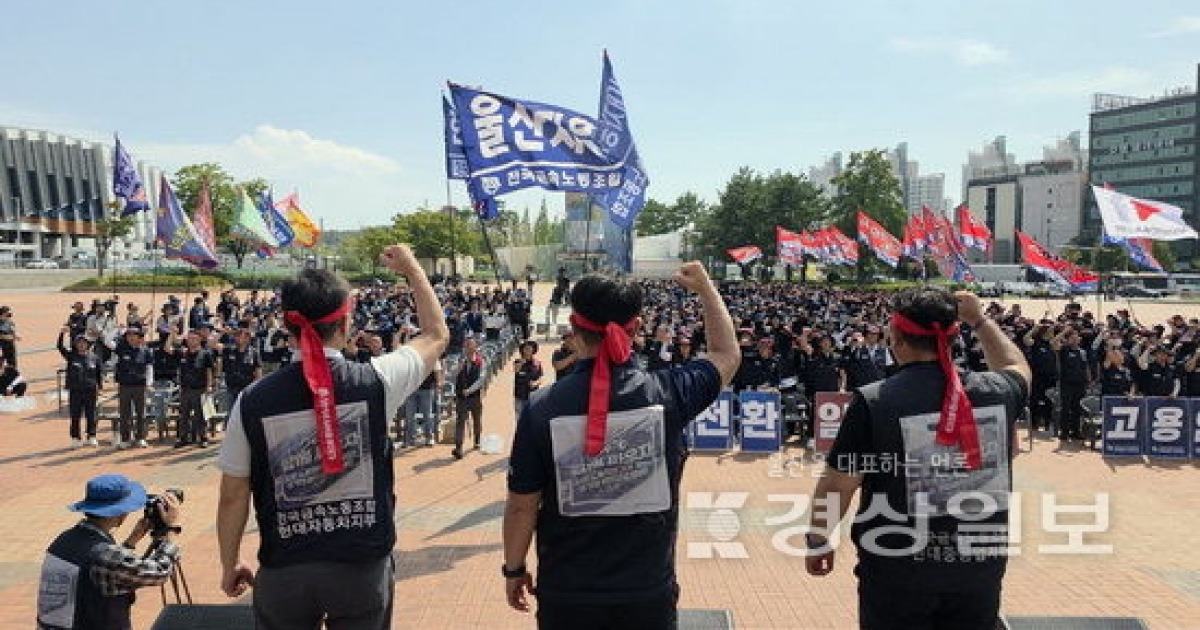
The strike is happening at Motras, a subsidiary of Hyundai Mobis that supplies components to Hyundai Motor and Kia. The union is demanding a joint bargaining agreement with UniTus — another Hyundai Mobis production subsidiary — along with fixed wage increases and employment guarantees. It began with a partial walkout on the 26th. A second partial strike is scheduled for the 28th.
Inside Ulsan, the effect was immediate. Production line utilisation dropped noticeably. Some lines went idle altogether. The Metal Workers’ Union of Korea mobilised not just at Ulsan but across eight regions — Gyeonggi, Chungcheong, Seoul, Jeonbuk, Gwangju/Jeonnam — for what it called a second general strike, framing the dispute as a battle over subcontractor worker rights.
What English-Language Readers Miss About This
Most international coverage of Korean auto labour disputes stops at the headline number: wages, headcount, the usual scoreboard. What gets overlooked is the structural shift happening beneath it.
Korean auto companies have long relied on a multi-tier supplier hierarchy where the “original manufacturer” — the woncheong in Korean — holds disproportionate leverage. Subcontractors like Motras and UniTus sit far down the chain, their working conditions invisible to the end consumer. The union is now forcing that invisibility to the surface. Its demand for joint negotiations between the subcontractor and the prime contractor is essentially a demand for contract transparency that the industry has never had to accept.
The Metal Workers’ Union pointedly cited cases where companies like Hanwha Ocean and Donghui Auto refused to comply with labour committee rulings and filed administrative lawsuits instead. The union’s argument is constitutional: the right to organise and bargain is guaranteed by the South Korean constitution, yet subcontractor workers remain excluded from meaningful collective bargaining. That is a legal contradiction the industry cannot easily shrug off.
The Supply Chain Fragility Question
Here is where the story exits Korea and enters global territory.
The EV supply chain is already under stress from China’s recent moves to tighten controls on battery-critical mineral exports — graphite, antimony, and other components essential to lithium-ion batteries. Beijing’s export restrictions, implemented through licensing requirements and quota systems, have forced automakers to accelerate diversification away from Chinese-supplied battery materials. That diversification is expensive, slow, and uncertain.
Into that environment comes a labour strike in Korea that is already interrupting vehicle production. The two dynamics are not the same event, but they converge on the same truth: the EV supply chain has traded concentration risk for fragility.
Korea’s auto sector built its competitiveness on efficient, lean supply chains. Lean means minimal inventory, minimal buffer, maximum efficiency. That works in normal times. It does not work when geopolitics pushes critical inputs behind regulatory barriers and labour unrest disrupts domestic production simultaneously.
Who Wins and Who Loses
Workers in the short term: Motras and UniTus employees are the immediate beneficiaries if the union’s demands for joint bargaining and wage guarantees are met. Employment security for subcontractor staff — often the most precarious tier of auto employment — would represent a genuine shift in bargaining power.
Hyundai Motor and Kia: They lose on production continuity. Even a partial strike at a single subcontractor can cascade. Ulsan is one of the world’s largest integrated auto complexes. Every day of reduced output is revenue on the line, and every delayed vehicle is a competitive disadvantage in markets where delivery speed matters.
Consumers: The indirect victims. Supply disruptions either delay deliveries or get passed through as price increases. In a market where Chinese EVs are flooding into Southeast Asia, Europe, and Latin America at aggressive price points, Korean manufacturers cannot afford cost escalation on their own side.
The broader industry: The loss here is confidence. If a parts subcontractor strike in South Korea — a country with historically stable labour relations in manufacturing — can halt production at a major OEM, investors and executives will reassess the resilience of lean supply chains everywhere.
What Comes Next
The immediate question is whether the Motras partial strikes escalate. A full strike at a Hyundai Mobis subsidiary would paralyse Ulsan more severely. The union’s decision to hold coordinated action across eight regions suggests it is building momentum, not winding down.
The structural question is whether Hyundai Motor Group will concede to joint bargaining with subcontractors. That would set a precedent across Korean manufacturing. The union has made clear it views this as a constitutional rights issue, not a negotiable grievance. Expect legal challenges from companies reluctant to open the subcontractor bargaining door.
For the global EV supply chain, the lesson is blunt. Efficiency was the religion. Resilience must now become the priority. That means rebuilding inventory buffers, diversifying supplier relationships beyond single-region concentration, and confronting the hidden vulnerability of multi-tier subcontracting — the very model that made Korean autos dominant in the first place.
China’s export controls on battery materials are one pressure. Korean labour action is another. Together they signal that the era of cheap, reliable, uninterrupted EV supply chain growth may be over.
The Ulsan strike started as a local labour dispute. It is becoming something larger.