Korea Just Broke Into NATO's Backyard — And It Changes Everything
South Korea's K9 howitzer sale to Spain marks the first time a domestically produced complete weapons system has been exported to both the US and Western Europe. Here's why the deal matters far beyond the contract value.
A Wall Cracks in Western Europe
South Korea has done something that no one expected a decade ago. It just sold a complete, domestically engineered weapons system into the heart of Western Europe — a region that has traditionally viewed its defense industrial base as strictly off-limits to non-allies.
On August 31, Hanwha Aerospace confirmed it signed an execution contract with Spanish defense firm Indra Sistemas for the export of K9 self-propelled howitzers. The specifics — exact quantities, pricing, delivery timelines — remain undisclosed under business confidentiality rules. But market observers estimate the deal exceeds 667.5 billion won, based on Korea Exchange disclosure thresholds tied to Hanwha’s revenue. Industry insiders say the underlying MOU from March calls for 128 K9 howitzers and 120 K10 ammunition resupply vehicles, putting the total contract value near one trillion won.
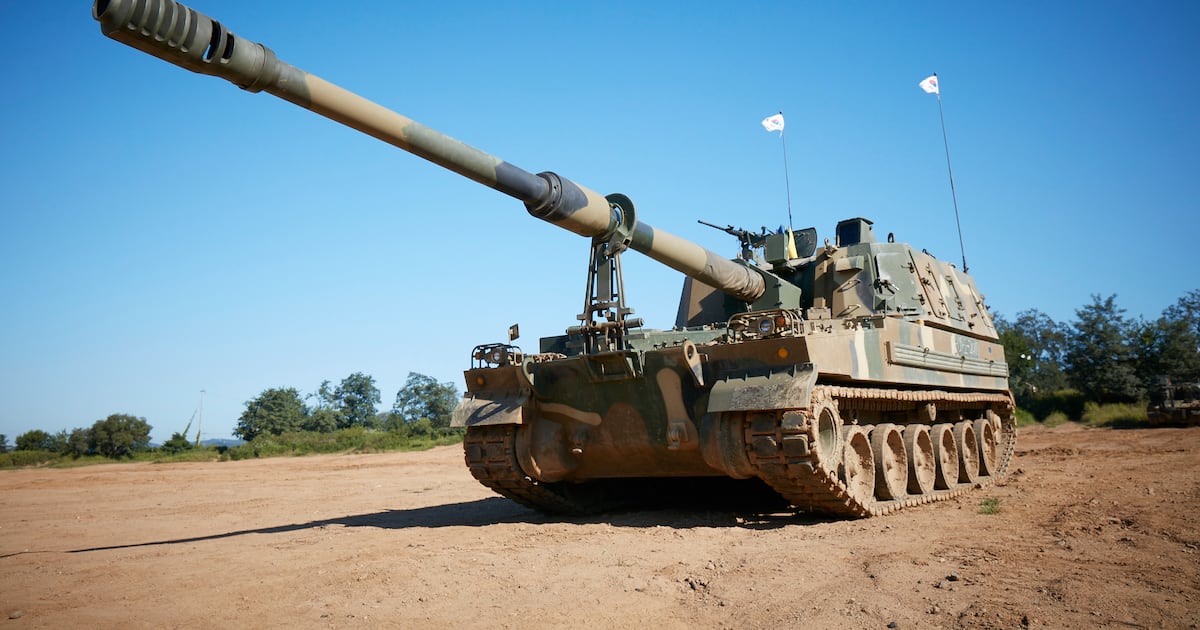
More important than the money is what this transaction represents. The K9 is now flowing to two NATO members — the United States and Spain — meaning South Korea has become the first country in the world to export a homegrown, complete-tier weapons platform to both. That distinction matters. It signals that the transatlantic defense bloc, long insulated behind layers of regulatory friction and industrial protectionism, has found a credible non-EU, non-NATO supplier it is willing to trust with frontline artillery.
Why Spain Chose Korea
Spain’s army is running an ambitious modernization program worth roughly 7 trillion won to replace aging self-propelled howitzers and associated support vehicles. In late 2024, a consortium led by Indra Sistemas was selected as the project’s prime contractor. The search then turned to which foreign manufacturer could deliver the artillery piece itself.
Spain did not simply buy off-the-shelf. The K9 being delivered is a modified, tracked variant tuned to Spanish military specifications — a customized platform rather than a catalog order. Under the deal’s structure, Hanwha provides the K9 platform technology and core systems, while Indra manufactures the chassis, fire-control, and communications equipment at its factory in Gijón, in northern Spain’s Asturias region. This is not a warehouse shipment from Busan. It is a technology-transfer arrangement with local manufacturing embedded in the supply chain.
That localization strategy appears to have been the decisive factor. European defense buyers have grown increasingly reluctant to purchase weapons systems that cannot be serviced, upgraded, or eventually reproduced within European soil. By anchoring final assembly and subsystem production in Spain, Hanwha removed the single biggest objection any European procurement official could raise: dependency on an Asian supply chain that runs through straits and seas outside NATO’s direct control.
The Ukraine War Is Changing the Rules
The broader context for this deal is the war in Ukraine, which has turned Europe’s artillery stocks into a strategic liability. Germany, France, and the United States have all watched their own howitzer inventories dwindle under the demands of Ukrainian operations. The United States has committed to ramping up M777 and Paladin production, but those programs cannot scale fast enough to meet European rearmament targets.
Korea’s K9 — a 155-millimeter, self-propelled howitzer with a proven track record in South Korea, Australia, Norway, Finland, and now the United States — fills exactly that gap. It fires standard NATO 155mm ammunition. It integrates into existing European command-and-control architectures. And it is available in volumes that European manufacturers simply cannot match today.
Sweden’s Bofors, Germany’s Krauss-Maffei Wegmann, and France’s Nexter are all capacity-constrained. Korea’s defense industry, by contrast, has been building these systems at scale for its own needs and for export markets. The K9 is not a prototype program waiting for government approval. It is a mature, battle-tested platform produced on an industrial assembly line.
Who Wins and Who Loses
Hanwha wins the most obvious prize: a foothold in Western Europe that will likely open doors to additional NATO contracts. Spain is not an isolated buyer. The K9’s presence in Spanish service — assembled on Spanish soil — creates a reference case for other European armies considering how to refresh their artillery stocks without deepening dependence on a single ally’s industrial base.
Spain wins through technology transfer and domestic industrial stimulation. The Gijón plant’s new role in producing K9 variants means skilled jobs, engineering know-how, and a supply chain that will persist beyond this single contract. European defense firms that had hoped to capture the Spanish modernization program on their own terms now face competition from a Korean platform that is arguably more capable and significantly faster to deliver.
The losers are less visible but real. European defense primes that bet on the assumption that Western Europe would remain their exclusive domain have just been undercut by a non-traditional competitor. The assumption that NATO defense procurement would continue to prioritize American and European sources above all else is broken. So is the assumption that advanced artillery systems require decades of joint development between allied governments — Korea built, refined, and exported the K9 largely on its own.
What Comes Next
The execution contract finalizes the Spain deal, but the strategic trajectory is already clear. South Korea is no longer perceived merely as a regional supplier for Asia-Pacific customers. It is becoming a global defense exporter with access to the most politically sensitive procurement markets in the world.
Every additional NATO country that adopts the K9 deepens Korea’s leverage in two directions. It gives Seoul diplomatic weight in Indo-Pacific security discussions, where Washington and European capitals increasingly value Korean industrial contributions. And it gives Hanwha and its Korean supply chain partners a negotiating position that extends well beyond artillery — into munitions, ammunition, and the broader ecosystem of integrated fire-support systems that Ukraine and Europe will need for years.
The K9 sale to Spain is not the end of a negotiation. It is the opening move in a restructuring of Western defense sourcing that will accelerate through the rest of this decade.