Korea's Chip Crash Is Testing Where Global Money Flows Next
A brutal correction in Korean semiconductors has reshuffled Wall Street hedge funds and pushed capital toward gold, Bitcoin, and AI infrastructure plays. The move reveals a deeper shift: money is abandoning national currencies altogether.
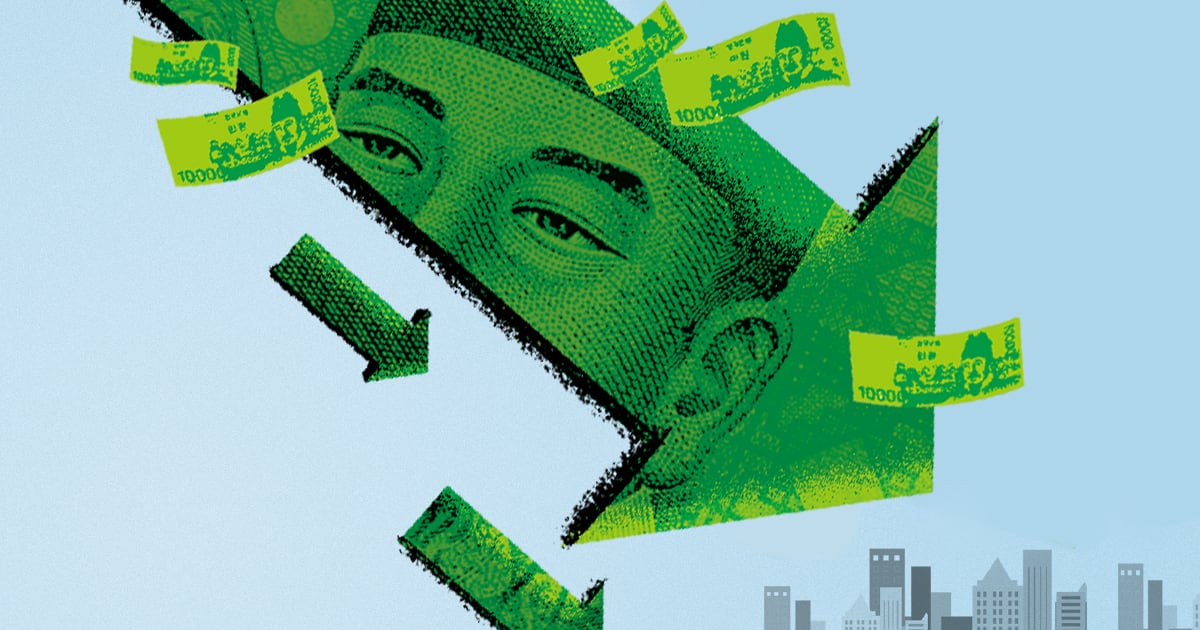
The Rollerskater Stopped
The Korean stock market earned a nickname in the first half of 2026: Rollercoaster KOSPI. It was a volatile mess from the start, driven almost entirely by the insatiable appetite for domestic semiconductor stocks. Samsung Electronics and SK Hynix — the twin engines of Korea’s export economy — became the primary beneficiaries of aleveraged investment boom that exploded when new margin products hit the market.
Then the summer hit, and the ride ended abruptly.
Average daily trading value plummeted from 50.3 trillion won in June to 25.8 trillion won by August. Trading volume collapsed even harder, falling to a quarter of its March peak. The lesson, cold and immediate: betting on Korean chips at the top was expensive. Betting against them at the right moment was profitable beyond proportion.
Wall Street Split in Two
What happened next inside American hedge funds tells the real story of where the capital is heading — and who gets burned.
Citadel, the hedge fund giant known for acting as Wall Street’s resident predator, cut its exposure to Micron and TSMC as those stocks hit their highs. It sold quickly and cleanly. Meanwhile, its AI-focused fund, Situational Awareness, did the opposite. It piled into memory chip makers like Micron and Sandisk at a 10 percent discount to the broader market, leveraged up to four times its capital, and survived a margin call when prices kept falling.
The surviving funds shared one trait: they didn’t stay concentrated in semiconductors when the sector got crowded. They rotated into software, energy, and utilities — the unglamorous infrastructure that actually powers AI data centers. The diversification wasn’t philosophy. It was survival math.
The losing funds learned it the hard way.
The Currency Empty Corner
While Korean chip stocks cratered, gold and Bitcoin — two assets that had been sitting on the sidelines — started climbing. Most commentary attributes this to simple risk-off psychology. That’s the wrong explanation.
The real driver is the United States Treasury’s desperate attempt to suppress long-term interest rates. Three-year Treasury yields had climbed to their highest level since the 2007 financial crisis. In response, the Treasury doubled the size of its bond buyback program, purchasing long-dated debt directly from the market. Treasury Secretary Scott Bessent warned creditors that shorts would get crushed if they kept betting against the government’s ability to manage the curve.
But suppressing yields creates a paradox. When the government buys long-term bonds, it finances those purchases by issuing short-term debt. And now a new buyer has entered that market: stablecoin issuers.
Under the GENIUS Act, which took effect this year, stablecoin发行 companies must hold customer deposits in short-term Treasury bills and equivalent instruments. As the stablecoin market expands, so does the structural demand for short-end Treasuries. The Treasury’s own liquidity management and the stablecoin economy are feeding each other in ways that were not obvious six months ago.
The Flight From Fiat
Here is what English-language coverage of this episode typically misses. The money leaving Korean semiconductors is not flowing into Japanese yen or euros. Japan and Europe are dealing with the same fiscal deficits and the same pressure on long-term rates. There is nowhere conventional to park capital that does not carry the same risks.
So the capital is doing something more radical. It is leaving national currencies entirely.
Gold does not yield interest. Bitcoin does not yield interest. Stablecoins are dollar-denominated but live outside the banking system. The common thread is that none of them depend on any single government’s ability to manage its balance sheet. That is the real thesis behind the recent surge — not speculation, but a structural migration away from sovereign debt as the default store of value.
This matters for semiconductor investors because it changes the cost of capital. If institutional money increasingly prefers hard assets and off-balance-sheet dollar instruments over government paper, the yield environment that underpins tech valuations shifts subtly but persistently. High-multiple companies face a harder path to justification when the risk-free rate is being managed rather than set by markets.
What Happens Next
The immediate consequence is a re-rating of AI infrastructure plays. Software companies, utility providers, and energy firms that supply data centers are where the hedge funds are moving. These are not sexy names. They are the plumbing of the AI economy, and they are cheaper than the chip designers everyone was riding into summer.
For Korea, the semiconductor downturn is a recalibration, not a collapse. Samsung and SK Hynix still dominate memory chip production. The question is whether global demand for AI compute will sustain the valuations that drove the Rollercoaster KOSPI in the first place, or whether the current rotation signals a longer trough.
For investors, the math behind diversification is older than the market but no less relevant. Harry Markowitz, who won the Nobel Prize for formalizing portfolio theory, showed that combining assets with different return patterns reduces total risk without necessarily reducing expected return. You do not diversify because you lack conviction. You diversify because conviction is expensive when it is wrong.
The Korean semiconductor crash of 2026 was not an anomaly. It was a stress test on concentration. The funds that survived were the ones that acknowledged the possibility of error before the error arrived.
The Bigger Picture
What started as a sector-specific correction in Seoul has exposed a structural realignment in global capital. The Treasury’s bond buybacks, the GENIUS Act’s stablecoin requirements, and the flight from sovereign currencies into hard assets are interconnected in ways that go beyond any single market move.
The money is not going anywhere safe. It is going somewhere different. And that difference is what will shape the next cycle of investment in AI, semiconductors, and everything built on top of them.