Korea Is About to Join an Exclusive Export Club — And Washington Is Watching
South Korea is on track to become only the fourth country to surpass $1 trillion in annual exports, a milestone achieved 117 days early amid global headwinds. The achievement carries outsized implications for semiconductor supply chains and US tariff policy.
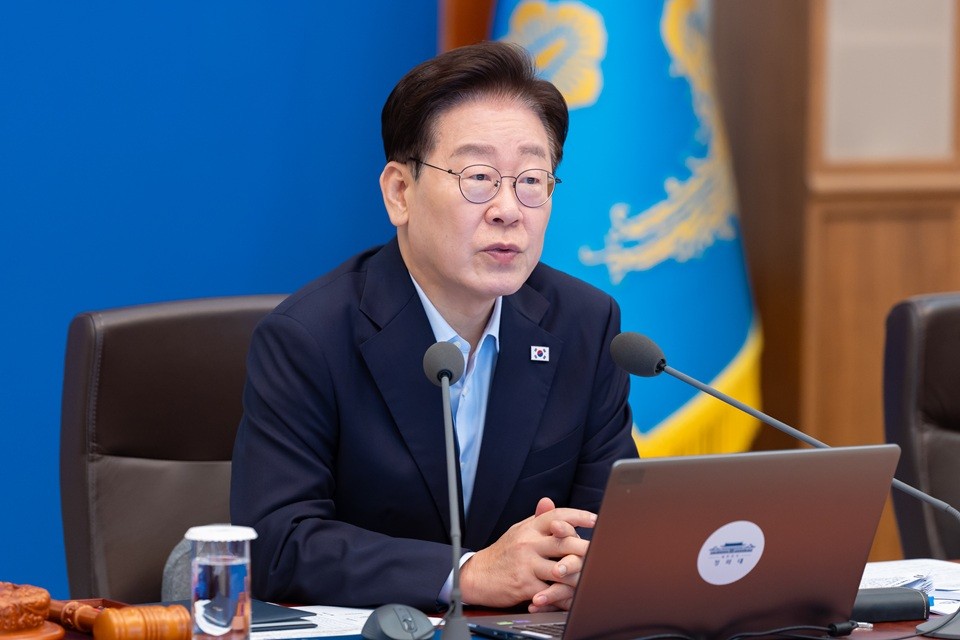
The President Is Posting About Customs Reports Now
South Korean President Lee Jae-myung did something unusual for a head of state in September: he took to X to celebrate a customs briefing.
On the 5th, Lee posted under the headline “Customs Chief Lee Jong-wook reporting,” sharing data that South Korea’s cumulative exports had already surpassed last year’s full-year record of $709.3 billion — and had done so 117 days earlier, in just 248 days. At $709.4 billion on the books, the country is now projecting it will cross the $1 trillion annual threshold by early December.
That would make South Korea only the fourth country in history to reach that benchmark, joining the United States, China, and Germany. The fact that the president personally amplified a customs report — a detail that would barely register as newsworthy in Seoul — signals how seriously the administration is treating this moment. It is not just a number. It is a strategic signal.
Why This Matters Beyond the Balance Sheet
$1 trillion in annual exports is not merely a GDP footnote. It is a structural threshold that marks a country as a first-order participant in global trade — not a dependent, not a niche supplier, but a systemic player. Only three countries have ever stood there. South Korea is about to join them, and the composition of its export basket determines what that membership looks like.
The difference between South Korea and, say, Germany, is the silicon factor. Germany’s export engine runs on machinery, chemicals, and automobiles — diversified, if cyclical. South Korea’s engine runs on semiconductors, display panels, and battery materials. Its export profile is narrower and more concentrated, which makes the $1 trillion milestone both more impressive and more fragile.
When Customs Chief Lee noted that the country has achieved this growth “amid protectionism, supply chain reorganization, and Middle East instability,” he was describing the exact conditions that should make export growth harder — not easier. That South Korea has grown faster than expected under those conditions points to something specific: demand for its core exports is outpacing the headwinds.
The Chip Question
Semiconductors account for roughly a third of South Korea’s total exports. That concentration is the story inside the story.
Samsung Electronics and SK Hynix have been racing to ramp production of high-bandwidth memory (HBM) and advanced DRAM, products that sit at the center of the AI boom. Every hyperscaler building GPU clusters needs HBM. Every Chinese AI firm looking to circumvent US restrictions needs whatever it can source through third parties. The demand curve for South Korean memory chips is steeper than the macro trade picture suggests.
South Korea’s decision to approve additional semiconductor investment — including what appears to be a push toward expanded fab capacity — is being read in Washington as a bet that this demand cycle will outlast the current uncertainty. If the bet is right, the $1 trillion milestone is the floor, not the ceiling. If it is wrong, the country becomes the poster child for overcapacity in memory chips.
The Tariff Angle Washington Is Underreporting
Here is what Western trade coverage is mostly missing: South Korea’s export surge changes the calculus for US tariffs.
The Trump administration has floated tariffs on South Korean imports, a move that would directly target the very sectors powering this export record — autos, steel, and increasingly, electronics components. But hitting Korean exports with tariffs at a moment when the country is on the verge of a historic milestone carries political risk for Washington too. Korea is a treaty ally hosting US forces. Its semiconductor industry is deeply integrated into US defense supply chains. Tariffs that disrupt that integration have second-order effects beyond trade balances.
The $1 trillion threshold gives Seoul leverage it has not had in years. It is no longer a country begging for exemption from tariff threats; it is a country that has proven it can deliver economic performance even when global conditions are adverse. That shifts the framing from “South Korea needs us” to “South Korea is essential to us.”
Whether that leverage translates into concrete tariff relief is another question. But the mere existence of the milestone forces the conversation.
Who Wins, Who Loses, What Comes Next
If South Korea crosses $1 trillion in December as projected, the immediate winners are the Korean chaebol whose export volumes drove the number — Samsung, SK Hynix, Hyundai Motor Group. The losers are competitors in Japan and Taiwan who were expected to capture the AI-memory demand surge and instead watched Korean capacity expand faster than anticipated.
For the United States, the outcome is ambiguous. A stronger Korean economy means a more reliable ally and a more resilient semiconductor supply chain. It also means a trading partner that is less willing to accept unfavorable tariff terms. The White House will have to choose between punishing Seoul economically or recalibrating its approach to allies who are doing exactly what Washington asks — producing chips, hosting bases, buying arms — while also pursuing their own economic interests aggressively.
The next six weeks will be telling. If the December target holds, expect Seoul to push harder for tariff exemptions and to frame its export success as evidence that open trade with allies works. If the number slips below $1 trillion, the political mood in Seoul turns sharply inward, and the US-Korea economic relationship resets on less favorable terms for Washington.
Either way, the president posting about customs reports on social media is a sign that Korea knows it is playing a different game now.