Koreas First Homegrown AI Chip Just Hit Production — What It Means
SK Telecom is running four AI services on a domestically made NPU from startup Rebellion, processing 4 billion tokens daily. It is a small but symbolic step in a global race for AI chip sovereignty that could reshape supply chain calculations.
The Numbers Behind a Small Milestone
SK Telecom is running four of its AI services on a chip made in South Korea. The processor, an NPU called Atomax from startup Rebellion, handles call summarization, voice synthesis, an AI customer service desk, and a scam-message detection tool called Scambanguard. It processes more than 4 billion tokens a day and fields roughly 14 million user requests daily. The deployment started in December 2025 with one function. By June and July 2026 it had expanded across all four services.
The headline figure — 4 billion tokens — sounds large. It is not yet in the range that would shake NVIDIA, whose datacenter GPU shipments move in volumes that dwarf this by orders of magnitude. But the point of the story is not scale. It is velocity. SK Telecom took about five or six months to integrate Atomax into A.dots in late 2025. When it added the next wave of services this year, the rollout took two or three months. That acceleration matters more than the raw token count.
Why an NPU, Not a GPU
Rebellion chose to build a neural processing unit specialized for inference rather than a general-purpose GPU. That is a deliberate architectural bet. Training and inference are different beasts. Training demands massive parallel throughput. Inference is about answering questions efficiently, token by token, often in real time. NPUs can do that work using less power and at lower cost per query than a GPU squeezed into a role it was not primarily designed for.
SK Telecom is not replacing NVIDIA across the board. It is using GPUs where training and heavy batch work still belong and routing inference-heavy customer-facing tasks to the domestic NPU. That split strategy is practical, not ideological. It also means Rebellion does not need to match NVIDIA on every benchmark. It only needs to win on the inference slice, where margins and latency are what operators actually measure.
The Sovereign AI Game Is Real
The broader context is what Washington and Beijing have been quietly preparing for. Anthropic CEO Dario Amodei recently argued that the pace of AI development should slow and that exports of advanced chips to China ought to be restricted. Whether or not you agree with that position, the direction of policy is clear: chip access is becoming a political lever. No country wants its AI stack held hostage by another country’s export controls.
That is why the term “sovereign AI” has moved from conference panel to government program in a surprisingly short time. According to an analysis by the Center for a New American Security reviewed by Dong-A Ilbo, NVIDIA supplied GPUs for 45 percent of the 117 government-backed AI infrastructure projects tracked globally as of late June. Forty-five percent is not a monopoly in the strict sense, but it is close enough to make any country with design ambition nervous.
South Korea is one of those countries. It has world-class chip designers, world-class memory makers, and a domestic telecom giant with real workloads. What it lacked until now was a commercially validated inference chip that could prove the loop from design to deployment inside a Korean company. Atomax just closed that gap.
The Next Step Is Harder
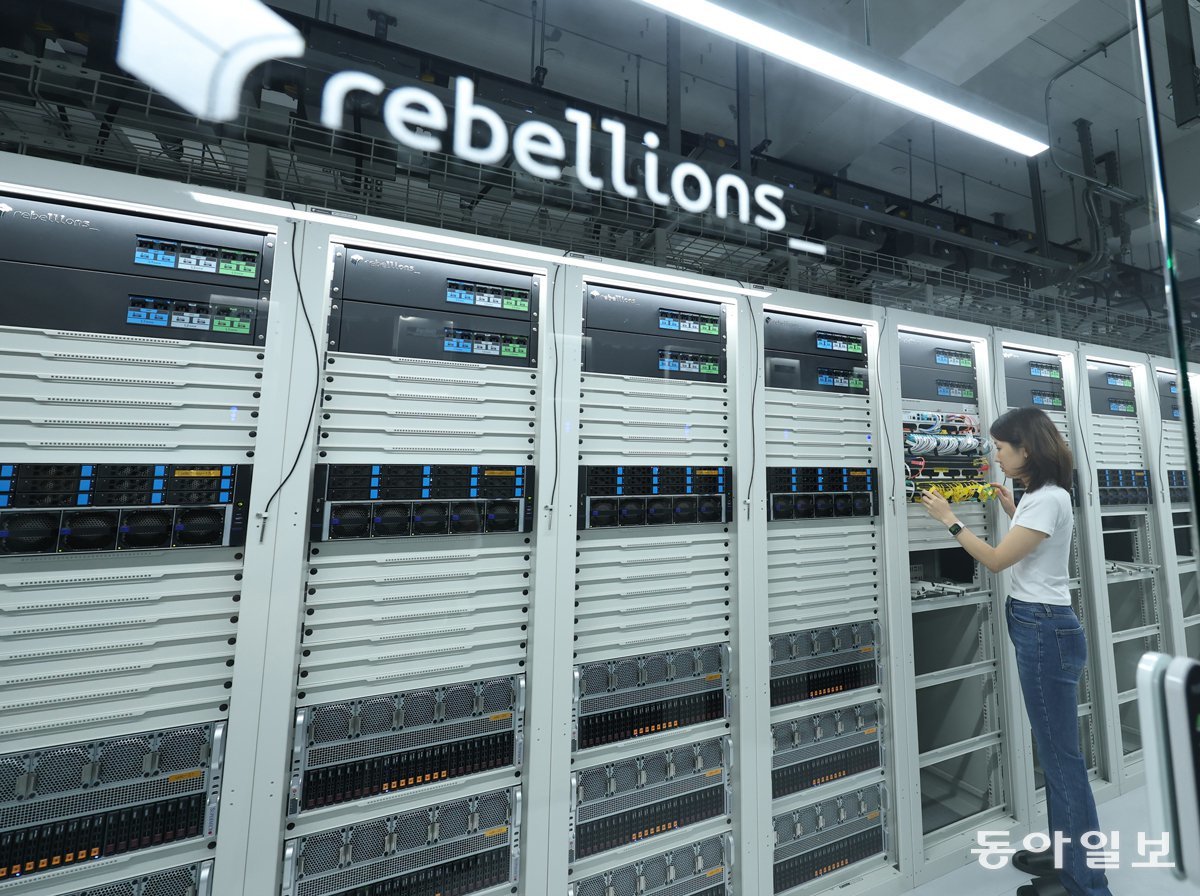
The next chip Rebellion is preparing is called Rebel 100. Dong-A Ilbo visited the company’s data center in Seoul’s Magok district on August 8 and found eight Rebel 100 units installed in a test server. The room ran at 77.5 decibels. Engineers needed to raise their voices to talk. After about 30 minutes the system recognized the cards and the chips loaded HBM3E high-bandwidth memory. The test rig is not yet in a customer production environment. It is in the phase where every bug is visible and every thermal issue is real.
Moving from a proven inference chip to a next-generation product that can scale is where most startups stall. Rebellion has crossed the first line. The second line is harder. It requires not just a working silicon sample but a supply chain that can deliver volume, firmware that keeps improving, and a software stack that does not force every customer to write custom drivers from scratch.
Who Wins, Who Loses, Who Watches
SK Telecom wins first. It gains a domestic supplier for a growing slice of its inference workload, reduces exposure to geopolitical chokepoints, and gathers operational data that no simulation can replicate. Rebellion wins second. Commercial validation is the currency that attracts further investment, talent, and partnerships.
NVIDIA does not lose anything today. Its customers still need GPUs for training, for multi-GPU clusters, for the heaviest inference loads. But the psychological effect is real. Every Korean company watching Atomax run at scale is now measuring its own exposure and asking whether a domestic alternative could cover part of its stack. That question alone shifts the negotiating table.
The Chinese chip sector watches carefully. SMIC, Hygon, and others are building inference-capable accelerators under their own export-control constraints. A Korean NPU that proves useful at scale gives Seoul leverage in any future negotiation about technology transfers or regional chip alliances. It also gives Beijing a reference point for what a non-U.S. inference accelerator can look like in production.
The Real Risk: Backing Out
The most honest assessment comes from KAIST professor Yu Hoe-jun, who told Dong-A Ilbo that an AI ecosystem built entirely on foreign chips is vulnerable to whatever the supplier decides to change. Professor Kim Yong-seok of Catholic University warned that Korea can design AI semiconductors but lacks the follow-through in mass production and commercialization. Both warnings point to the same structural problem: building a chip is easy compared to sustaining a commercial ecosystem around it.
The risk is not that Rebellion fails. The risk is that momentum stalls because the next deployment does not happen fast enough, or because the software toolchain cannot keep up, or because the economics stop looking compelling once volume ramps. A single successful product does not make a semiconductor industry. It makes a possibility.
What to Watch Next
Three signals will tell you whether this is a one-off project or the start of a trend.
First, whether SK Telecom expands Atomax and Rebel 100 to additional services beyond the current four. The integration timeline is already shrinking. If the next round drops in under two months, the ecosystem is learning faster than expected.
Second, whether Rebellion signs other domestic customers. SK Telecom is a strong reference, but one anchor tenant is not a market. A second major Korean company — a bank, a cloud provider, a manufacturer — adopting the chip would confirm that the value proposition travels beyond one company’s data center.
Third, whether the chip earns certification or inclusion in any Korean government sovereign AI procurement list. Public-sector buying is how countries accelerate domestic semiconductor adoption, and South Korea has shown it is willing to use public demand as industrial policy.
The Bottom Line
South Korea’s first homegrown AI chip is no longer a lab prototype. It is running real services, processing billions of tokens, and shrinking its integration cycle month over month. That is not yet a challenge to NVIDIA’s dominance. It is a crack in the assumption that the dominance is uncontestable. In the politics of AI infrastructure, cracks are where strategy starts.