Korea's Labor Wave Hits Hyundai — and Global Auto Supply Chains
Hyundai Motor's 17th round of labor negotiations risks escalating into industry-wide strikes as Kia joins the pressure. What's at stake: retirement age, performance pay, and a supply chain ripple that could reach Europe and North America.
The 17th Negotiation That Could Define a Season
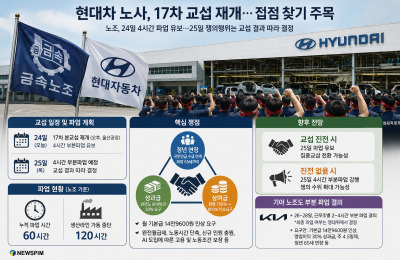
Hyundai Motor and its union reconvened on August 24 at the Ulsan plant for the 17th round of main labor negotiations. The union suspended its planned four-hour partial strike that day, buying both sides a narrow window. But the real test arrives tomorrow: if the talks produce nothing meaningful, a second wave of walkouts begins. And this time, it won’t just be Hyundai.
Kia’s union already voted on August 22 to launch its own partial strikes starting August 26, demanding the same package — a base wage increase of 149,600 won per month, performance pay equal to 30 percent of last year’s operating profit, a raise of the bonus scale from 750 percent to 800 percent, and retirement age extension to 65 tied to National Pension eligibility. The overlap is not coincidental. This is a coordinated push across Korea’s automotive sector, and it carries implications far beyond Ulsan and Hwaseong.
The Numbers That Matter
Hyundai’s cumulative strike time this year has hit 60 hours. Production line shutdowns total 120 hours. The industry estimates the output loss at roughly 55,200 vehicles and revenue impact exceeding 2.3 trillion won — calculated using an hourly output rate of approximately 460 units and an average selling price per vehicle. Those are conservative figures. They do not yet account for any new walkouts that may follow.
The full-scale strike on August 21 was the first at Hyundai since 2016. That detail matters because it signals how much patience has eroded. When a company that prides itself on labor-management cooperation resorts to its first general strike in a decade, the underlying tension is structural, not cyclical.
Three Flashpoints, One Strategy
The core demands cluster around three issues, each one harder than it looks on paper.
Performance pay. The union wants 30 percent of prior-year net profit distributed as variable compensation. Hyundai’s management has signaled this is non-starters at that level. The gap is not rhetorical — it is mathematical. A 30 percent profit-share commitment would restructure the entire compensation framework and set a precedent across the chaebol system. No Korean automaker wants to be the first to break that ceiling unilaterally.
Retirement age. The union is pushing for extension to 65, linked to when workers become eligible for the national pension. Hyundai’s position is straightforward: the government and ruling party are currently legislating mandatory retirement age extension. Why make a corporate commitment before the law changes? The logic is sound, but it ignores the political reality. Legislation in Seoul moves slowly, and the union has every reason to believe that waiting for parliament is a strategy for losing.
Bonuses. The jump from 750 percent to 800 percent — referring to the bonus multiplier relative to base pay — sounds incremental. In absolute terms across Hyundai’s workforce, it is not. This is where the cumulative cost of the demands becomes visible.
Why POSCO Matters
The suggested angle mentions POSCO, and it should. Korea’s labor movement does not operate in silos. When autoworkers strike, steelworkers watch. When steelworkers gain ground, autoworkers use it as leverage. POSCO’s own labor tensions, when they surface, compress the timeline for every other negotiation in the industrial ecosystem. Hyundai’s supply chain runs through POSCO steel. A coordinated pressure campaign across both sectors would be catastrophic for delivery schedules — not just in Korea, but at Hyundai’s plants in Alabama, Hungary, and India.
Who Wins, Who Loses, What Comes Next
If Hyundai and Kia reach a deal before the strikes intensify, both companies absorb higher labor costs into a year already strained by EV margin pressure and Chinese competition. The winner is the labor movement — it gains proof that coordinated sector-wide demands can extract concessions even from Korea’s most profitable manufacturers. The loser is the company’s cost structure, which was never designed for this kind of wage-profit sharing model.
If talks break down and strikes expand, the losses spread outward. Hyundai’s export pipeline — particularly the Ioniq electric models destined for Europe and North America — faces disruption. Inventory buffers exist, but they are thin. Dealers in Germany and California who are already waiting for allocation shifts will feel it first. Chinese EV makers, meanwhile, watch with interest. Every week of Korean production uncertainty is a week where BYD and Geely gain shelf space in third-party markets.
The most likely outcome sits somewhere in between. Both sides have exhausted enough goodwill that a messy compromise is more probable than a clean breakthrough. Expect a smaller-than-demanded wage increase, a phased approach to retirement age, and performance pay structured around future profitability targets rather than past profits. The strikes will likely narrow rather than expand. But the template — sector-wide coordination across Hyundai, Kia, and potentially POSCO — will endure long after these specific numbers are settled.
That template is the real story here. The 17th negotiation round on August 24 was not an endpoint. It was a pressure valve. And the valve is still leaking.