Korea's New Probe Chief's 38B Won Fortune Raises Questions
Kim Ji-yong, nominated to lead South Korea's new Major Crime Investigation Agency, has declared 38 billion won in assets — including two apartments in Pangyo — amid political backlash over his prosecutorial background.
A Prosecutor’s Fortune Steps Into the Spotlight
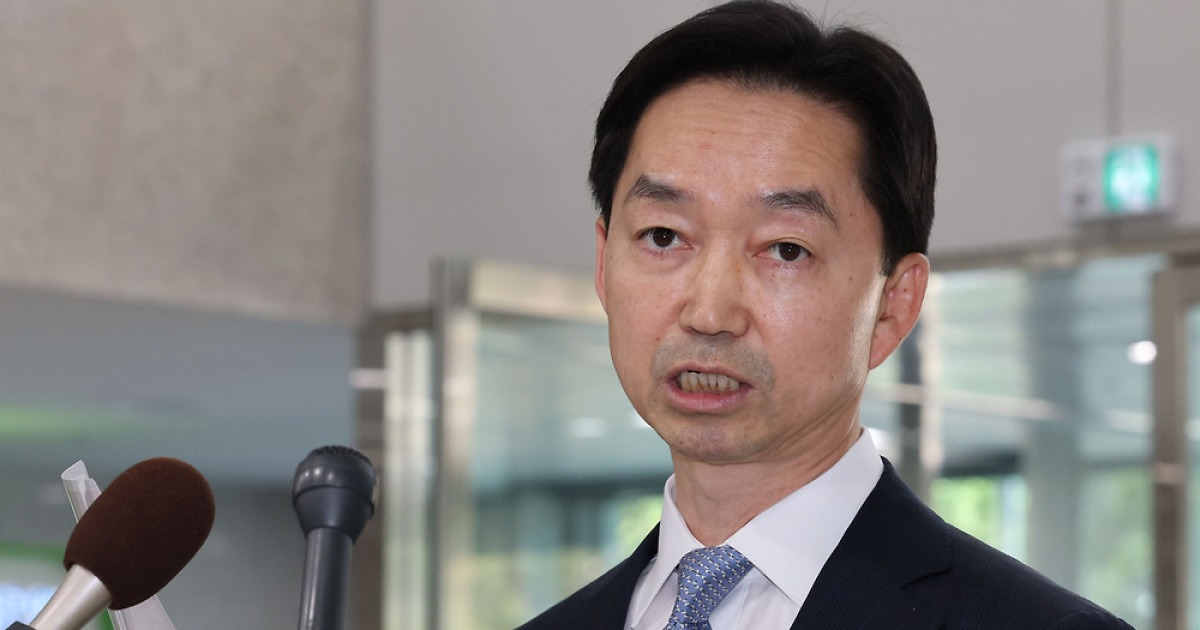
Kim Ji-yong stood before reporters at the Government Seoul Complex in Jongno on October 2, 2026, and said he would embody the spirit of prosecutorial reform. Two days later, a fuller picture of the man tasked with leading South Korea’s new Major Crime Investigation Agency emerged — and it carries the weight of 38 billion won.
The asset declaration, submitted to the National Assembly as part of his nomination hearings, reveals a man built from the very establishment he now claims he will reform. He owns two apartments in Pangyo, Gyeonggi Province — one held solely in his name valued at 1.174 billion won, another jointly with his wife at 1.74 billion won. He and his spouse also hold a jeonse (long-term lease) right on an apartment in Seocho-gu, Seoul, worth 1.45 billion won. Combined with bank deposits of 285.62 million won in his name and his wife’s holdings — 913.16 million won in deposits, 123.08 million won in stocks, and 26.04 million won in virtual assets — the total lands squarely at 3.8 billion won.
To the average South Korean, where median home values in Pangyo rank among the highest outside central Seoul, this is not outrageous wealth. But it is precisely the kind of comfortable, property-anchored prosperity that defines the Korean prosecutorial class — the very institution that has long operated with near-insular authority and faces mounting demands for accountability.
The Political Minefield
President Lee Jae-myong named Kim as the first chief of the Major Crime Investigation Agency on grounds that his 24-year career across special investigations, criminal prosecution, and trial management made him the right person to lead an agency designed to investigate high-profile corruption and organized crime with fresh independence.
But the Democratic Party’s hardline faction has refused to back the appointment. They have branded Kim a “pro-Yoon prosecutor” — a label meaning he is perceived as sympathetic to former President Yoon Suk Yeol, who was removed from office in 2025 after a turbulent tenure marked by his own clashes with the prosecutorial establishment. Lee fired back on X late on September 30, pointing out the contradiction in dismissing all prosecutors simply because of their background: “If we throw out every prosecutor, what about Rep. Park Eun-jeong, Chief Prosecutor Lim Eun-jeong, and Rep. Lee Seong-yun? They are all prosecutors or former prosecutors. What happens to them?”
The exchange reveals the core tension. The Major Crime Investigation Agency was created as a reform measure — an attempt to strip the Prosecutors’ Office of its legendary investigative monopoly and create a body answerable to civilian oversight. Yet the person handed the keys to that new institution is a career prosecutor who rose through its ranks to become a senior vice chief of the Supreme Prosecutors’ Office before leaving for private practice in September 2023.
Who Lives in Pangyo — and What It Signals
Pangyo, in southern Seongnam, is one of Korea’s most expensive residential corridors. It sits at the heart of the country’s technology belt — home to major corporate headquarters, startups, and the expatriate professional class. An apartment there is not merely a home; it is a symbol of having navigated Korea’s fiercely competitive meritocratic ladders and emerging on the winning side.
Kim’s portfolio — two units in Pangyo plus a jeonse right in affluent Seocho-gu, where the Constitutional Court and several major law firms cluster — maps directly onto that trajectory. The prosecutor who spent decades working inside the system now holds property in the neighborhoods where the system’s most powerful players live and work.
This is not unusual. Korean prosecutors routinely accumulate real estate as they climb the career ladder, and Pangyo has become a standard destination for those who reach the upper ranks. What makes Kim’s disclosure noteworthy is the timing: he is about to take charge of an agency whose mandate includes investigating cases involving people who look exactly like him — wealthy, well-connected, and embedded in the same institutional networks.
The Stakes for Korean Institutions
The Major Crime Investigation Agency is still finding its footing. Its first chief will set the tone for how aggressively it pursues cases that previously fell under prosecutorial control — corruption scandals, chaebol wrongdoing, political crime. The agency’s credibility depends on being seen as independent, not as the prosecutorial establishment wearing a new uniform.
Kim’s defenders argue that his record speaks for itself: he handled high-profile special investigations, served as head of the Seoul Central District Prosecutors’ Office’s trial division, and ran the Busan Western District Prosecutors’ Office. His career suggests someone who understands the machinery from the inside. His critics say that is precisely the problem — an insider cannot be trusted to dismantle the privilege his entire life has depended on.
The asset declaration does not answer that question. Thirty-eight billion won is enough to make any reformist institution’s independence look questionable from the outside. It is also, by Korean standards, modest. A chief justice of the Supreme Court typically holds closer to 100 billion won. A mid-tier chaebol chairman holds ten times that.
What matters is not the absolute number but the perception: a man tasked with breaking the prosecutorial monopoly arrives with a portfolio that signals he benefited from it.
What Comes Next
The National Assembly’s screening process will determine whether Kim takes the post. The hardline Democrats hold enough seats to force a showdown if they choose. President Lee has staked political capital on the appointment, framing it as a test of whether reform can survive institutional resistance.
Either way, the asset declaration has already shifted the conversation. The question is no longer whether Kim understands the prosecutorial world — he clearly does. The question is whether a man who thrived in that world can now rebuild something that constrains it.
South Koreans watching from Pangyo, from Seocho, and from everywhere else will be weighing that against their own mortgage statements and their own doubts about whether institutions ever truly change hands.