Korea's Mayor Demands Rentals From Neighbors While Skipping His Own
Gwangmyeong Mayor Park Seung-won ordered redevelopment districts to add public rental housing — while his own building reserves just 2.4% for it, half the regional average. The hypocrisy is a lens into how housing reform in dense East Asian cities keeps privileging owners over renters.
A mandate handed down, a double standard left uncovered
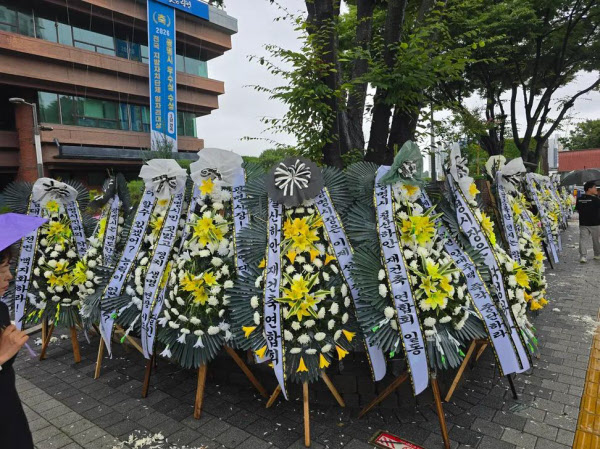
Gwangmyeong City Hall recently became the site of an unusual protest: mourners’ wreaths, the kind typically reserved for funerals, displayed on its lawn. The message was blunt — the mayor is trying to extend his political life by trampling citizens. The target is Park Seung-won, the Democratic Party mayor of Gwangmyeong, a city in Gyeonggi Province just outside Seoul.
Park sent official correspondence to redevelopment committees in the Cheolsan and Hahan districts, ordering them to reflect public rental housing in their maintenance plans. His justification rested on a technicality: when the district plan was gazetted in March 2024, these sites were granted the ability to apply overlapping floor area ratio (FAR) up to 330%, well above the 280% ceiling. Since residents received this policy benefit, he argued, they owed something back in public rentals.
The residents of Gwangmyeong heard a different story. They said the original plan never mentioned public rentals. The directive arrived late, after years of planning, and now threatens to disrupt project viability, add months or even a year to timelines, and inflate financing costs for complex associations already operating on tight margins.
Complex 5 of the Hahan Jugo site is holding its general contractor selection bid on August 26. For those teams, the new requirement is not a theoretical policy exercise — it is a fire on their doorstep.
The numbers that turned policy into scandal
What made Park’s order personally explosive was not abstract — it was mathematical.
According to the South Korean government’s public ethics reporting system, Park owns a 84-square-meter unit in Cheolsan The Heritage, a redevelopment complex that replaced the old Cheolsan Jugo 8th and 9th complexes. The building rises to 40 floors across 23 towers with 3,804 units. He moved in last May after purchasing the allocation right for 565.55 million won and taking a 565.55 million won loan from agricultural cooperative banks.
The unit is worth roughly 977 million won today. In July, allocation rights for the same building traded at 1.92 billion won — pushing the property into the so-called 2 billion won club, a status that signals prestige in Korea’s housing hierarchy.
Here is the detail that turned outrage into ridicule: Cheolsan The Heritage contains only 92 public rental units. That is 2.4 percent of total housing. Park’s own building sets a rental ratio that is roughly half what nearby complexes are delivering.
Truus Gwangmyeong, completed in 2024 with 3,344 units, includes 168 rental units — 5 percent. Gwangmyeong Central I’Park, delivered in 2025 with 1,957 units, has 105 rentals — 5.3 percent. Gwangmyeong The Sharp Foresta, a 2025 completion with 3,585 units, dedicates 217 units, or 6 percent, to public rental.
Park did not request that his own development increase its rental share. He asked everyone else to do so. Residents noted the discrepancy openly. Wreaths followed.
Who benefits, who pays, and why it looks like politics
Park is a three-term mayor. Under South Korea’s term limits, he cannot seek re-election. Political analysts at home read his rental mandate as a bid for favor with the Jae-myung Lee administration’s housing supply agenda — an agenda that could determine whether Park secures his party’s nomination in Gwangmyeong-gap, the constituency where his own apartment sits. To win that nomination, the logic goes, he needs to deliver visible results on national housing policy, even if the delivery falls on his neighbors.
That reading is not settled fact. But it explains timing. A policy shift arriving after years of quiet planning, targeting districts where Park seeks political credit, while sparing his own portfolio — that sequence invites suspicion.
Residents are pushing back harder than most local governments anticipate. Twelve redevelopment sites in the Cheolsan and Hahan area have signed a joint statement demanding both project viability guarantees and withdrawal of the rental requirement. Complex 13 in Cheolsan Jugo leads the signature drive with 1,605 endorsements — the highest count — and has spoken publicly about the damage a retroactive mandate would cause.
The association argued that the city held resident explanation sessions in which the maintenance plan was presented without any public rental component. They want transparency first: an accounting of what the additional rental requirement would cost member households, followed by deliberation before enforcement.
The larger pattern: reform that asks residents to pay, not owners to yield
The Gwangmyeong dispute is not an isolated failure of administrative communication. It reveals a recurring structure in East Asian housing policy: reforms that extract contributions from current residents while leaving the policy architecture itself unexamined.
South Korea has long relied on a mechanism known as “additional burden contributions” — fees levied on redevelopment projects when public benefits such as parks, roads, or affordable housing are required. These contributions can reach one billion won or more for large complexes, as industry sources have reported in the Gwangmyeong case. The money funds public goods, yes. But the cost is absorbed by household-level associations that are already shouldering construction risk, financing costs, and the uncertainty of multi-year timelines.
The result is a system where the people expected to finance housing reform are the people who already own homes in high-density urban areas — typically middle-income households who bought into redevelopment promises under older rules and now face new obligations retroactively applied.
This pattern repeats across the region. In Tokyo, rezoning negotiations often require developers to set aside a small share of units for municipal housing, but the burden falls on future buyers rather than on existing landowners or taxpayers. In Hong Kong, the land lease renewal system extracts premiums from residents while the state controls the supply pipeline. The common thread is structural: reform costs are distributed downward, onto those with vested property interests, while the policy lever remains controlled by officials whose portfolios are insulated from the same constraints.
What happens next
The immediate consequence for Gwangmyeong residents is delay and expense. Adding public rental units requires revising maintenance plans, running new approval procedures, and absorbing higher construction costs. Complexes at the contractor-selection stage face the steepest disruption, since bidding assumptions will shift mid-process.
The political consequence is less certain. Park’s mandate has generated visible resentment. Wreaths at city hall are a symbolic act with real local meaning — they signal that residents view the policy not as governance but as self-preservation. If Park seeks a legislative seat or party leadership role, the Gwangmyeong episode will be part of the record. If he does not, the policy may survive him even as the backlash fades.
The policy consequence could be broader. If the federal government or the Gyeonggi provincial administration endorses Park’s interpretation — that overlapping FAR grants automatically create a retroactive rental obligation — other cities will follow. Developers and resident associations across South Korea’s dense urban corridors will recalculate project economics under a new assumption: that past approvals are not final, and that new policy requirements can attach to old concessions.
That assumption, if adopted widely, would change the calculus of every redevelopment project in the country. It would make financing more expensive, timelines longer, and resident associations more risk-averse. The short-term gain for public rental supply could be offset by a longer-term chill on redevelopment activity — the very mechanism that has produced much of Korea’s recent housing stock in high-density neighborhoods.
Why this should matter outside Korea
Gwangmyeong is a mid-tier city, not the epicenter of South Korea’s housing market. That is precisely why the story matters.
Cities like Gwangmyeong sit in the gravity well of Seoul, absorbing commuters, stretching infrastructure, and managing redevelopment pressure without the fiscal capacity or political insulation of the capital. When mayors in these satellite cities attempt policy experiments — even well-intentioned ones — they expose the friction between national housing agendas and local realities.
The rental mandate in Gwangmyeong is not inherently unreasonable. Public housing shortages are a structural problem across East Asia, and extraction mechanisms like overlapping FAR have always carried implicit social obligations. The problem is the asymmetry: a mayor asking neighbors to increase their rental share while his own building remains at 2.4 percent is not merely an administrative misstep. It is a signal that the people designing reform are not subject to its harshest terms.
That signal travels. It travels to Tokyo, where similar debates over developer contributions and public housing quotas play out in districts with their own political economies. It travels to Hong Kong, where the tension between state revenue extraction and resident welfare is even more acute. It travels to any city where housing policy is negotiated between officials with secure portfolios and residents who bear the cost of every new mandate.
The residents of Gwangmyeong have put their grievances in writing and on display. Whether the policy reverses, persists, or mutates into something else depends on political calculus, not justice. But the record they have created — wreaths, signatures, spreadsheet comparisons of rental ratios — is itself a form of accountability that outlives any single election cycle.