Why the Memory Supercycle Isn't Ending Despite AI Doubts
Korean memory giants face spooked markets over AI capex fears, but their long-term supply contracts and controlled expansion strategy form a thicker shield than Wall Street appreciates.
The Noise Is Loud. The Foundation Is Stiffer Than It Looks.
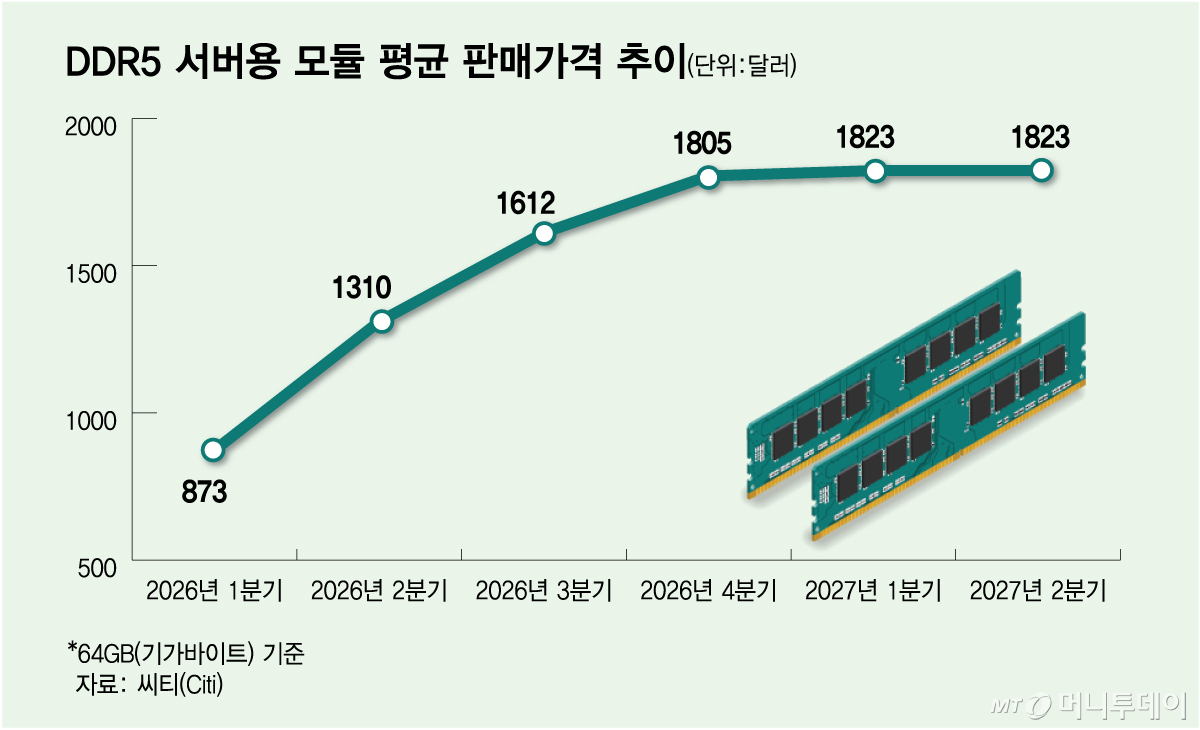
A single line item in a recent Citi research note did enough to set alarm bells ringing across semiconductor desks this week. Server-grade DDR5 64GB RDIMM contract pricing was expected to climb just one percent next quarter, a blunt contrast to the 361 percent surge recorded this year. Spot prices peaked at roughly $3,300 in September before sliding back toward $2,000. Meanwhile, SemiAnalysis cut its 2028 global AI accelerator spend forecast by 28 percent, and Trump administration tax threats on overseas datacenter construction added another layer of political friction.
Taken together, the picture looks like the end of a memory supercycle. And for investors watching NASDAQ semiconductor ETFs and the TSMK-Samsung correlation, that framing matters.
But the conventional reading here conflates short-term spot pricing with structural demand. The two are diverging — and that divergence is precisely where Samsung Electronics and SK Hynix hold their strongest cards.
Contract Prices Have Floor Support. Spot Prices Do Not.
What makes current market panic misleading is the gap between two parallel pricing tracks. Spot prices react to near-term sentiment — orders delayed, inventory rebalancing, speculative positioning. Contract prices under long-term supply agreements, which now cover well over half of both companies’ planned output, move on fundamentally different logic.
Goldman Sachs calculated that general-purpose DRAM prices would need to fall 32 to 54 percent below base-case assumptions before any customer found it economically rational to walk away from a locked-in LTA. Even in a worst-case breach scenario, net revenue impact is estimated at 3 to 10 percent after factoring in upfront payments, product reallocation, and replacement sourcing timelines.
In plain terms: the contractual floor exists. The spot-market turbulence above it is real, but it does not erase the underlying commitment structure.
Why HBM Changes the Supply Equation Forever
A detail easily missed outside Seoul is the wafer-intensity problem that HBM introduces. High-bandwidth memory demands significantly more silicon wafers per unit of output compared with standard DRAM. Every additional HBM stack pulled to satisfy NVIDIA or AMD supply queues consumes capacity that would otherwise feed general-purpose server modules.
That dynamic, rather than creating excess, tightens overall DRAM supply availability going into next year. Analyst consensus inside the Korean industry leans toward worsening shortage conditions through 2027, precisely because the mix shift toward HBM restricts conventional memory growth even as absolute demand climbs.
Citi projects HBM average selling prices could roughly double next year, lifting overall DRAM pricing by 35 percent — a figure that already assumes softer general-purpose demand. If HBM outpaces those expectations, the upside revision sits above the street number, not below it.
Capacity Discipline Is the Real Moat
Samsung and SK Hynix are not repeating the mistake that defined earlier memory cycles: building aggressively during boom periods and being left holding expensive idle fabs during busts. Both companies have shifted to staged fabrication construction, pacing equipment installations and building timelines against confirmed order intake rather than projected demand curves.
The operational lever is straightforward. When demand weakens, you slow the crane, delay the tool shipment, and extend the payoff horizon without canceling the project. This flexibility materially reduces fixed-cost exposure and softens the price decline that historically amplifies each cycle bottom.
An industry executive told Money Today that both companies are monitoring demand shifts closely and will actively decelerate fab builds and equipment receipts if signs of weakness appear. That kind of supply management did not exist in previous cycles.
Who Wins, Who Loses, and What Comes Next
For Western institutional investors who bought the “memory supercycle extension” narrative without understanding its contractual scaffolding, the near-term volatility will be uncomfortable. The DDR5 spot signal is undeniably negative. Consumer DRAM and NAND prices are already falling. AI infrastructure skepticism is growing among venture and public-market allocators alike.
But Samsung and SK Hynix are positioned differently than previous-cycle incumbents. Their LTA coverage exceeds 50 percent. Their pricing floors absorb moderate spot deterioration. Their HBM-dependent supply constraint tilts future DRAM balance sheets tighter rather than looser. And their ability to pace capital expenditures reactively gives them a buffer that pure-play competitors lack.
The losing side is anyone treating next-quarter spot pricing as a proxy for annual earnings power. The winners are the buyers of those long-term contracts — the hyperscalers and server OEMs who secured allocation during the trough and now hold it through whatever volatility comes next.
What happens next depends largely on whether the SemiAnalysis downward revision becomes a trend or a blip. If AI accelerator spend stays closer to the revised $780 billion trajectory through 2028, demand remains ample to sustain HBM dominance and keep DRAM structurally supported. If the revision proves premature and spending accelerates again, the entire question flips — and the companies that managed supply discipline will look prophetic rather than cautious.
Either path favors scale players with contractual cover and flexible capex. It does not favor traders watching spot charts.
A Note on Context Western Readers Miss
Korean memory manufacturers do not compete on spot-market agility. They compete on relationship durability, allocation certainty, and manufacturing scale. Western analysts often evaluate these stocks using commodity-cycle frameworks that undervalue exactly those structural advantages. The result is periodic mispricing whenever spot data disappoints — which is what appears to be happening right now.
The supercycle is not over. Its rhythm has simply changed. And the companies that understood that distinction first will be the ones trading accordingly.