Koreas Nuriro Success Rate Hits 80 — The Real Story Is What Comes Next
South Korea's fifth Nuriro launch hit an 80 percent success rate, confirming indigenous launch capability. But the real question isn't whether it works — it's whether Seoul can cross the 90 percent threshold that unlocks the global commercial market.
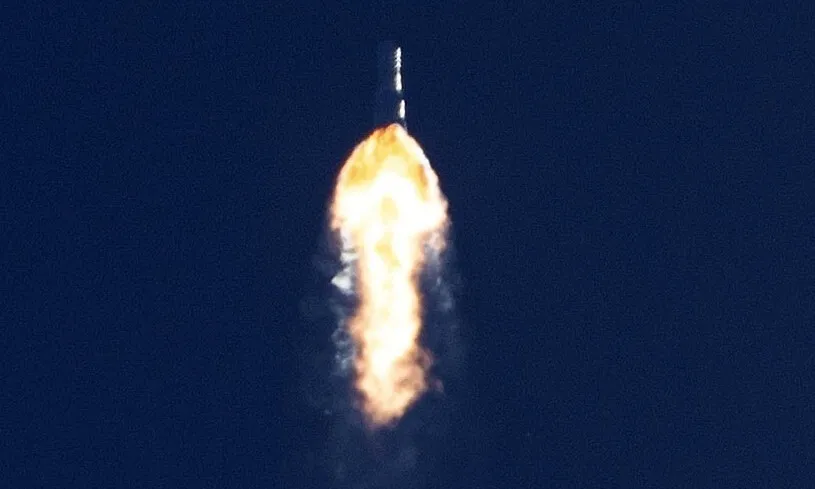
The number that matters is eight zero.
South Korea’s Nuriro reached an 80 percent success rate after its fifth launch on July 7, a milestone that quietly reorders the regional balance of space access. The rocket lifted off the Naro Space Center in Goheung at precisely 12:25 PM — the first time in its history it flew on schedule without a single delay — and placed fifteen satellites, including five primary mini-constellation payloads, into a 576-kilometer orbit. All five primary satellites subsequently confirmed contact with ground stations, starting with Neoneushat-6 at the Sejong Station in Antarctica at 1:08 PM.
One of the ten CubeSats, however, sent a separation command but never actually detached. The launch vehicle itself completed its mission. The satellite deployment did not.
This is not a failure. It is data. And it is the kind of data that separates nations that pretend to have space access from nations that actually do.
Eighty percent puts Korea in a narrow club.
Eighty percent cumulative success is a specific threshold in orbital mechanics. It means a launch system has moved past the developmental stage where every flight teaches you something new and entered the operational stage where reliability is becoming predictable. The only countries with regularly scheduled indigenous orbital launch capability at comparable rates are the United States, Russia, China, Japan, India, and Israel. Korea’s entry into this group was previously provisional. The fifth launch makes it substantive.
Japan’s H3 program has been far more public about its struggles, suffering multiple failures and cost overruns that pushed its schedule into disarray. China launches frequently but predominantly carries state payloads. India’s success rate is strong but its commercial pricing and orbit flexibility remain constrained. Korea now sits in a position where it can credibly offer both government and commercial launches without depending on a foreign launcher — something no Southeast Asian or Middle Eastern buyer ever had to consider before.
The 90 percent problem.
Oh Tae-seok, director of the Korea Space Administration, stated plainly that the next target is 90 percent. That is the number that matters for one reason alone: commercial contracts. The global commercial launch market does not tolerate eighty percent. Insurers will not underwrite customer satellites at that rate. Operators will not commit to constellation deployments when there is a one-in-ten chance their payload stays in the atmosphere or falls apart in transit. The margin between eighty and ninety percent is where national pride ends and market reality begins.
South Korea currently has roughly five successful flights out of six attempts. To reach ninety, it needs to win its next four or five launches without a single failure — or, more realistically, lose no more than one of the next ten. That is achievable. It is also the exact stretch where most new launch programs stall. The U.S. Falcon 9 spent years in this zone before achieving the kind of reliability that made SpaceX dominant. Korea is early in the same curve.
The first on-schedule launch changes nothing and everything.
Flight controllers executed the July 7 launch at the originally planned time with no delays. This sounds like a procedural detail. It is not. Launch windows are rarely flexible because they depend on orbital mechanics, weather, range safety, and the coordination of multiple ground stations across time zones. Hitting the exact window means the entire ecosystem — telemetry, tracking, meteorology, ground control, range operations — is mature enough to stop improvising and start repeating. That maturity is what commercial buyers actually purchase. They are buying predictability, not rocketry.
The CubeSat that stayed on the pad.
The one undeployed CubeSat is worth noting because it reveals where Korea’s launch system still has loose edges. The separation command was sent. The mechanism did not respond. The ejection door or latch failed to open. This is a secondary payload issue, not a primary one, and the Nuriro vehicle completed its mission. But for a program seeking commercial credibility, every anomalous data point is a liability until it is understood and resolved. The space agency has acknowledged this as a separate investigation item. How quickly and transparently they release findings will shape buyer confidence more than any successful deployment.
Who wins and who loses.
Korea wins immediate strategic autonomy. For years, Seoul depended on foreign launch providers or accepted subordinated slots on other nations’ rockets. That era is over. Hyundai Aerospace, which is absorbing technology transfer from the government program, now holds a product with proven flight heritage and a growing success rate. Southeast Asian buyers — Indonesia, Vietnam, Thailand — who have historically rented fairings on European or Japanese rockets may now have a closer, cheaper, faster option. The pricing advantage of a Korean launcher versus a European Ariane or Japanese H3 flight is not marginal. It is structural.
Japan loses narrative dominance in the region. Tokyo has spent years positioning itself as East Asia’s space leader. Korea’s fifth successful launch complicates that story in ways that matter to investors and governments, not just engineers. China loses nothing — it launches far more frequently and carries heavier payloads — but the symbolic weight of another indigenous launcher in the region shifts the calculus for countries that have been hedging between Beijing, Tokyo, and Washington.
The timeline ahead.
The Korean government has framed the current phase as one of repeated launches to build trust, alongside technology transfer to Hyundai Aerospace. That transfer is not ceremonial. Hyundai is the entity that will produce future variants, manage commercial contracts, and ultimately carry the Nuriro brand into the global market. The timeline for competitive pricing and orbit flexibility is measured in launches, not years. Five more successful flights would likely push the success rate past eighty-five. Ten would cross the line where commercial buyers start asking serious questions rather than politely watching from the sidelines.
The Nuriro has now proved it can fly, it can carry more satellites than any previous Korean launcher, and it can do so on schedule. What remains unproven is whether it can do all of that reliably enough for the market to pay for it. That is the gap between eighty and ninety percent — and the distance between a national achievement and a commercial enterprise.