Korea's Robot Gamble: Chinese Bodies, American Brains, a Path to Market
South Korea's humanoid robot research runs on Chinese hardware and American chips. But a US import ban on Chinese robots creates a narrow opening — if Seoul can move from assembly to sovereignty before the window closes.
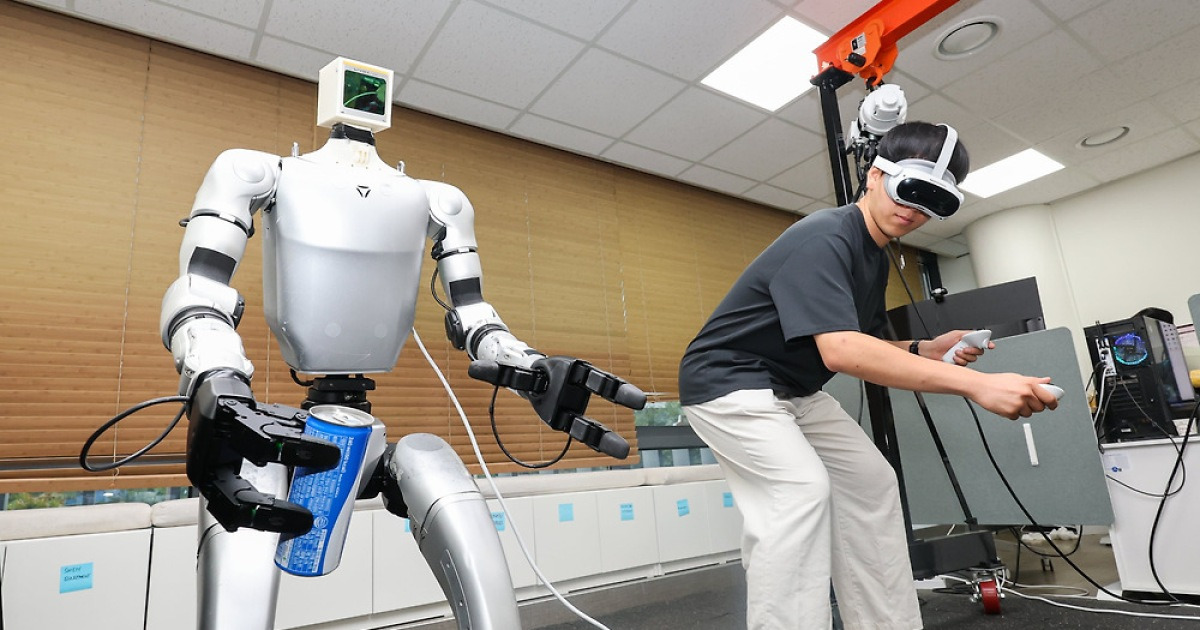
The hybrid robot on KAIST’s lab floor tells the story of Korean robotics in 2026.
A 130-centimeter humanoid picks up a beverage can and drops it in a trash bin, mirroring the movements of a researcher wearing a VR headset. The robot’s body is a Chinese-made Unitree G1. Its brain is an American Nvidia Jetson Orin computer. The software intelligence — navigation, whole-body manipulation — is Korean.
This is the default configuration at South Korea’s most prominent robotics lab, and it reveals a structural problem that goes far deeper than one research paper.
Korea’s humanoid market share: 1 percent
The Korean government has staked its ambition on becoming a global leader in physical AI. In June, it grouped semiconductors, AI data centers, and physical AI into three mega-projects, pledging 504 billion won ($360 million) by 2030 in partnership with LG Electronics and other domestic firms. The slogan is bold. The reality is fragile.
According to industry estimates, South Korea holds roughly 1 percent of the global humanoid robot market. The company that dominates that market is Unitree, a Chinese firm that accounts for an estimated 97 percent of worldwide humanoid shipments. The gap is not incremental — it is generational.
KAIST associate professor Park Dae-hyung puts it plainly: domestic humanoid robots simply do not yet have the operational track record to serve as research platforms. Korean-built robots like Robotis’s Sapience and the earlier Hubo2 models are available, but they are expensive, their software ecosystems are immature, and researchers need immediate results. Chinese robots ship with open SDKs, extensive community code, and ready-made experimental data. “You can start an experiment the day you receive the unit,” Park says. That convenience, more than price, is what locks Korean labs into Chinese hardware.
The feedback loop that traps Korea
The situation creates a self-reinforcing trap. Domestic robots see limited field use. Field use generates the failure and repair data that makes a robot attractive to researchers. No data means no adoption. No adoption means no improvement. Korean robotics firms are stuck in a loop they cannot exit without a catalyst.
The government’s investment plan is designed to break that loop, but the timeline is aggressive and the engineering challenge is enormous. Building a competitive humanoid requires coordinating motors, sensors, processors, actuators, and hands — components that Korean firms like Robotis and Hyundai Motor Group’s Boston Dynamics subsidiary partially produce, but rarely integrate at scale. No other country combines that breadth of component capability with humanoid-specific software expertise. That is Korea’s potential advantage. It is not yet an advantage in practice.
The US ban is the catalyst
A policy shift in Washington may provide the opening Korea needs.
In July, the Federal Communications Commission announced it would refuse equipment certification for new models of foreign-made advanced robots, including humanoids and quadrupedal systems. The ban also covers robots containing communication modules or chipset logic produced by regulated entities. Given that Unitree and similar Chinese firms control nearly all global humanoid shipments, the policy effectively targets them.
The FCC decision does not ban existing robots already in use. It blocks new certifications, which means new purchases of Chinese humanoid units by US entities will face a regulatory wall. For a market that is still in its infancy, that is a decisive signal.
Industry analysts say this creates a direct opportunity: Korean firms should target sectors where security and reliability are non-negotiable — defense, healthcare, critical infrastructure — and establish domestic robots as the default alternative to Chinese hardware. Professor Song Jae-bok of Korea University notes that even if Chinese robots are cheaper, they cannot be deployed in secure environments without political and technical risk. “You need a track record first,” he says. “That means securing early wins in defense and medical applications.”
What happens next
The next 18 months will determine whether Korea’s humanoid strategy remains a policy aspiration or becomes a supply chain reality.
Three outcomes are plausible.
In the first, Korean firms fail to convert the US ban into market share. Domestic robots remain too expensive and too immature. Labs continue importing Chinese bodies with American chips, and Korea’s 1 percent market share does not move. The government’s 504 billion won investment is absorbed into R&D without commercial output.
In the second, a narrower path, Korea leverages its component manufacturing base — motors, sensors, microprocessors — to assemble a domestically integrated robot tailored for secure-sector applications. Early contracts with Korean defense and hospital systems generate real-world data. That data improves the robots. The improved robots win more contracts. The feedback loop reverses.
In the third, China responds to the FCC ban by tightening its own robotics ecosystem, accelerating domestic AI stacks and closing the software gap that currently makes Unitree’s open SDKs so attractive. The competitive landscape shifts again, and Korea’s window narrows.
The key variable is time. The US ban creates a window that will not stay open indefinitely. Chinese firms are adapting. American firms like Tesla and Figure AI are building their own humanoid lines. Korea’s position — caught between two technological superpowers, borrowing bodies from one and brains from the other — is strategically intelligent but fundamentally transitional.
The broader implication
Korea’s robotics dependency mirrors a wider pattern in the fragmented tech economy: countries that sit between rival spheres of influence can extract short-term value from arbitrage, but they cannot build lasting competitiveness on assembly alone.
The Unitree-G1-and-Jetson-Orin configuration is clever. It is also a sign that Korea has not yet solved the hardest part of the humanoid challenge — integrating hardware and software into a product that is simultaneously affordable, reliable, and sovereign. The FCC ban gives Seoul a chance to leap from integration to ownership. Whether it takes that chance depends on how quickly it can turn laboratory prototypes into field-proven machines that American and allied buyers will trust.
The robot picking up cans at KAIST is not yet a national champion. But it is the prototype of one — if Korea moves fast enough.