Why the Korea Selloff Is the Canary in the AI Capex Mine
Foreign investors dumped 10.4 trillion won of Korean semiconductors in a single week — not because fundamentals broke, but because AI infrastructure bets got scared. What's happening in Seoul matters far beyond Asia.
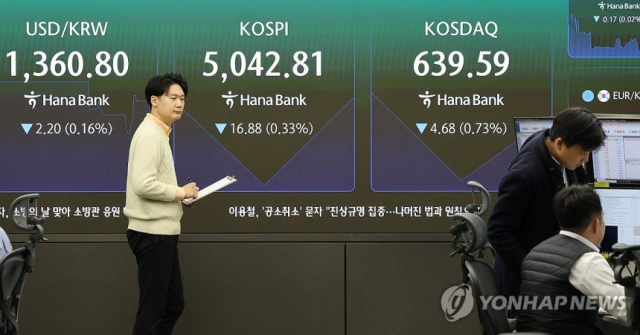
The Numbers That Should Make Wall Street Nervous
Foreign investors sold 10.44 trillion won ($7.1 billion) of Korean stocks in a single week. Half of that came from one company: SK Hynix, which absorbed 5.42 trillion won in net selling. Samsung Electronics took another 2.19 trillion won. Together, those two names accounted for more than three-quarters of the total — and they represent less than 1% of global equity market capitalization.
On November 6, the Kospi plunged to 4,911.28, breaking below 5,000 for the first time in nine months. A circuit breaker halted trading within three minutes and thirty-three seconds of the open. Then a sell-side carjack activated after resumption, compounding the damage. Forty percent of South Korea’s largest chipmakers fell between 16% and 20% that week alone.
But here is what the wire services are likely missing: this was not a fundamental breakdown. Memory supply remains constrained. Prices are still rising. The selloff was driven by something more fragile — the sudden reappearance of policy risk and balance sheet anxiety around AI infrastructure spend.
Who Dumped and Why It Matters Beyond Seoul
Foreign ownership of Samsung Electronics fell to 45.95% on November 6, the lowest level since July 2009 — nearly seventeen and a half years of accumulated positions unwound in days. SK Hynix dropped to 48.27%, its lowest since November 2021.
The selling was not confined to chips. Samsung Electric, Samsung SDI, SK Square, and Doosan Enerbility all appeared on foreign investors’ sell lists. Thirty-one point seven percent of all listed companies on the Kospi and KOSDAQ wrote intraday yearly lows between November 2 and 6. Seven hundred twenty stocks hit new troughs on November 6 alone.
This breadth matters because Korean semiconductors are not isolated assets. They sit at the center of the global AI supply chain as the primary producers of high-bandwidth memory — the DRAM and HBM products that every major cloud provider and AI infrastructure company depends on. When foreign funds flee Korean chips, they are effectively voting against the durability of AI capex plans, not necessarily against memory demand itself.
The Policy Spark Nobody Saw Coming
The trigger was not earnings. It was politics.
After the US midterm elections, speculation intensified that Democrats would sweep both chambers — what some analysts called a “Blue Wave.” That scenario raises the probability of stricter permitting and environmental review for datacenter construction, higher electricity costs from new grid regulations, and potentially slower approval timelines for the very projects that underpin the AI infrastructure thesis.
The market did not wait for legislation. It priced the possibility into Korean memory stocks, which trade on expectations of continued NVIDIA GPU deployment and corresponding HBM demand. If datacenter builds slow, even marginally, the narrative shifts from “how much AI spending” to “when does spending pause?”
That distinction may seem academic. It is not. It is the difference between a sector rotation and a sector revaluation.
The Real Question: CoreWeave, Credit, and Whether the Build-Out Holds
Samsung Investment’s Seo Sang-young put it plainly: the concern is not structural demand destruction. It is execution speed and funding access. Large datacenter investors are carrying significant debt. Credit risk and borrowing costs are now part of the equation — variables that did not matter when AI capex projections were based on cheap money and unrestricted build-out rights.
That is why the CoreWeave quarterly report, due November 10, carries disproportionate weight. Investors are not looking for revenue beats. They are looking for evidence that datacenter investment plans remain intact, that cash flow covers interest obligations without dilutive fundraising, and that the company can service its growing debt load. If CoreWeave signals strain, the fear will spread to every other player in the AI infra chain — including the Korean memory makers whose products power those same datacenters.
US semiconductor stocks offered a contradictory signal on November 6. Nvidia, AMD, and Micron all rallied. The Philadelphia Semiconductor Index climbed more than 4%. Technical buying after the overshoot provided some relief. But a bounce in Santa Clara does not resolve the underlying question of whether Korean chip demand will hold if US datacenter builders pull back.
What Comes Next: Three Dates That Will Set the Direction
The next ten days contain three events that will determine whether this is a buying opportunity or the beginning of a deeper correction.
November 10 brings the US October CPI print. A hotter-than-expected reading would dampen Federal Reserve rate-cut expectations and increase valuation pressure on growth stocks across the board. A cooler reading would relieve the pressure and create room for mean reversion in Korean semis.
November 13 delivers the US PPI data, reinforcing whatever direction CPI establishes.
November 12 is the Kospi 200 monthly options expiry. With foreign investors having unloaded such a large block of shares last week, the key variable is whether their positioning improves ahead of expiration. Options roll-over dynamics can amplify moves in either direction depending on where the spot price sits relative to the dominant put-call skew.
MSCI’s periodic index rebalance adds another mechanical dimension. If foreign funds are forced to reduce Korean allocations by the rebalance date, that creates fresh selling pressure regardless of fundamentals. If the rebalance favors retention or inflow, the opposite applies.
The Valuation Argument and What It Ignores
Yuanta Securities’ Lee Jae-won noted that the Kospi’s 12-month trailing price-to-book ratio at the November 6 low sat around 1.2x — a level that, historically, has attracted mean-reversion buying. He also pointed out that the forward PER had compressed below 4x, signaling extreme undervaluation relative to expected earnings.
These metrics are real. But they measure past earnings and book value, not future capex decisions by datacenter developers who may scale back if regulation tightens or financing conditions worsen. A cheap stock can stay cheap if the earnings revision runs in the wrong direction.
That is the core tension right now. The fundamentals of memory demand have not broken. Supply remains tight. Prices are still climbing. But the shadow falling over AI infrastructure — regulatory uncertainty, credit concerns, rate path ambiguity — is casting doubt on whether those fundamentals will materialize on the timeline the market priced in.
Foreign investors are not selling because the story is over. They are selling because the story just got harder to finance. Whether that distinction matters for the Kospi in the coming weeks depends entirely on what CoreWeave tells us, what CPI prints, and whether the moneymarkets let rates drop fast enough to ease the pressure.
Until then, the 10.4 trillion won exit remains the loudest signal we have — and it is not reassurance.