Korea's AI Crash Was a Warning Shot Wall Street Missed
Korea's stock market just hit dual circuit breakers for the first time since July — and the selloff tells us something about AI's fragile economics that America hasn't fully absorbed yet.
The Sidecar Fired Again — And It Should Have Frightened Everyone
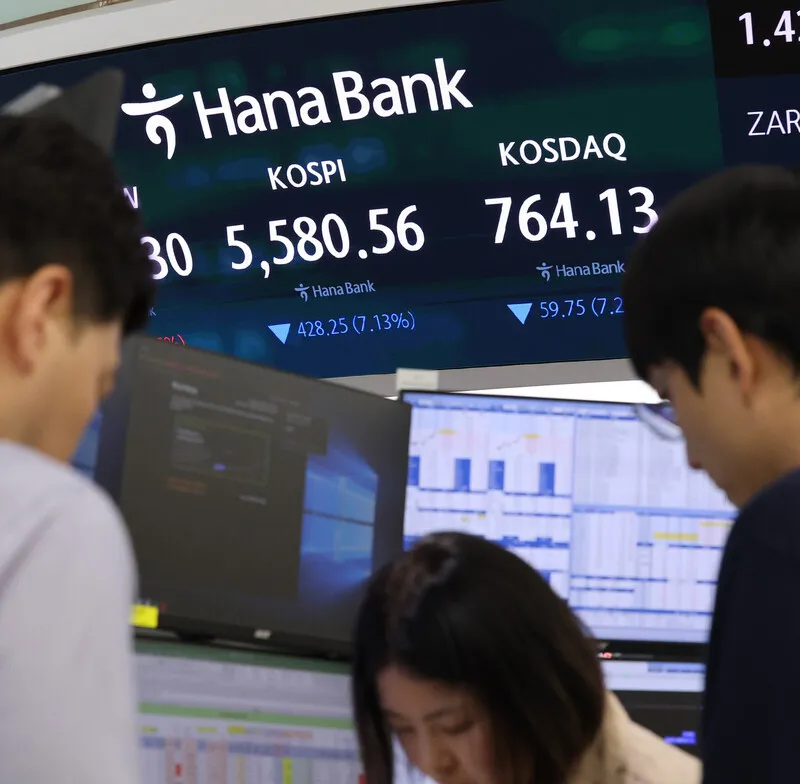
South Korea’s stock market did something on May 15 it hadn’t done in nearly three months: both the KOSPI and KOSDAQ triggered their selling-side circuit breakers in the same session for the first time since July 29.
The KOSPI opened down 5.59% and ended up nearly 7.2% lower at 5,576.46 — not bad on its own, but remember the intraday low was 5,534.24, a full 7.8% off the previous close. That was the lowest point since late July’s flash crash. The index had been sliding for seven straight trading days and had already lost the 6,000 level three days running.
KOSDAQ wasn’t spared either. The tech-heavy board dropped 7.11% to 765.27, dragged down by the same semiconductor names that fuel roughly a third of Korea’s export revenue and its entire reputation as an AI hardware power.
Samsung Electronics fell 8.41% to 212,500 won. SK Hynix lost 10.39%, trading at 1.271 million won. Follow-on names took it even harder — SK Square dropped 11.38%, Samsung Electro-Mechanics cratered 15.21%. Of the 912 stocks on the KOSPI, 844 were in the red. That’s a 92.5% hit rate, the kind of number that suggests panic, not selectivity.
What happened here isn’t just another bad day in Asia. It’s a stress test on the AI investment story — and Korea got the first clean read.
The American Trigger Korea Priced First
The catalyst landed overnight, in the form of US CPI data that came in above expectations. Oil prices had surged — that’s the obvious part — but what worried markets was broader-based inflation creeping up across non-energy categories. The implication was stark: the Federal Reserve may have to raise rates again, which means higher borrowing costs at a time when AI companies are spending like there’s no tomorrow.
The connection to AI isn’t tenuous. CoreWeave, a niche cloud infrastructure player, saw its bond prices tumble overnight. That’s a direct signal that the debt markets don’t believe the current pace of AI capex is sustainable. Companies that financed their growth through leverage — the so-called “debt-fueled investing” — are suddenly getting repriced.
Anthropic reported blistering third-quarter results on the same day, but the growth rate was decelerating. The market didn’t care about the absolute number. It cared that revenue growth was slowing at the exact moment capital costs were about to rise.
South Korean investors saw that coming before Wall Street did. Not because they have better data — they had the same CPI print — but because their markets are more exposed to the AI supply chain in a way that forces earlier conviction. When your two most valuable companies are memory chipmakers, you don’t get to wait and see how the narrative evolves.
Why This Matters Beyond Asia
The KOSPI’s 7.8% intraday drop put it dangerously close to the 7/29 low of 5,262.77. A break below that level would re-open the door to a sustained bear market in one of the most liquid emerging-market indexes in the world. But the real spillover concern isn’t the level — it’s the behavior.
Circuit breakers are meant to cool things down. In practice, they’re often read as a signal that institutional selling has overwhelmed bid support. When the sidecar fires on both boards simultaneously, it’s not a pause button. It’s a warning light.
Asian investors are now watching three things unfold in sequence: whether the Fed backs off the hiking threat, whether CoreWeave’s bond curve stabilizes, and whether Hynix and Samsung can hold above the current price floor. If any one of those moves the wrong way, the next session could be worse.
Wall Street is still pricing in a “higher for longer” rate environment as a manageable scenario. Korea’s market just told them it doesn’t feel manageable — it feels like a repricing event for the entire AI infrastructure thesis.
The Real Story Is the Debt Trap
Here’s what the headlines aren’t saying loud enough: the problem isn’t that AI is a bubble. The problem is that AI is being built on debt, and debt doesn’t survive rate shock.
CoreWeave’s bond selloff is the canary. A company that went public relatively recently, relying on massive borrowing to build out GPU capacity, is now being punished by the very mechanism that funded its expansion. That’s the dynamic every leveraged AI play faces if the Fed keeps hiking — and right now, the data suggests it will.
Samsung and Hynix sit at the top of this chain. They sell the memory chips that power AI training clusters. Their earnings are fine today. But their valuations assume continued demand growth that depends on customers like CoreWeave being able to borrow cheaply. If borrowing costs stay elevated, that demand curve bends — and it bends fast.
An analyst at Mirae Asset Securities put it plainly: the market is now asking whether trillions in AI infrastructure spend will ever convert into proportional revenue, and whether that spending is even financeable. Those aren’t long-term questions. They’re immediate ones.
What Happens Next
The KOSPI opened at 5,673.01 on Thursday and never recovered. It traded below 5,534 for hours before clawing back to close near 5,576. That bounce was likely algorithmic, not conviction-driven.
Two circuit breakers fired in three days. That’s a pattern, not a coincidence. Markets don’t usually double-pump the brakes without reason.
Watch the KOSPI’s ability to hold above 5,500 over the next few sessions. If it doesn’t, the 7/29 low becomes the new target. If it does, the question shifts from “is this a correction” to “how long until the Fed signals pause?”
Either way, the story Korea told on Thursday is the one the rest of the world is about to hear — just a few hours later, when the U.S. opens and finds that its AI narrative just lost its cheapest funding source.