Korea's Yellow Envelope Law Exposes Asia's Labor Bargaining Gap
South Korea's new implementation guidelines for the yellow envelope law strip collective bargaining of profit-sharing and strategic decision-making threats, pivoting power decisively toward management. The move reveals a broader Asian pattern where governments prioritize corporate competitiveness over worker voice.
The loophole that hollows out the yellow envelope law
South Korea’s revised Trade Union Act, nicknamed the yellow envelope law for the bright envelopes striking workers carry, took effect on March 10. Three weeks later, the Ministry of Employment and Labor published implementation guidelines that effectively neutered the law’s core promise: expanding collective bargaining to indirect and subcontracted workers.
The guidelines carve out two critical exclusions. First, profit-linked performance bonuses are no longer a mandatory bargaining subject. Second, business management decisions — plant construction, mergers and acquisitions, and even the adoption of artificial intelligence — are shielded from labor disputes unless objective proof shows concrete changes to working conditions.
The target is obvious. Samsung Electronics and SK Hynix unions have long demanded a fixed percentage of operating profit be distributed as performance pay. The guidelines explicitly reject that approach, arguing that company profits fund R&D, capital investment, and dividends, and pre-allocating a share would constrain the freedom of business.
Workers are told instead to bargain for base salary increases or fixed amounts.
Who wins, who loses
Management wins decisively. By removing profit-sharing and strategic decisions from mandatory bargaining, the government has created a buffer zone where corporate strategy proceeds without labor input. A semiconductor cluster announcement triggers no obligation to negotiate. A humanoid robot deployment plan is off-limits until workforce reduction details are finalized.
Samsung and SK Hynix will simply stop negotiating over profit ratios, knowing the labor commission cannot force them to the table. Unions lose leverage at the exact moment they need it most.
Workers in indirect employment — the law’s original beneficiaries — lose twice. The guidelines apply to all sectors, not just the high-profile semiconductor firms. Chain stores, logistics companies, and platform workers who gained bargaining rights under the yellow envelope law now face a government that defines their negotiation table as smaller than the statute intended.
The government claims neutrality. It is not. By narrowing the scope of mandatory bargaining subjects, it has picked management’s side in the most structural dispute of Korean labor relations: who decides how prosperity is distributed.
The sequencing trap
Perhaps the most consequential detail is the timing rule. Unions can only bargain over business decisions when changes to working conditions are “objectively confirmed.” That means negotiations begin only after management has already decided to close a plant, introduce AI, or relocate operations.
This reverses the normal logic of collective bargaining. Instead of negotiating alongside management as decisions form, workers are brought in only when outcomes are locked. Labor economists call this last-stage consultation; critics call it theater.
A Democratic Confederation of Trade Unions official warned that delaying negotiations until after workforce plans are finalized eliminates compromise. When management presents a fait accompli, unions have two options: accept or escalate. Acceptance weakens the movement. Escalation pushes disputes toward strikes that the guidelines simultaneously make harder to justify legally.
The Korean context, and why it matters beyond Asia
Korea’s labor movement has spent two decades fighting for recognition of indirect employment relationships. The yellow envelope law was supposed to close the gap between formal employees and the growing mass of subcontracted, dispatched, and platform workers. Instead, the implementation guidelines have redrawn the boundary in management’s favor.
The semiconductor angle is particularly revealing. Samsung and SK Hynix sit at the center of a global technology supply chain. Their profitability is tied to AI demand, chip shortages, and geopolitical competition with China. Management arguments about protecting investment flexibility sound reasonable to Western readers familiar with Silicon Valley dynamics. But in Korea, where union contracts have historically covered profit-sharing mechanisms, this feels like a retrograde move dressed in modern language.
The pattern echoes across Asia. Japan’s government has similarly constrained labor dispute mechanisms in recent years, prioritizing corporate turnaround over worker voice. Taiwan’s labor reforms stall repeatedly against business lobbying. Even China’s limited union structures face pressure to defer to state-defined economic priorities.
What makes Korea distinct is the visibility of the rollback. The yellow envelope law passed with bipartisan support and public sympathy. Its implementation guidelines represent a quiet renegotiation of that political compact, executed through administrative detail rather than legislative debate.
The legal battleground ahead
The guidelines establish criteria for the Labor Relations Commission’s determinations on bargaining subjects. If the commission follows them, unions lose the right to legally strike over profit distribution and strategic decisions. That removes the enforcement mechanism behind collective bargaining.
Two major federations are demanding the guidelines be scrapped. Legal scholars quoted in the source material argue the guidelines violate the principle of labor-management autonomy embedded in the law itself. Park Eun-jeong, a labor law professor at Korea Open University, stated plainly that government categorization of bargaining subjects contradicts the autonomy principle.
The commission may yet push back. But the timing is unfavorable. The new guidelines were published before the union resistance could mobilize. Management now has a written standard to cite against any bargaining demand it wishes to deflect.
What happens next
Three scenarios are plausible.
The first is gradual erosion. Unions accept the narrowed framework, negotiate within the new constraints, and slowly lose ground on profit-sharing and strategic input. Management gains the ability to restructure without labor opposition. This is the path of least resistance and likely the most probable outcome over the next two years.
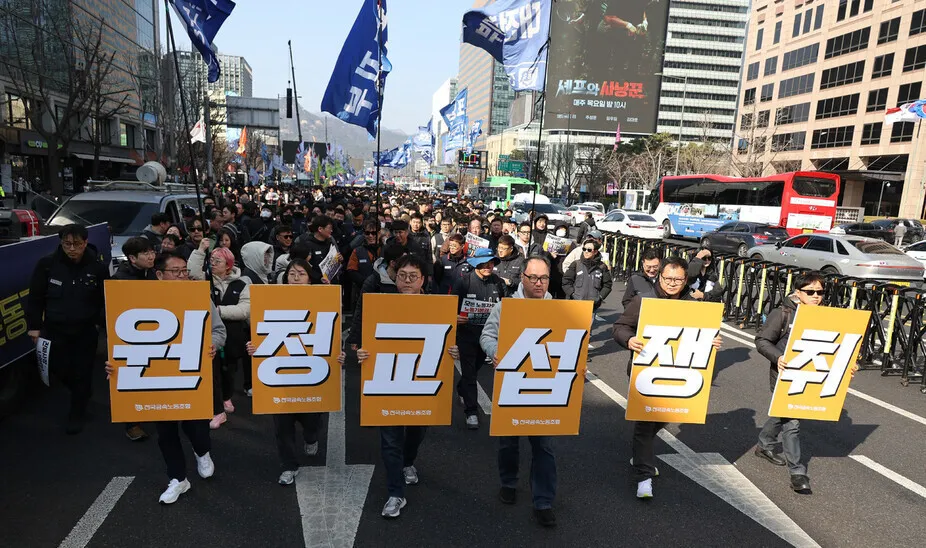
The second is escalation. Unions treat the guidelines as illegitimate, organize strikes that challenge the commission’s authority, and force a political confrontation. This path risks violent clashes and political backlash, but it could rebuild momentum for broader labor reform. The March 10 demonstration on Sejong-daero in central Seoul, where subcontracted and platform workers chanted for direct negotiation with primary contractors, suggests the willingness exists.
The third is legislative reversal. Public pressure forces the National Assembly to amend the guidelines or pass clarifying legislation. This requires political capital and an opposition that treats labor rights as a voting issue. Given Korea’s current political dynamics, this is the least likely scenario but not impossible.
The broader lesson
Korea’s yellow envelope law episode illustrates a tension that defines Asian labor markets today. Governments want flexible, competitive corporations. They also face pressure to protect workers in economies where informal and subcontracted employment is growing faster than regulatory frameworks can address it.
The implementation guidelines resolve that tension by preserving corporate flexibility and narrowing worker protections. The result is a law that looks progressive on paper and operates restrictively in practice.
International readers should watch Korea not just for labor policy but as a signal. When the world’s sixth-largest economy decides that profit-sharing and strategic decision-making are off-limits to collective bargaining, it sets a reference point for business communities across the region. The question is whether other Asian governments see this as a model to follow or a warning to avoid.
The next twelve months will answer that.