Korean Fuel Cell Maker Lands Huge US Data Center Contract
Doosan Fuel Cell's 50-billion-won US data center order signals fuel cells are becoming primary power sources for AI infrastructure, not just backups. The upgrade to 'buy' carries a 58,000 won target.
A Korean Company Is Powering American AI — With Fuel Cells
The most powerful narrative in tech right now is that AI devours energy. Every new data center needs megawatts of power. Every chip needs cooling. Every training run needs relentless electricity. But the story getting told is almost entirely about semiconductors and cloud providers. The energy suppliers on the ground floor are another story.
Doosan Fuel Cell, a Korean manufacturer that most English-language readers have probably never heard of, just became a material player in that hidden layer. On July 7, NH Investment & Securities upgraded the stock from hold to buy and raised its target price to 58,000 won — a clear signal that the market is re-pricing what this company can do.
The reason is a single order worth roughly 50.14 billion won, or about $375 million at current exchange rates. Doosan Fuel Cell is supplying phosphoric acid fuel cells, or PAFCs, to data centers in the United States. Not a pilot program. Not a symbolic test. An order that analysts estimate sits at around 140 megawatts — nearly three times the company’s original 50MW expectation.
The Unit Price Tells the Real Story
Domestic orders paint one picture. The YH Power 1 and 2 projects in Korea trade at roughly 320 million won per megawatt. The US order commands a meaningfully higher unit price, analyst Jung Yeon-seung at NH Investment noted, though she declined to disclose the exact figure. The spread matters. It signals that the American market is willing to pay a premium for on-site generation — a factor that could reshape the company’s margin profile far more dramatically than volume alone.
That premium exists because American data centers face a crunch. Grid connections can take years. Permitting drags. Diesel generators work but carry emissions costs and regulatory risk. Fuel cells sit on-site, produce power with near-zero local emissions, and offer a dispatchable alternative that batteries cannot match at scale.
Jung’s assessment is blunt: given the absolute volume involved, these fuel cells are likely serving as the primary power source, not a backup. That is a significant conceptual shift. Backup power is a nice-to-have product. Primary power is a necessity — and necessities command longer contracts, stickier relationships, and more defensible revenues.
Three Names Now Own the US Data Center Fuel Cell Market
The US data center fuel cell market previously had two recognized players: Bloom Energy and FuelCell Energy. Both have been burning cash for years chasing exactly this moment. Doosan Fuel Cell’s entry through its American affiliate, HyAxiom, makes it the third name on the list.
That sounds modest. It is not. The fuel cell industry has long suffered from a credibility gap — companies promising breakthrough efficiencies while burning venture capital on prototypes. Landing a 140MW commercial order for primary data center power is proof of execution, not just promise. It also validates PAFC technology in a segment where solid oxide fuel cells (SOFC) were widely assumed to hold the efficiency advantage.
Jung pointed out that PAFC’s lower efficiency compared to SOFC did not prevent it from winning this market. On-site demand in the United States is the driving force, not lab-sheet efficiency numbers. That is an important lesson for investors who have been filtering every fuel cell opportunity through a pure efficiency lens. The data center market rewards reliability, scale, and speed to deployment. It does not reward thermodynamic purity.
Production Scale and the Path to Profitability
Doosan Fuel Cell is now positioning itself to deliver over 250MW annually. Its current PAFC production capacity stands at 275MW, and the company plans to add one more production line to push that to 350MW — leaving ample room for additional orders without immediate capital strain.
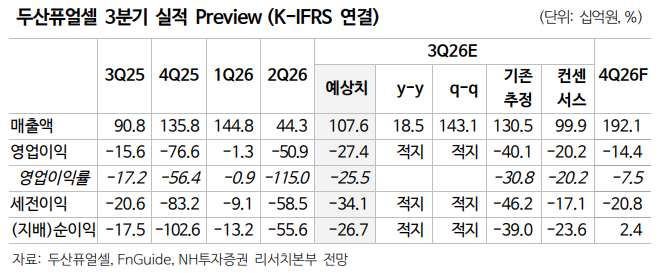
The financial trajectory is the critical variable. NH Investment projects 2027 consolidated revenue of 882.1 billion won and an operating profit of 40.4 billion won, marking a return to profitability. That turnaround depends on volume scaling fast enough to absorb fixed costs. The company will still carry a 94.1 billion won operating loss in 2026 from stack replacement costs on already-supplied fuel cells and working capital pressures from low utilization rates.
The target price of 58,000 won was derived using a 2027 EV/Sales multiple of 6.0x, consistent with the average applied to global fuel cell peers. Whether that multiple holds depends on execution — specifically, whether Doosan Fuel Cell can convert its order pipeline into delivered product at the assumed pace.
What This Means Beyond Korea
The broader implication reaches well past Seoul. For years, the conversation around AI’s energy appetite has focused on Nvidia, on TSMC, on Google and Amazon building out their fleets. The companies actually generating and hosting the power at the edge of the grid have received far less attention.
Doosan Fuel Cell’s order proves that Korean industrial players are not just suppliers of components — they are building end-product capabilities in a market that will only grow. The US data center build-out is multi-year. The fuel cell orders are multi-year. The companies that lock in placement now will have a timing advantage that competitors cannot easily replicate.
The stock upgrade from hold to buy reflects that shift in perception. Investors are no longer evaluating Doosan Fuel Cell as a speculative fuel cell company with a Korean home base. They are evaluating it as a proven supplier to the fastest-growing infrastructure market on Earth. The question is no longer whether the technology works. The question is whether it can scale fast enough to meet demand.
At 140MW and climbing, the answer is looking more plausible every day.