Korea's 9 Trillion Won Bet on an AI Valley in the Sea
A private meeting between President Lee Jae-myung and Hyundai's Chung Eui-sun signals Seoul's pivot toward industrial AI. The question is whether Saemangeum can compete with Silicon Valley and China's state-backed rush.
The Meeting That Wasn’t Announced
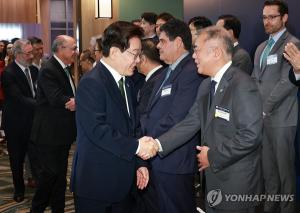
On August 2, President Lee Jae-myung met privately with Chung Eui-sun, CEO of Hyundai Motor Group. No press release followed. No joint statement. The only public trace is a business-source leak suggesting the centerpiece of that closed-door conversation: Hyundai’s plan to invest 9 trillion won — roughly $6.3 billion at current rates — in the Saemangeum reclaimed land district over the next three years.
The timing of this silence is itself a signal. In Korean politics, a president who just held separate private meetings with the three chaebol chiefs — Lee Jae-yong at Samsung, Chey Tae-won at SK Group, and now Chung — is building leverage on his own terms. Public announcements invite shareholder scrutiny, competitor reaction, and Beijing’s attention. A quiet handshake carries different weight.
What 9 Trillion Won Buys You in Saemangeum
Hyundai’s vision, called the Saemangeum AI Valley, targets three sectors: artificial intelligence, robotics, and energy. The company plans to phase the investment through 2029. The site itself — a 40,000-hectare reclamation project on Korea’s western coast, one of the largest land-reclamation works in modern history — offers something rare in a country where industrial land is scarce and expensive: empty space adjacent to existing heavy-industry infrastructure built by Hyundai, Posco, and SK.
That geography matters. AI training requires dense energy, water, and physical space for data centers. Korea has none of those in abundance in its existing urban cores. Saemangeum was engineered to solve exactly that constraint. Hyundai’s pitch is not abstract — it is a claim that the company can convert a coastal reclamation zone into a integrated AI and robotics campus in under three years.
Whether that timeline holds is another question. The last time a major Korean industrial pledge hit Saemangeum, the clock ran long and the costs ballooned. Reclamation projects in the Yellow Sea face environmental opposition, shifting regulatory standards, and the practical reality that building data-center-grade power and cooling infrastructure from scratch takes longer than a press release admits.
The Chaebol Triangle
The real story in these successive private meetings is not Hyundai alone. It is the pattern.
Lee Jae-myung has now met individually with the heads of Samsung, SK, and Hyundai — the three conglomerates that account for the bulk of Korea’s export-weighted tech and manufacturing output. Each has a different relationship with the White House. Samsung’s semiconductor arm dominates global memory-chip supply. SK operates battery and chemical facilities that feed the EV and storage markets. Hyundai is the world’s third-largest automaker making its most aggressive pivot toward software-defined vehicles and robotics.
Korea is not asking these companies to invest because the market spontaneously rewards it. It is asking because the alternative — letting AI infrastructure development proceed entirely under American or Chinese sponsorship — would cede the next cycle of industrial advantage. Washington has CHIPS Act money flowing. Beijing has state-directed capital and an appetite to deploy AI at municipal scale. Seoul has a government that sees private chaebol balance sheets as the only instrument fast enough to matter.
Who Wins, Who Loses
The winners in this arrangement are straightforward: Hyundai’s robotics and energy divisions gain a domestic proving ground. Samsung and SK, watching from the sidelines of Hyundai’s Saemangeum announcement, face pressure to announce their own commitments or risk being framed as lagging. The Korean government gains a visible industrial-policy flagship.
The losers are less celebrated but structurally real. Korean small and medium suppliers who do not sit inside the chaebol ecosystem may find Saemangeum’s supply-chain requirements favoring in-house sourcing. Environmental groups opposed to further Yellow Sea reclamation will see their concerns absorbed into a bigger national-security narrative. And Japanese competitors in industrial robotics — Fanuc, Yaskawa, Denso — face a rival backed by a single government’s full policy weight.
There is also a geopolitical vulnerability. Korea’s AI infrastructure strategy rests on continued access to American chip equipment and design tools. Any escalation in US-China tech restrictions could sever the supply line Hyundai is betting on. The 9 trillion won pledge assumes a world where those flows remain open. That is not a guaranteed assumption.
What Comes Next
The immediate next test is whether Hyundai discloses project specifics — land allocation, power agreements, tenant commitments — within the next six months. If it does not, the Saemangeum AI Valley will become another Korean industrial slogan: ambitious in conception, vague in execution.
Samsung’s response is the second test. Lee Jae-yong has not yet announced a parallel Saemangeum commitment. If Samsung stays quiet while Hyundai claims the AI-infrastructure mantle, the balance of influence inside Korea’s executive branch tilts. If Samsung announces its own plan, the competition between chaebol headquarters becomes part of the policy story — and potentially a race that raises the overall ambition level.
The third test is Beijing. Chinese local governments have been buying AI data-center capacity at scale, offering land, tax breaks, and subsidized power. Saemangeum’s pitch competes directly with that model. Whether Korean firms can match Chinese price-performance in the short term will determine whether the valley attracts multinational tenants or remains a domestic showcase.
The private meeting revealed nothing on paper. That is the point. In a landscape where AI infrastructure is becoming the new industrial base, silence is a strategic choice — and one that lets Seoul’s leaders keep their options open while the world watches the wrong headline.