KOSPI Breaks 7,000 as Korea Bets Everything on the AI Chip Narrative
The KOSPI reclaimed 7,000 for the first time in months, riding OpenAI's Astra reveal. But look closer and you see a market re-rating itself — not as a chip cycle play, but as an AI infrastructure bet.
The Number That Matters Is Not 7,000
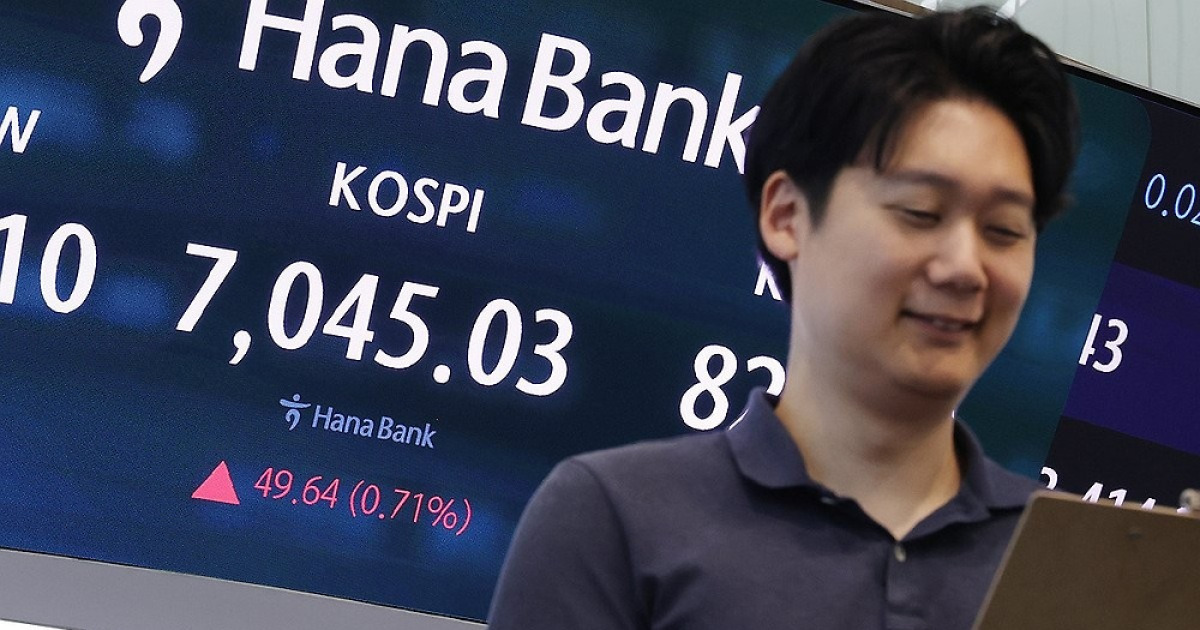
The KOSPI opened at 7,045.79 on September 8, clearing the 7,000 barrier within minutes of trading. The headline reason was straightforward: OpenAI unveiled its latest AI model, Astra, and Korean semiconductor stocks rallied on the expectation that another capable model means more tokens, more infrastructure spend, and more high-bandwidth memory.
Samsung Electronics rose 1.48%. SK Hynix surged 3.42%. The pair alone carried the index through profit-taking pressure from the prior session’s gains.
But the number 7,000 is mostly symbolic. What actually happened inside that move tells you more about where Korea’s tech sector is heading than the level itself.
The Real Story: A Strategy Re-Rated
Korea’s semiconductor stocks have long been treated as cycle plays. When DRAM prices rose, you bought them. When they fell, you sold. It was a reliable rhythm — until the last two years, when that rhythm stopped making sense. Memory prices had been depressed for a long stretch, and yet Samsung and SK Hynix kept investing aggressively in advanced nodes and HBM (high-bandwidth memory), the specialized chips that sit next to GPU stacks in AI servers.
Investors who held through that period were punishingly patient. Those who didn’t exited at lows that now look strange.
Astra, and the analyst commentary around it, gives those patients a moment to catch their breath. Lee Gyeong-min of Daishin Securities noted that Astra’s capability — performing a broad range of human-level tasks rather than excelling at one narrow function — raises the possibility that it marks progress toward AGI. More importantly, he said the model’s performance and utility could drive a step-change in token consumption, reinforcing the investment momentum around AI infrastructure.
That is the key phrase. This is no longer about cycle recovery. It is about a demand ceiling that keeps rising.
Who Is Buying, and Why It Matters
The ownership structure of this rally is telling. Foreign investors sold 1,427 billion won worth of KOSPI shares in the early session. Domestic institutions bought 893 billion. Individuals sold 161 billion. On the KOSDAQ, foreigners added 180 billion while institutions net-sold 303 billion.
Foreigners sold into the rally — the same pattern that repeated during Korea’s last major index breakthroughs. They are not skeptical of AI. They are skeptical of paying up for it in a market where the currency risk is real and the valuation gap has narrowed.
Korean institutions are buying because they own the companies that matter. SK Hynix is effectively the world’s leading HBM supplier, and HBM is the bottleneck product for every major AI chip design. Samsung is catching up fast. These are not abstract AI stories. They are manufacturing realities.
The domestic fund managers holding these names now have a narrative that matches their positions. That alignment has always been powerful in Korean markets, where institutional consensus can move indices disproportionately.
The Losers in This Setup Are Not Obvious
Not everything that rose was a semiconductor. Doosan Enerbility jumped 4.78% on Korea-U.S. nuclear cooperation hopes. Mechanical and equipment stocks led sector gains at 3.08%. But the big-cap losers carved out a counter-narrative that deserves attention.
Samsung Electro-Mechanics fell 1.65%. LG Energy Solution dropped 1.38%. Hyundai Motor slid 0.76%. IT services, food and beverage, and textiles all tracked lower.
This is a rotation, not a broad expansion. Money is moving from traditional Korean manufacturing and consumer-facing businesses toward the companies that sit on the AI supply chain. It is the same rotation that has defined global markets since late 2023, but here it is playing out in a market where the supply-chain winners happen to be headquartered domestically.
For investors who assumed a Korea tech rebound would lift everything, the selective nature of this move should be a warning. The rally is narrow by design.
What Happens Next Depends on Astra’s Actual Impact
The market is pricing in a sustained increase in AI infrastructure demand. That pricing is not unreasonable given the direction of travel, but it is premature in one important sense: Astra has not shipped. Token consumption figures have not been published. There is no order book to validate the rally yet.
If Astra drives a measurable increase in demand for HBM and advanced packaging — the products Samsung and SK Hynix actually sell — the KOSPI’s climb has structural support. If it generates excitement without moving unit demand, the 7,000 level will look like a ceiling rather than a floor.
The timing of the next data point matters. Earnings guidance from Samsung Electronics and SK Hynix over the coming quarters will either confirm or contradict this AI-driven re-rating. Until then, the index break is real, but its durability is not guaranteed.
The Global Signal Coming Out of Seoul
The most underappreciated implication of this move is geopolitical. The U.S. market was closed for Labor Day. European semiconductor names — Infineon up nearly 7%, ASML up 2.25% — were the only real-time proxy for chip sentiment. And they moved in the same direction as Seoul.
That convergence matters. For years, Korean semiconductor stocks moved independently of the U.S. narrative, driven by domestic cycle dynamics and currency swings. The fact that they are now moving in lockstep with OpenAI announcements signals a fundamental shift in how these stocks are valued globally. They are no longer Korean cycle plays. They are AI infrastructure plays, and the world is watching them as such.
That reclassification is the real milestone here — not the index level, but the change in how the market thinks about the companies that got it there.