Kraków Shooting Exposes Europe's Far-Right Terror Feedback Loop
Poland's deadliest shooting in decades was driven by the same ultranationalist ideology fueling extremist plots across Europe. Why Kraków matters far beyond its cobblestone squares.
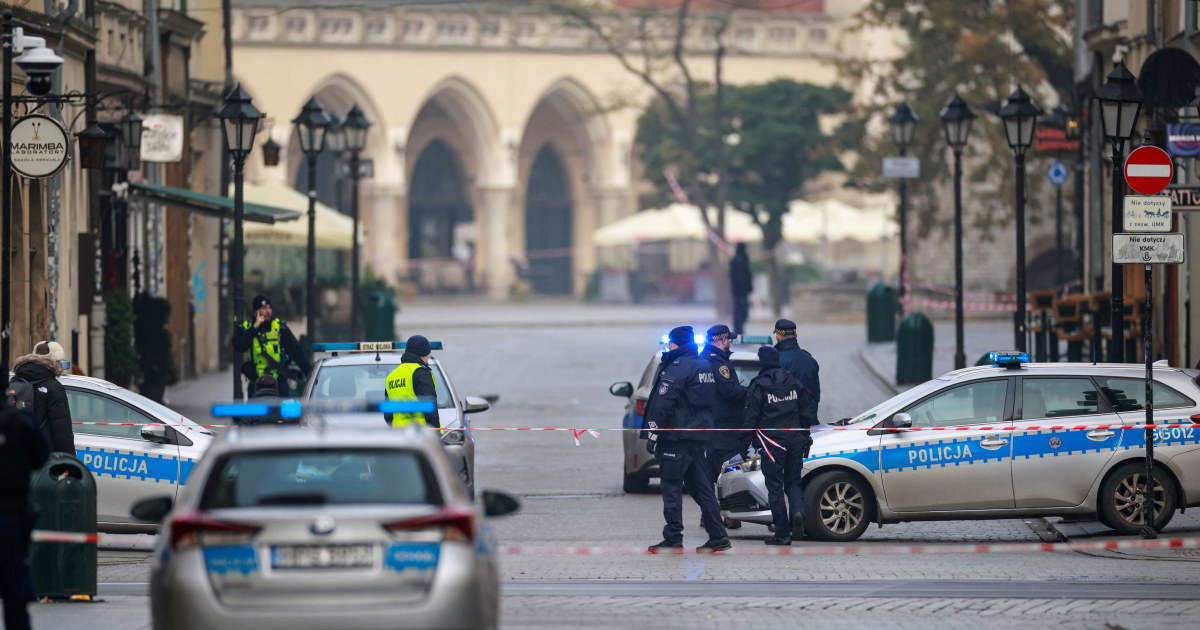
The Attack
Six people died in Kraków’s Main Market Square on Saturday when a man in his mid-20s opened fire with an automatic rifle. Among the dead was a British national. Twelve others were wounded, including two police officers — one fighting for his life after confronting the gunman. By Sunday, Polish authorities confirmed the attacker was motivated by ultranationalistic, far-right ideology.
This was not a spontaneous act. Days earlier, three members of the shooter’s family — reportedly his parents and sister — had been found dead inside a home in Ostrowiec Świętokrzyskie, a town roughly 93 miles to the northeast. The suspect faces separate murder charges tied to those killings. Polish Justice Minister Waldemar Żurek described the full sequence as a terrorist offence aimed at intimidating a large number of people.
Poland’s defense minister called it a terror attack. Prime Minister Donald Tusk declared two national days of mourning. In a country where mass shootings are virtually unheard of, the shock reverberated well beyond Poland’s borders.
The Bigger Pattern
What happened in Kraków did not happen in isolation. The pieces on display — a young male radical, a domestically manufactured firearm, a prior domestic homicide, a public mass-casualty event — form a template that intelligence agencies across Europe and North America have been tracking for years. The difference now is velocity. What used to unfold over months plays out in weeks, if not days.
UK counterterrorism officials have flagged internally that far-right violent extremism is evolving along lines familiar to those who study jihadist or left-wing radicalization: online echo chambers reinforce ideological commitments, personal grievances get absorbed into a broader narrative of civilizational decline, and lone actors receive no formal orders but nonetheless draw inspiration from a shared symbolic universe. The US Federal Bureau of Investigation has issued similar internal guidance to field offices since 2022, warning that domestic violent extremists remain the most persistent threat to US soil.
The Kraków suspect appears to fit a recognizable profile. He was in his mid-twenties — the prime demographic for far-right recruitment across multiple European countries. He used an automatic rifle, suggesting access to firearms that go beyond casual ownership. His prior killings at home point to what researchers call a pipeline: private violence precedes public violence, and the transition often occurs faster than law enforcement can anticipate.
Who Is Connected to What
The victim list tells a story about Europe’s open-border reality. Among the dead were four Polish nationals, one British national, and one woman of undisclosed nationality. Tourists described hearing gunfire and fleeing into shops, hiding under counters while bullets flew overhead. One American student told NBC News he ran up a staircase and hit a dead end. Another visitor wrote that she saw bodies on the ground and called it true horror.
Poland receives tens of millions of visitors annually. Kraków’s Old Town is one of Europe’s most visited historic centers. An attack in the Main Market Square is therefore an attack on the idea of Europe itself — a space where movement is free, borders are porous, and crowded public squares are assumed safe. That assumption just broke.
Who Wins and Who Loses
The immediate loser is Poland’s reputation for safety. The country has one of the lowest rates of gun violence in Europe. Even compared with neighbors like Germany and France, Poland rarely registers in international discussions of mass casualty events. This shooting changes the calculus overnight.
The longer-term loser may be public trust in institutions. A man who murdered his own family and then acquired an automatic rifle clearly passed through every screening layer available — background checks, mental health evaluations, community monitoring — without triggering an alarm. How many such men exist in Poland alone is unknowable. The question will be asked relentlessly, starting tomorrow.
There is also a political winner, however unintentional. Poland’s ruling Civic Platform party, led by Tusk, faces pressure to respond credibly to both security failures and the ideological roots of the attack. Opposition parties will demand action. The far right will claim the attack proves the collapse of multiculturalism — a narrative that gains traction regardless of whether the perpetrator actually held that worldview. Every mass shooting in a liberal democracy emboldens illiberal explanations.
The Feedback Loop
Here is what Kraków illuminates more sharply: the feedback loop between personal grievance, online radicalization, and public violence. The suspect’s actions cannot be fully understood without examining what he consumed before Saturday. Police are reviewing his digital footprint. That investigation will determine whether he operated within a structured movement or followed the far more common pattern of unaffiliated individuals radicalized through algorithmic recommendation engines.
Both pathways feed the same cycle. Structured groups provide tactical knowledge and ideological framing. Algorithmic pipelines provide volume — thousands of disaffected young men exposed daily to content that normalizes violence against perceived enemies. When a crisis hits — migration flows, economic anxiety, cultural shifts — that normalized content becomes actionable. The gap between consuming extremist material and acting on it continues to shrink across Europe.
What Comes Next
Polish authorities have launched a terror-investigation task force. The prosecutor leading the case specializes in organized and terrorist crime. That institutional response is appropriate but insufficient on its own. The harder work involves understanding how radicalization spreads in communities that have historically been immune to this kind of violence.
European governments will face new pressure to tighten surveillance, restrict firearm access, and increase funding for deradicalization programs. None of these solutions are trivial. Poland does not yet have the extensive counterterrorism infrastructure of France or Germany. Closing that gap quickly is difficult and expensive. Moving slowly invites repeated shocks.
The US and UK will also reassess their own assessments. Kraków validates warnings that have existed for years in classified briefings but never received the public resonance that a headline-making attack provides. Expect terminology shifts — more frequent use of “domestic terrorism” in official language, tougher posture toward borderline extremist content, and likely some cross-border intelligence sharing enhancements.
For ordinary people in Kraków and across Europe, the immediate effect is psychological. A city center that felt sacrosanct now feels vulnerable. That feeling will not dissipate quickly, regardless of how effective the security response proves to be.
The deadliest shooting in Poland’s recent history arrived not through ideological machinery or state sponsorship but through a single individual, an automatic rifle, and a crowd of tourists unaware that danger could arrive so suddenly. That is precisely why the pattern matters. It does not require organization to reproduce. It requires only the conditions that generate alienation, rage, and access to lethal means — conditions that exist in abundance across Europe today.