LG Free-Spins Frontier AI Model in Korea's Open-Weight Gamble
LG's decision to open-source its K-Exaone 2.5 API for free is a bold but risky bet to challenge U.S.-dominated open-weight models like Llama — especially in Asian markets where deepseek has already taken root.
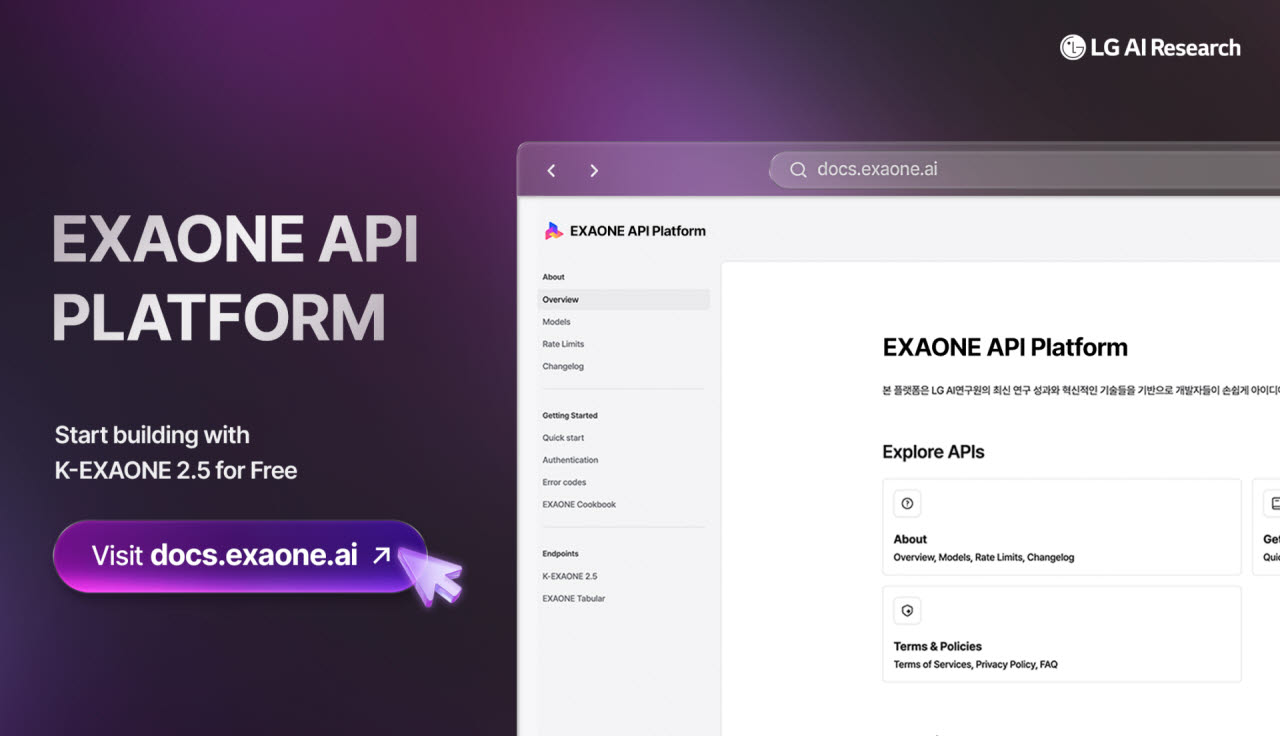
LG Is Betting Everything on Open Access
At the Nvidia AI Day Seoul event on September 9, LG AI Research Institute announced the free public release of its K-Exaone 2.5 API.
No usage fees. No tier restrictions. Any developer, startup, company, or research institution can obtain an API key and begin building immediately through LG’s own platform. The timing was deliberate — this came just weeks after the initial release of Exaone’s second-generation model in August, positioning 2.5 as both a technical proof-of-concept and a market-facing play all at once.
But the real signal isn’t that LG released another model. It’s that LG is choosing free as its primary distribution strategy in a space where even the most generous competitors — Meta with Llama, Alibaba with Qwen, DeepSeek with its Chinese-language heavyweights — still generate billions in closed-API revenue or require significant infrastructure investment to self-host.
LG is trading near-term monetization for something else entirely: ecosystem lock-in at the earliest possible stage.
The Numbers Tell a Story, But Not the Whole One
According to LG’s internal evaluation, K-Exaone 2.5 posted notable results across four benchmarks focused on agentic AI capabilities — the subset of large language model work where systems plan tasks and execute them using external tools.
On the Automation Benchmark, Exaone 2.5 scored 74.6 out of 100. DeepSeek V4.1 Flash edged ahead at 74.9. GLM 5.3 sat at 71.6. On ClawEval, which measures problem-solving in simulated work environments, Exaone hit 77.3 versus DeepSeek’s 75.8 and GLM’s 77.6. In web navigation — BrowsingComp — Exaone took first place at 78.0 against DeepSeek’s 75.8. For software engineering tasks measured by SWE-Bench Pro, Exaone scored 59.2 versus DeepSeek’s 58.4.
Kim I-reun, who leads the Exaone Lab at LG AI Research Institute, stated that performance across 24 evaluation metrics improved more than 70 percent compared to the August release. That is a substantial jump for a single iteration and suggests LG’s internal training methodology — particularly around data curation, post-training refinement, and reinforcement learning — is maturing faster than many outside observers expected.
Lim Woo-hyung, co-director of LG AI Research Institute, said the team is targeting completion of a frontier-grade Exaone model by January 2027, incorporating the techniques validated through 2.5 into what will become the third-generation release.
So the trajectory is clear. And the ambition is real. But ambition alone does not build ecosystems.
Why Free Doesn’t Beat Better
Here is what English-language readers outside Korea often miss when evaluating Asian AI launches: free API access does not equal competitive parity. It equals accessibility. There is a meaningful difference.
Meta’s Llama family, Google’s Gemini open weights, and Alibaba’s Qwen lineup have one structural advantage over every challenger entering the space — they arrived first with fully open weights. Developers can download them, run them locally, modify them, fine-tune them, and integrate them without ever contacting a corporate API desk. Exaone 2.5 offers only an API key. It cannot be self-hosted. It cannot be altered. Its outputs can be used, but its architecture cannot be inspected or extended by anyone outside LG.
This matters enormously for enterprise buyers, academic researchers, and independent developers who operate under budget constraints or sovereignty concerns. An API is a dependency. Open weights are an asset.
DeepSeek has demonstrated precisely this dynamic in the Asian market. By releasing highly capable models at dramatically lower prices — and in some cases, fully open weights — it captured developer attention and institutional trust that no amount of marketing spend could replicate. LG’s free API move is an honest attempt to enter that same conversation on its own terms, but the structural gap between API-only access and true open-weight deployment remains unresolved.
The Agentic AI Angle Is the Real Bet
What makes LG’s timing and focus interesting is the emphasis on agentic AI — models that do not simply answer questions but reason through multi-step tasks, call tools, browse the web, write code, and execute workflows autonomously.
The benchmarks that matter for this use case are not the standard reasoning or coding leaderboards. They are specialized evaluations like Automation Benchmark, ClawEval, BrowsingComp, and SWE-Bench Pro — and on those, Exaone 2.5 competes directly with or exceeds leading Chinese alternatives.
That is strategically significant. Agentic AI is where enterprise value materializes fastest. Companies do not care about chatbot fluency; they care about automation that replaces manual processes. If Korean firms can deploy Exaone-based agents that outperform available alternatives on workflow execution — and do so at zero marginal cost per API call during the promotional window — they gain a foothold in a market segment where switching costs are high and first-mover advantage compounds quickly.
What This Means for Korea’s AI Strategy
South Korea has spent years trying to build domestic AI capability without becoming either a mere consumer of American models or a low-cost manufacturing hub for foreign chips. The Exaone initiative represents the most sophisticated articulation of that goal yet.
But the model-by-model approach has limits. Each iteration requires tens or hundreds of millions of dollars in compute, data acquisition, and talent. China’s deepseek and Qwen families benefit from domestic data abundance, state-supported infrastructure, and a developer community that iterates openly. America’s Llama, Gemini, and Claude ecosystems benefit from capital markets, cloud provider integration, and cultural gravitas that attracts top engineers worldwide.
Korea sits in a structurally difficult middle position — capable enough to produce genuinely competitive technology, but small enough that every breakthrough must be proven repeatedly from scratch. A free API is a smart tactical move within that reality. It buys attention, generates usage data, and creates the conditions for future open-weight releases. Whether it is enough to shift the global balance is far less certain.
The January 2027 target for Exaone 3.0 will be the real test. If the next iteration matches or exceeds the performance of DeepSeek V4.1 Flash or comparable frontier models while remaining freely accessible, LG may have built something rare — a non-American, non-Chinese open-access pathway into the frontier tier. If it falls short, the free API becomes a costly goodwill gesture rather than a strategic cornerstone.
Either outcome matters for everyone watching how AI infrastructure divides geographically in the coming years.