Why the Next Wave of Anti-Aging Drugs Targets Macrophages, Not
A new Nature study reveals that declining autophagy in aging macrophages impairs their ability to clear senescent cells — and that CMA activation could be a more effective anti-aging strategy than senolytics.
The immune system is losing its cleanup crew.
A study published this month in Nature provides the most detailed molecular map yet of why aged immune systems fail to clear out senescent cells — those so-called zombie cells whose accumulation drives age-related disease. And the finding may reshape how the biotech industry thinks about the next generation of anti-aging therapies.
The short version: as animals age, a cellular quality-control process called chaperone-mediated autophagy, or CMA, declines across multiple tissues. This decline doesn’t just happen inside the senescent cells themselves. It also occurs in the macrophages tasked with eating and disposing of those cells. The result is a vicious feedback loop — senescent cells secrete factors that further suppress macrophage CMA, which in turn impairs the macrophages’ ability to recognize and engulf dying cells. The cycle reinforces itself.
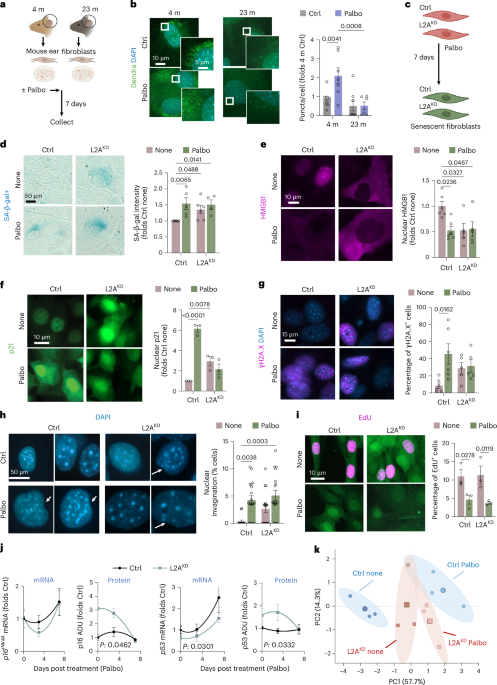
The researchers, led by Rosa Sereda and colleagues, used primary mouse ear fibroblasts from young (4-month-old) and old (23-month-old) mice, combined with a genetic reporter system that fluorescently tracks CMA activity in real time. They found that young fibroblasts robustly upregulated CMA when forced into senescence via palbociclib treatment. Old fibroblasts failed to do so. Basal CMA activity was already lower in aged cells, and the senescence-induced boost simply didn’t happen.
That single observation — the failure to upregulate CMA during senescence — cascaded into a series of downstream consequences that are individually interesting and collectively alarming for anyone betting on current senolytic strategies.
CMA loss rewires the senescent cell secretome
Senescent cells are dangerous not because they sit there quietly dividing nothing. They are dangerous because of the SASP — the senescence-associated secretory phenotype — a cocktail of inflammatory cytokines, chemokines, growth factors, and proteases that remodels surrounding tissue and can drive neighboring cells toward senescence themselves.
The Nature paper shows that when CMA is impaired, the composition of the SASP changes. The secretome shifts toward one with enhanced prosenescent properties — meaning it is better at converting healthy cells into senescent ones. At the same time, it becomes worse at summoning and enabling macrophages to clear senescent cells through efferocytosis, the specialized form of phagocytosis that removes apoptotic or senescent cells.
Proteomic and metabolomic profiling revealed the mechanism. CMA normally degrades a specific set of proteins during the transition into senescence — proteins involved in vesicular trafficking, metabolism, and extracellular matrix remodeling. When CMA is blocked or missing, these proteins persist or accumulate, altering both the proteome and the metabolome of the senescent cell. The metabolic signature of CMA-deficient young cells closely resembled that of naturally aged cells, suggesting that much of what we attribute to aging may actually be attributable to declining CMA activity.
Pathway enrichment pointed to disruptions in fatty acid beta-oxidation, the TCA cycle, aromatic amino acid metabolism, and mitochondrial function. These are not peripheral findings. They are central to the energy reprogramming that supports the SASP.
The macrophage side of the story is where this gets interesting
The more important part of the paper — and the part with the biggest therapeutic implication — focuses on what happens inside the macrophages themselves.
Macrophages rely on CMA to internalize and degrade specific receptors that inhibit phagocytosis. When CMA is active, these braking receptors are turned over, allowing the macrophage to extend its clearing machinery. When CMA is suppressed — and the SASP from senescent cells actively suppresses it — those inhibitory receptors accumulate on the macrophage surface. The cell becomes functionally blind to senescent targets.
The researchers demonstrated this bidirectional relationship experimentally. SASP from CMA-impaired senescent cells fed back onto macrophages and downregulated their CMA. Macrophages with compromised CMA showed delayed wound healing and reduced efferocytic capacity. The senescent cell burden increased across multiple tissues in aged mice.
Then came the intervention.
The team tested systemic pharmacological activation of CMA in aged mice. The result was a broad reduction in senescent cell burden across tissues and improved disease severity in a lung fibrosis model. This is a small number of experiments at this stage, but the direction of the effect is consistent: restoring CMA in both the senescent cells and the macrophages simultaneously produces a clearer outcome than targeting either arm alone.
What this means for the senolytic investment thesis
The dominant strategy in anti-aging biotech for the past several years has been senolytics — drugs that selectively kill senescent cells. Companies like Unity Biotechnology built their entire pipeline around this logic. The approach has shown promise in animal models and early human trials, but it carries an implicit assumption: that the primary problem is the presence of senescent cells, and the solution is to eliminate them.
This paper suggests the problem may be half-clearance, not just half-cause. If the immune system’s ability to clear senescent cells is degraded by the same CMA decline that accelerates aging, then killing remaining senescent cells without addressing the clearance deficit may only slow the inevitable rebound. New senescent cells will accumulate faster than the immune system can remove them.
CMA activators occupy a different position in the therapeutic landscape. They are not cell-killing agents. They are mechanism-restoring agents. That distinction matters for developers because it changes the risk profile — and the potential combination strategies.
A CMA activator could be paired with a low-dose senolytic, reducing the burden while simultaneously restoring the body’s own cleanup machinery. It could also be used in conditions where senescent cell accumulation drives pathology without a primary immune clearance defect, such as the lung fibrosis model tested here.
The biology is not yet proven in humans. The mice in this study were 23 months old, roughly equivalent to late middle age in human years, and the interventions were systemic. The long-term safety of chronically activating a lysosomal degradation pathway is unknown — CMA is involved in protein quality control across dozens of tissue types, and chronic modulation could have unintended consequences in the brain, liver, or kidney.
But the conceptual shift is already visible. The field is moving from a kill-based framework toward a clearance-based framework. The Nature paper provides one of the strongest mechanistic arguments for that transition to date.
The non-obvious implication
Most commentary on senolytics and aging research focuses on efficacy — which compounds work, in which diseases, at what doses. The deeper story in this paper is about the interface between two Hallmarks of Aging that are typically discussed separately: defective autophagy and cellular senescence.
CMA sits at that intersection. It is an autophagy pathway. It is also a regulator of the senescent cell proteome and secretome. And it is required in immune cells for the removal of senescent cells. Disruption at this node affects both sides of the equation simultaneously — the generation of the problem and the resolution of it.
That makes CMA a leverage point. Interventions that restore it don’t just treat one symptom of aging. They address a shared upstream mechanism that feeds into multiple hallmarks. For a field that has struggled to find molecules with broad-spectrum impact, that is the kind of target that attracts investment.
The Nature paper does not prove that CMA activation alone will extend healthspan in humans. It does show that in aged mice, it reduces senescent cell burden and improves disease outcomes. Whether that translates to meaningful clinical benefit remains the question that will determine whether CMA activators join the growing senolytic pipeline or remain a laboratory curiosity.
The evidence so far points toward the former. The biology is cleaner than the prevailing narrative suggests.