Melania Trump's Unlikely Peace Brokerage Tests the Limits of Informal
A ceasefire in a Russian-occupied Ukrainian town brokered by Melania Trump reveals the growing role of informal diplomatic channels—and raises questions about what happens when backchannels bypass formal statecraft.
The First Lady as Peace Broker
Melania Trump has spent years walking a tightrope between traditional first lady duties and a political identity of her own making. Last week, she stepped onto a wider stage.
A ceasefire has taken effect in Oleshky, a Russian-occupied town in Ukraine’s Kherson region where an estimated 2,000 civilians—including children—are surviving on homegrown produce and reportedly resorting to eating grass. The agreement was brokered through a communication channel that Trump established while campaigning to repatriate Ukrainian children taken by Russia. It is an unusual path to diplomacy, one that circumvents the State Department, bypasses NATO protocols, and operates in the gray space between private initiative and official policy.
The White House did not frame this as a contradiction. It quoted Trump as saying Oleshky was “on the brink of disaster” and that without her intervention, bringing humanitarian aid into the city and evacuating the elderly “would be impossible.” Civilian representatives from both sides will visit the town to assess needs. An American media organization will document the process.
That last detail is telling. The administration is inviting scrutiny even as it embraces an unorthodox method. Something about this arrangement feels performative—not in the sense of being false, but in the sense of being staged for an audience that extends beyond Kyiv and Moscow.
The Oleshky Crisis
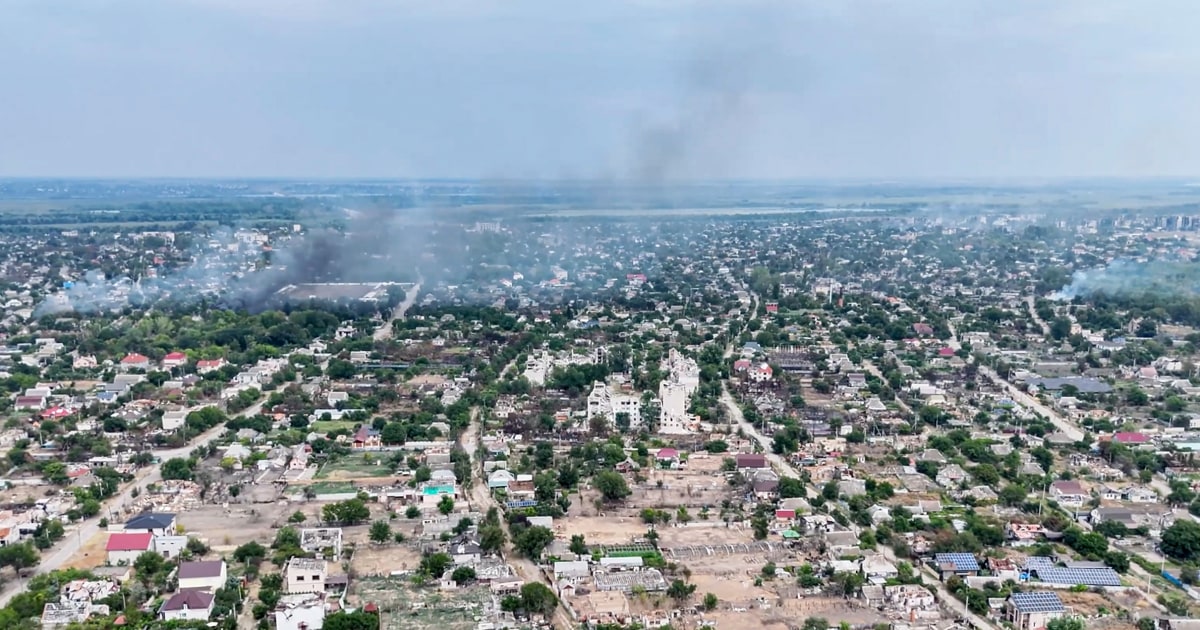
Oleshky has been under Russian control since the early weeks of the invasion. Drone footage verified by NBC News shows charred residential and administrative buildings, a town reduced to ruins. Those who remain—roughly 2,000 people, mostly elderly—have been cut off from food deliveries since late May, according to the UN Human Rights Monitoring Mission in Ukraine. Internet and cellphone service are severely compromised. Winter is approaching.
Ukraine accuses Russian forces of mining roads and using civilians as human shields. Russia blames Kyiv for drone strikes that prevent aid from entering. Both sides have traded blame for months. The Kremlin acknowledged supply problems last month but offered no concrete solution. Ukrainian media has featured interviews with escapees who described choosing between mine detonation and starvation.
Pope Leo XIV raised the crisis with Vladimir Putin. European Parliament Vice President Pina Picierno went on a hunger strike, saying the people of Oleshky “cannot be abandoned.” The international community watched helplessly.
Then Trump intervened.
The Mechanics of an Unconventional Deal
The White House statement said Trump leveraged a communication channel established through her humanitarian campaign to bring about the ceasefire. That channel presumably connects to Russian counterparts she has engaged while advocating for the return of Ukrainian children—a cause that has drawn bipartisan support and positioned her as a neutral figure in a conflict where formal diplomacy has stalled.
Whether that channel includes direct lines to Kremlin officials or operates through intermediaries remains unclear. What is clear is that the arrangement bypasses the structured diplomatic processes that normally govern ceasefire negotiations. There was no multilateral framework. No OSCE monitoring. No formal treaty language. Just an American first lady stepping into a vacuum.
Ukrainian President Volodymyr Zelenskyy acknowledged the deal but voiced skepticism about Russian intentions. He told TSN TV that Russia would “do everything it can to clear the roads of mines so that these people head toward Russia and stay there.” His forces would need to verify the area is secure before any evacuation proceeds. The ceasefire is expected to last only several days.
President Donald Trump has also signaled that this arrangement could serve as a model for similar humanitarian agreements elsewhere. Kremlin spokesman Dmitry Peskov called the American involvement “highly positive.”
What This Means for the Peace Process
The Oleshky ceasefire is a tactical achievement, not a strategic breakthrough. It addresses an immediate humanitarian emergency without resolving the underlying conflict. But its implications extend beyond the town itself.
First, it demonstrates that informal channels can produce results where formal ones have failed. The Trumps’ children-repatriation campaign created a lifeline that proved useful in Oleshky. That is not nothing. Humanitarian outcomes matter, and every civilian saved is a victory against the grinding violence of war.
Second, it raises questions about the role of unofficial diplomacy in an era when formal institutions appear paralyzed. The State Department has been locked in protracted debates over weapons deliveries. Starlink service to Ukraine was reportedly slowed. Interceptor missiles were held up. Meanwhile, a first lady with a separate agenda was brokered a ceasefire through a backchannel.
This is not a new phenomenon. Backchannels have long been part of diplomatic practice. Henry Kissinger’s secret trips to Beijing in 1971 operated outside official frameworks. The Oslo Accords were negotiated through unofficial tracks before being formalized. But those examples involved professional diplomats working in the shadows. Melania Trump is not a diplomat. She is a former model and former first lady with her own political brand and her husband’s executive authority.
Third, the arrangement exposes the fragility of U.S. policy toward Ukraine. President Trump has already reversed years of American sanctions policy by allowing Russia to supply diesel to the global market, a move designed to lower prices ahead of midterm elections. He has waived sanctions. He has pressured Kyiv to negotiate. And now his wife is brokering ceasefires through informal channels.
The message to Ukraine is ambiguous at best. Is the United States committed to its sovereignty? Is it pushing for a deal? Or is it testing the waters for a negotiated settlement that favors Russian interests?
Kyiv has complained about gaps in intelligence sharing and a slowdown of Starlink service. Both have been restored, according to Ukraine. But the underlying tension remains: the U.S. is both Ukraine’s primary supporter and the country whose president is pressuring Kyiv to accept terms Moscow has rejected.
The Politics of Humanitarian Action
There is no denying the moral clarity of the Oleshky intervention. Two thousand people are facing starvation. Children are at risk. The elderly are trapped. Any action that brings aid to them is justified on humanitarian grounds.
But justification is not the same as strategy. The administration is using a humanitarian crisis to demonstrate the effectiveness of informal diplomacy—an approach that could prove useful in other contexts but also sets a precedent for bypassing established institutions.
The inclusion of an “impartial American media organization” to document the process suggests the administration wants to control the narrative. This is not a modest humanitarian gesture. It is a staged event designed to showcase American leadership and the Trumps’ unique ability to operate outside conventional frameworks.
That is not inherently bad. Conventional frameworks have failed to produce a comprehensive peace deal. The war continues. Civilians suffer. If informal channels can save lives while formal ones stall, they deserve a chance.
But the risk is that humanitarian action becomes a tool for political positioning rather than a genuine effort to resolve conflict. The Oleshky ceasefire could be a model for future arrangements—or it could be a one-off stunt that distracts from the harder work of diplomacy.
What Comes Next
The ceasefire is likely to hold only as long as both sides find it useful. Russia may use the pause to consolidate its position in Oleshky or relocate residents deeper into occupied territory. Ukraine may exploit the window to gather intelligence or reposition forces. Neither side has an incentive to make this a permanent arrangement.
The real test will come if similar humanitarian crises emerge elsewhere. Can the Trumps replicate this model? Will other towns become bargaining chips in a larger negotiation? Or will Oleshky remain an exception—a reminder of what informal diplomacy can achieve when formal mechanisms fail?
One thing is certain: the line between private initiative and official policy has never been blurrier. Melania Trump’s channel to Moscow exists because her husband controls the levers of American power. Her humanitarian campaign gained traction because she operates outside the constraints that bind professional diplomats. The Oleshky ceasefire is a product of that ambiguity.
It is also a preview of what American diplomacy may look like if the current trajectory continues—informal, unpredictable, and responsive to immediate crises but disconnected from the long-term strategies that have historically guided U.S. foreign policy.
Whether that is a feature or a bug depends on your perspective. For the 2,000 people in Oleshky, it is a lifeline. For the peace process, it is a question mark.
The war in Ukraine will not be resolved by ceasefires in isolated towns. But if informal channels can keep civilians alive while diplomats deliberate, perhaps that is enough—for now.