Meta's $1,300 VR Glasses Are a Statement About Where the AR Race Actually Stands
Meta's first official AR glasses announcement reveals a company willing to trade immersion for wearability. At $1,300 with Spring 2027 shipping, the question isn't whether it's good enough—it's what it says about Apple's Vision Pro trajectory.
The Split-Architecture Gambit
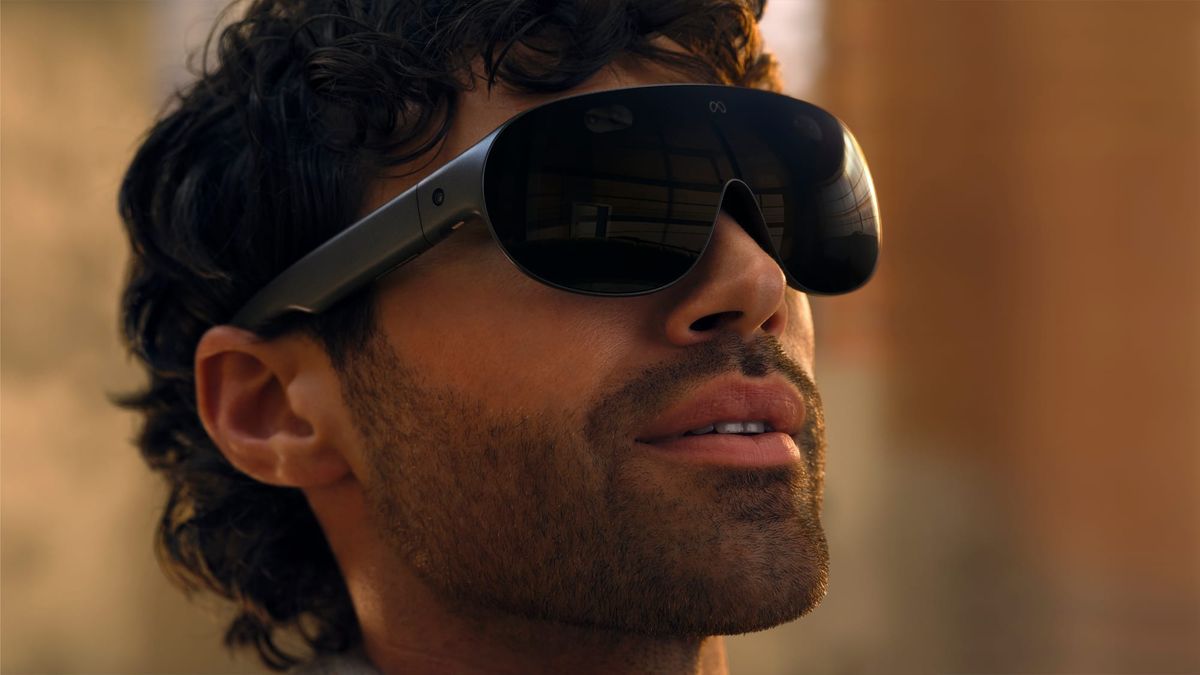
Meta’s decision to ship its first glasses-shaped device with a 300-gram computing puck isn’t an engineering compromise—it’s a philosophical one. By offloading the Snapdragon Reality Elite chipset, 12GB of RAM, battery, and all processing to a tethered brick, Meta has bought itself permission to make the glasses themselves weigh just 100 grams. That number matters more than anything else about this device.
A Quest headset sits at roughly 515 grams. Apple’s Vision Pro? A hefty 650 grams. Meta’s glasses land closer to high-end sunglasses than a traditional VR rig. The trade-off is a field of view that peaks at roughly 87 degrees diagonal compared to the Quest 3’s more immersive 110 by 96 degrees. Meta is explicitly betting that what users will actually wear all day isn’t the most immersive headset available—it’s the one that doesn’t feel like a gas mask.
This is a direct rejection of the path Apple took with Vision Pro, which prioritized display quality and sensor density on a device no one will wear for more than an hour without fatigue. Meta is instead positioning the glasses as a practical workspace and entertainment companion—the kind of device you’d carry in a bag and pull out at a coffee shop or on a train.
The Price Signal
$1,300 puts Meta VR Glasses firmly in enthusiast territory, but the arithmetic is telling. Apple’s Vision Pro launched at $3,500 and has struggled to gain traction. Google’s AR Glasses project was cancelled entirely after years of development. Even Xreal’s Aura device—Meta’s closest analog on the open platform side—has kept its pricing opaque, suggesting the Chinese manufacturer hasn’t cracked the cost equation either.
At $1,300 Meta is pricing itself in a strange middle ground: accessible enough relative to Vision Pro to seem almost reasonable, expensive enough that it won’t move the needle on mainstream adoption. The real play here isn’t volume at launch. It’s establishing a form factor standard. If Meta can make the puck-and-glasses architecture feel normal—like a wired gaming headset rather than a futuristic contraption—it creates a template competitors will have to match or leapfrog.
The absence of controllers by default is another calculated signal. Meta is saying this isn’t primarily a gaming device, even though it will run the same Quest 3 software library. Hand tracking becomes a first-class feature, not an afterthought, with the launch of games like Flux, a hand-tracked Beat Saber mode. Optional tracked controllers are available separately, which means the default experience is designed for casual spatial interaction rather than precision gaming.
The Specifications Tell a Different Story Than the Form Factor
Under the hood, Meta VR Glasses are packing the highest-resolution display Meta has ever shipped. Dual 120Hz micro-OLED panels at 2412 by 2288 pixels per eye deliver 37 pixels per degree in the foveated rendering sweet spot—surpassing even Quest 3’s 25 PPD central resolution. Dolby Vision HDR support and IMAX Enhanced certification signal that Meta is serious about the media consumption angle: private cinema, multi-monitor workspace, portable game console, all in a device that fits in your bag.
The USB-C DisplayPort passthrough capability is quietly significant. For the first time on a Meta standalone device, you can plug in a phone, laptop, or gaming handheld and see its output as a virtual screen. This turns the glasses into a monitor replacement without any proprietary ecosystem lock-in. It also means Steam Deck owners, iPhone users, and anyone with a USB-C laptop can use the glasses without Meta’s approval—a potential wedge into markets Meta doesn’t directly control.
Hologram avatars represent Meta’s longest-term bet. The launch version is stereoscopic video streaming with fixed perspective, not true volumetric rendering. But Meta’s roadmap calls for evolving it into a full 6DoF system that would supersede the cartoon Meta Avatars currently used across the platform. If that happens, it fundamentally changes the social dimension of VR—moving from abstract representations to photorealistic presence that works across devices.
What This Means for Apple
Apple’s Vision Pro has occupied the premium spatial computing space at $3,500, and the market response has been tepid. Reports suggest Apple is already working on a lower-cost version and has scaled back its near-term ambitions. Meta’s $1,300 glasses with comparable or superior display technology and a form factor people can actually wear chronically creates an uncomfortable comparison.
The real pressure on Apple isn’t the price gap—it’s the directionality. Meta is building toward glasses that look like regular eyewear and function as everyday companions. Apple is building toward a headset that looks like a headset and demands intentional use sessions. If Meta’s approach gains any traction, the narrative around spatial computing shifts from “immersive escape device” to “always-on information layer,” which is a fundamentally different product category with different winners.
Apple’s answer will likely involve lighter hardware and possibly a separate compute module, but the company has historically been unwilling to fragment its product line the way Meta is experimenting with here. That discipline is a strength for user experience but a liability when the market is still figuring out what form factor it wants.
The Narrow Field of View Problem
The 70-by-66-degree field of view is the most conspicuous specification on paper. At 87 degrees diagonal it falls well short of the Quest 3’s roughly 105-degree diagonal immersion window. For pure VR experiences with light blockers attached, this will feel noticeably less enveloping. The open-periphery design becomes a liability when you want to disappear into a virtual environment.
But this is precisely Meta’s argument. The glasses are designed for mixed reality—the real world is always visible at your sides and below. In that mode, the narrower FOV is arguably irrelevant because you aren’t trying to block out everything around you. The 100-gram weight, the natural view of your environment, the ability to walk through your living room without removing a device—that’s the value proposition, and it only makes sense if you’re not using the glasses as a pure VR headset.
This means early reviewers who judge the device against Quest 3’s immersion standards will miss the point entirely. The comparison should be with smartphone screens, laptop displays, and perhaps Augmented Reality overlays—not with dedicated VR headsets.
Who Wins and Who Loses
Meta wins by defining a category before competitors can articulate one. A $1,300 tethered-glasses platform with controller-free hand tracking, high-resolution displays, and cross-device USB-C compatibility gives developers and creators a concrete target to build for. The software ecosystem benefits from backward compatibility with Quest 3 titles, lowering the barrier for content creators.
Consumers who want an always-wearable spatial device win, though at a price that won’t feel like a no-brainer. The $1,300 tag is aggressive for a first-generation product with a tethered architecture that some will find constraining. Those expecting true untethered glasses-like experience will be disappointed until battery and chip technology catch up.
Apple loses the most visible battle here, even though Vision Pro’s $3,500 price keeps the two products from occupying the same market segment. The damage is narrative: Meta is proving that spatial computing doesn’t require Apple’s level of hardware integration or price premium to deliver a compelling experience. Every Meta glasses owner becomes a living advertisement for an alternative approach.
Xreal and other Android XR platforms occupy an ambiguous middle ground. The Xreal Aura uses the same Snapdragon Reality Elite chipset and appears to target a similar use case, but without Meta’s software ecosystem or brand recognition. Whether Xreal can differentiate on price or openness remains unclear.
What Comes Next
Spring 2027 is still a year away, and first-generation tethered glasses will inevitably face gripes about the cable, the puck’s battery life, and the learning curve of controller-free interaction. The hand-tracking game library—including Flux and the expanded catalog—will determine whether the no-controllers approach feels liberating or limiting.
The more consequential metric is whether developers take Meta’s platform seriously. If the USB-C passthrough and open ecosystem attract third-party builders, the glasses become a genuine computing platform rather than a closed entertainment device. If they remain a curated media consumption tool, the $1,300 price becomes harder to justify.
Meta’s longer play is obvious: make the puck small enough to disappear, shrink the glasses to true spectacle weight, and solve the battery problem. Each generation gets lighter, cheaper to produce, and more capable. The company isn’t selling a finished product in 2027—it’s selling a direction.
The AR race has a new cadence, and Meta just set it.