North Korea Opens China Bridge After 12-Year Wait — Why It Matters
North Korea and China have officially opened a long-delayed bridge linking Sinuiju and Dandong, capping a 12-year standoff. The move deepens economic ties with Beijing while raising fresh concerns about sanctions enforcement in the region.
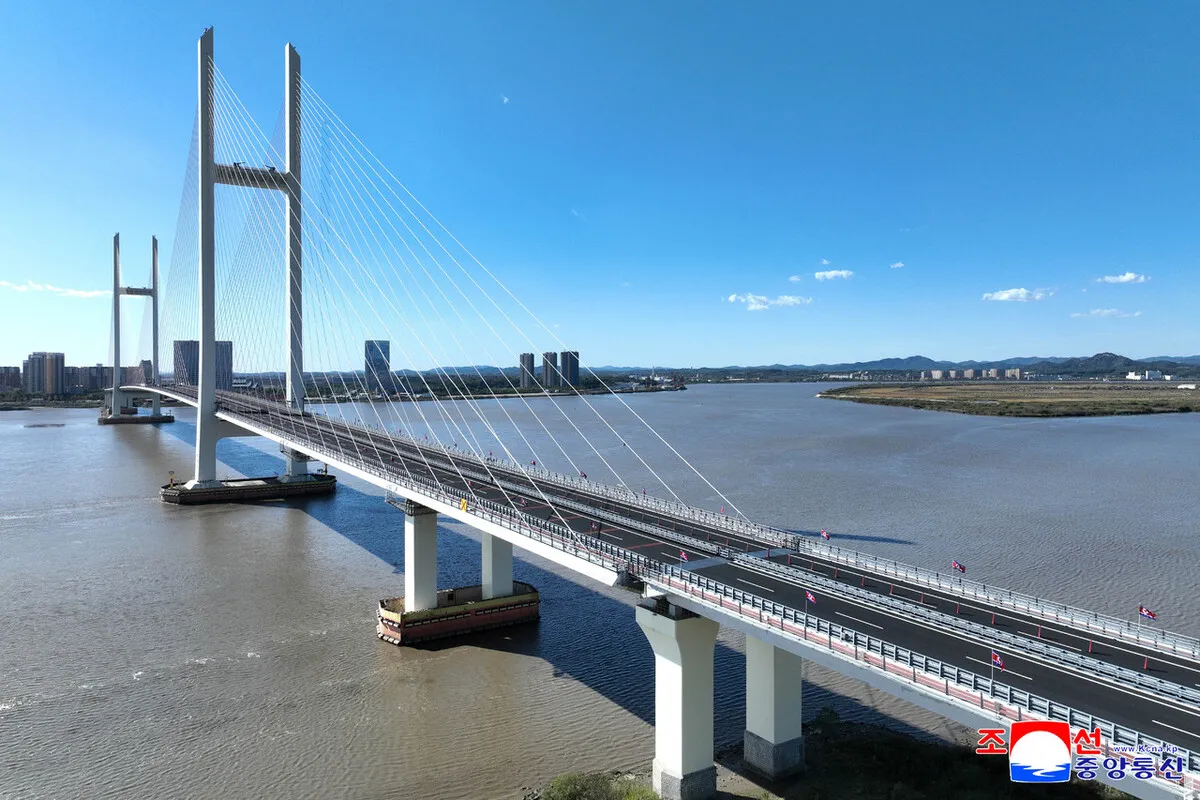
A bridge finally opens — after more than a decade of holding its breath
North Korea and China officially opened the new Yalu River Bridge on Wednesday, completing a crossing that has sat idle since 2013. The 3,030-meter, four-lane structure connecting Sinuiju in North Korea and Dandong in China’s Liaoning province was built at a cost of roughly 2.2 billion yuan — about $300 million — entirely funded by Beijing.
Twelve years later, it finally has traffic. That alone makes the announcement notable. But the real story isn’t the steel and concrete. It’s what the opening signals about where Pyongyang and Beijing are heading together, and what that means for the rest of the world.
The timing says something
North Korea’s state media, KCNA, broke the news on the 16th, confirming the opening ceremony took place on the 15th. The photos were significant: Kim Tae-sung, North Korea’s premier, and Li Qiang, China’s premier, both delivered video speeches from afar. But the physical attendees told a more grounded story. Li Yong-nam, North Korea’s ambassador to China, stood alongside Yang Myong-chol, the ruling party secretary for North Pyongan Province — the province that directly borders China. On the Chinese side, Ma Zhongshu, China’s consul general in Shenyang, and Wang Yajun, the Chinese ambassador to North Korea, were present. So was Xu Kulin, secretary of the Liaoning provincial committee of the Chinese Communist Party.
This wasn’t a symbolic photo op. Provincial-level party officials showed up. Those are the people who handle cross-border logistics, customs coordination, and trade infrastructure. Their presence indicates that the bridge is not just being opened — it’s being prepared for regular use.
What the speeches revealed
Li Qiang’s remarks, as reported by Rodong Sinmun, carried a message aimed squarely at Washington and Seoul. “No matter how the international situation changes,” Li said, “the Chinese Communist Party and government’s firm stance of highly valuing China-North Korea friendship will not change. The firm resolve to protect the common interests and strategic environment of both sides will not change.”
That language is deliberate. It frames the bridge as more than an infrastructure project — it is a pledge of continuity. North Korea’s premier, Kim Tae-sung, echoed the sentiment, adding that the bridge would “add new momentum to mutually beneficial economic cooperation.” Notably, Kim’s remarks did not appear in Xinhua’s English-language coverage of the event. That omission speaks volumes: Beijing is amplifying the diplomatic messaging while leaving the economic promises for bilateral channels.
Why the bridge stalled for so long
Understanding the delay matters. The bridge was completed in 2013 under improved relations between Kim Jong-un and Xi Jinping. But crossing never became routine. The reasons were practical and political. North Korea’s side of the border lacked adequate inspection facilities. Infrastructure for customs, quarantine, and passenger processing was minimal. Then the pandemic hit — and the bridge effectively froze in place for most of 2020 through 2022.
But even before COVID, there was a deeper structural issue: North Korea’s reluctance to allow increased human contact with China. Open borders mean more information, more movement, more exposure. Pyongyang has historically treated controlled access to its Chinese border as a security priority, not an economic opportunity.
The fact that the facility has now been upgraded with modern inspection buildings and quarantine stations — as Rodong Sinmun itself noted — suggests that North Korea has recalibrated its calculus. Something has changed.
Who benefits, and what changes
For North Korea, the bridge is an economic lifeline. China is already its largest trading partner, accounting for roughly 90% of its foreign trade by most estimates. Sanctions have narrowed legal trade to a fraction of that, but the bridge creates the possibility — and the temptation — for expanded cross-border movement of goods and people.
For China, it is a strategic investment paying dividends. Liaoning province, particularly Dandong, has long been the commercial gateway to North Korea. A functioning bridge boosts local businesses, increases demand for logistics services, and gives Beijing a tangible lever of influence over Pyongyang. It also reinforces China’s position as the primary economic backer of the North Korean regime — a role it is clearly comfortable occupying.
For the United States and South Korea, the bridge is a reminder that sanctions enforcement remains uneven. The structure was funded and built by China. It opened with Chinese and North Korean officials present. No third party was invited. That reflects a broader pattern: when it comes to the North Korean border, Beijing’s operational control is near-total, and Washington’s ability to monitor or shape outcomes is limited.
The sanctions question
The United Nations sanctions regime prohibits North Korea from exporting key commodities and restricts many forms of financial transactions. A functioning border crossing makes enforcement harder, not easier. Goods can be mislabeled. Inspections can be superficial. Revenue can flow through informal channels.
This is not speculation. Border crossings between China and North Korea have been the subject of repeated UN monitoring reports documenting evasion tactics. The new bridge, with its modernized facilities, raises the stakes. Whether it leads to systematic violations depends on how rigorously Chinese authorities choose to enforce existing rules — and historical evidence suggests that choice is not always made strictly.
What happens next
The immediate next step is operational testing. Both sides need to run customs, immigration, and quarantine procedures at scale. Initial traffic will likely be limited to official and business travelers, with freight following gradually. Full commercial operation could take months, possibly years.
But the symbolism is already doing work. Pyongyang has used the opening to reinforce its narrative of resilience and partnership with Beijing. Beijing has used it to demonstrate that its commitment to North Korea is durable regardless of external pressure. Both regimes gain from a visible act of cooperation that bypasses Western diplomatic channels entirely.
For the rest of the world, the open bridge is a quiet signal: North Korea’s economic lifeline remains firmly in Chinese hands, and China shows no sign of tightening the grip. The question now is not whether the bridge will be used. It is how much, and at what cost to the sanctions architecture that has defined the international response to North Korea for two decades.