North Korea Moves Howitzers to Border—A Tactical Shift, Not Just Show
North Korean 122mm self-propelled howitzers have been spotted deployed within sight of the DMZ at Kaepung County, a move that brings northern Gyeonggi into artillery range and marks the most serious escalation signal since 2018.
What North Korea’s Artillery Move Actually Says
The picture is straightforward enough, and that is precisely why it matters.
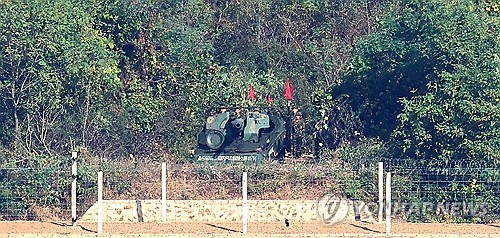
On October 25, soldiers manning the Aegibong observation point in Gimpo caught a view most analysts did not expect to see again: North Korean troops conducting live-fire drills with what appear to be 122mm self-propelled howitzers in the coastal border area of Kaepung County, Hwanghae Province. The vehicles are positioned so close to the line of contact that they are visible through telescopic cameras across the demilitarized zone. That alone is unusual. But the implications go well beyond a display of visible hardware.
This is not a routine training exercise. It is a deliberate, observable shift in North Korea’s military posture that deserves serious attention from Seoul, Washington, and any observer tracking the peninsula’s trajectory.
The Numbers Behind the Deployment
The 122mm howitzers in question have an effective range of approximately 15 to 24 kilometers, depending on the ammunition type. Kaepung sits roughly 10 to 15 kilometers from the Military Demarcation Line. That places significant portions of northern Gyeonggi Province—including Geumcheon, Ilsan, and areas extending toward central Seoul itself—within direct artillery reach.
North Korea has long maintained artillery in the border region. What changed is the nature of the deployment. Previously, these systems were concealed or parked in hardened positions that required satellite intelligence or special surveillance to confirm. Now they are positioned openly on the coastline, in full view of South Korean observers, with soldiers maneuvering red flags and conducting what appears to be live coordination drills.
This is an intentional signaling strategy. North Korea is removing the ambiguity.
The Propaganda Component
Perhaps the most striking detail in the footage is not the artillery itself but what is written on it. North Korean soldiers have painted anti-US propaganda slogans directly onto the armor plating of the howitzers. This is not standard military practice for combat-ready units. Propaganda on weapon platforms is meant to be seen. The message is layered: it targets South Korean audiences, it communicates resolve to domestic viewers, and it sends a calibrated signal to Washington.
The combination of visible deployment and visible messaging means North Korea is attempting to control the narrative around its own military movements. It is telling the world what to look at and how to interpret it.
The Context That Matters
This deployment does not occur in a vacuum. On October 19, Kim Yo-jong, the powerful deputy secretary of the Workers’ Party of Korea and Kim Jong-un’s younger sister, released a statement announcing that North Korean military command was reviewing two specific responses: reinforcing tactical strike assets near the southern border and resuming loudspeaker broadcasts aimed at South Korea.
The Kaepung deployment is the physical manifestation of that review. Whether the full scale of reinforcement has been completed or remains in progress is unclear. But the opening salvo of the announcement has already been delivered in steel and gunpowder, not words.
The loudspeaker controversy is also significant. Inter-Korean loudspeaker broadcasts have been a recurring source of tension since the two countries resumed the practice in recent years. Kim Yo-jong’s framing of loudspeaker resumption alongside military reinforcement suggests Pyongyang is treating psychological operations and kinetic positioning as a unified response strategy, not separate tools.
Who Wins, Who Loses
The immediate winner in this dynamic is North Korea’s leadership, which has successfully forced both Seoul and Washington to respond without committing further to a specific military action. By positioning artillery visibly but not firing, Pyongyang maintains plausible deniability while raising stakes. It is a classic escalation management technique: make the threat observable without crossing the threshold that would justify a counterstrike.
South Korea faces a difficult calculus. Acknowledging the deployment publicly validates North Korea’s signaling strategy. Ignoring it risks appearing indifferent to a capability that directly threatens civilian populations. The most likely response is measured condemnation paired with heightened surveillance, which satisfies domestic political requirements without escalating the situation.
The United States confronts a credibility question that extends far beyond the Korean Peninsula. Extended deterrence commitments depend on demonstrating that threats against allies produce credible responses. A visible artillery deployment along the DMZ tests that dynamic. If Washington responds with statements alone, the deterrent value weakens. If it responds with military posture adjustments, the cycle of escalation intensifies. There is no clean path.
What Comes Next
The most probable trajectory is incremental escalation. North Korea has signaled intent; the question is whether it follows through on the threatened reinforcements and loudspeaker resumption. Both are low-cost, high-signal actions that increase pressure without triggering armed conflict. They are the Korean Peninsula equivalent of gray-zone tactics, designed to erode the status quo slowly enough that each step remains deniable while cumulatively shifting the balance.
Seoul’s response will determine much of what happens next. A firm but restrained posture would likely contain the escalation. A disproportionate reaction could provide Pyongyang the pretext it needs to accelerate its plans. The risk is that miscalculation, not malice, drives the situation forward.
The deployment at Kaepung is not an act of war. It is something more dangerous: a demonstration of capability and willingness that redefines the new normal without firing a shot. Observers who dismiss this as propaganda will miss the point. The artillery is real. The range is real. The intention is real. The question now is whether anyone on any side is ready to act on what they see.