North Korea's Russia Gambit Shows Hidden Diplomatic Choreography
Kim Jong Un's closest aide traveled to Russia days after his international secretary flew to Beijing, revealing a coordinated diplomatic push against the backdrop of a looming US-China-Russia trilateral summit.
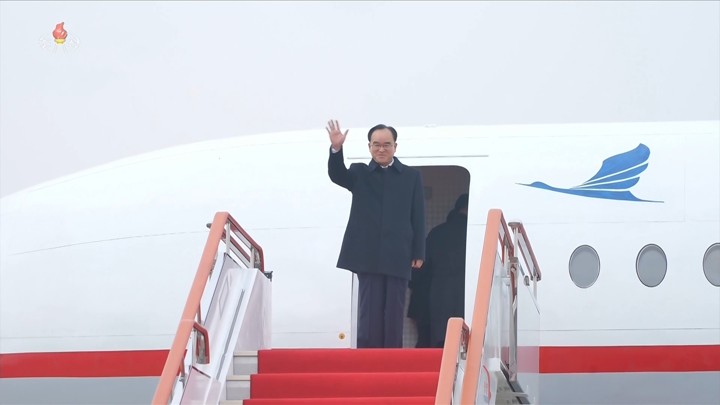
The Plane That Spoke Louder Than Words
When Cho Yong-won, one of Kim Jong Un’s most trusted lieutenants, stepped onto a North Korean special aircraft at Pyongyang International Airport on November 14, he wasn’t alone. Choe Son-hui, the foreign minister, saw him off. So did Kim Sung-nam, the party’s international secretary. And so did Andrei Podolyshchev, Russia’s ambassador to Pyongyang. The scene was staged deliberately — every person present understood exactly what this departure meant.
By the next day, Cho had landed in Moscow. His host: Dmitry Medvedev, former prime minister, former president, and now chairman of the ruling United Russia party. The timing was no accident. All told, this happened days before a planned US-China-Russia trilateral summit.
South Korea’s Unification Ministry noted the coincidence publicly, but missed its significance. The ministry called the visit noteworthy because of its timing, without recognizing it as part of a pattern.
That pattern tells a story Western capitals continue to misread.
Two Trips, One Strategy
The crucial detail the Yonhap report buried in passing: Kim Sung-nam had just returned from China, where he spent November 3 through 7 meeting Vice Minister Liu Haixing of the Communist Party’s External Liaison Department, Politburo Standing Committee member Cai Qi, and Foreign Minister Wang Yi. That was a full-spectrum Chinese engagement — party-to-party and state-to-state handled simultaneously.
Then came the Russia visit, also led by a joint party-government delegation. As the Unification Ministry itself observed, this was different from Kim’s recent China trip precisely because of its dual composition: both the Workers’ Party and the government were represented.
What looks like separate bilateral visits is actually a single campaign. Pyongyang is making parallel appeals to both Moscow and Beijing before the great powers gather to discuss global architecture. The message is clear: if you’re going to redraw lines, make sure your oldest allies are standing beside you first.
Western intelligence watchers tend to analyze North Korean diplomacy through the lens of nuclear provocations and missile tests. They look for leverage in sanctions evasion and weapons transfers. What they miss is the routine diplomatic infrastructure that has quietly been rebuilt over the past several years — a network that allows Pyongyang to operate at the highest levels of other capitals with the same ease that Seoul struggles to maintain its alliances abroad.
Why This Matters Beyond the Peninsula
The US-China-Russia trilateral talks represent the kind of gathering the Biden and Trump administrations have long warned could address regional security issues including North Korea. Pyongyang’s preemptive coordination with both countries signals that Kim understands perfectly well this conversation will happen — and intends to ensure his voice is already embedded in whatever framework emerges.
This is not reactive diplomacy. It is anticipatory. North Korea isn’t waiting for Washington and Beijing to make up their mind and then scrambling to respond. It is positioning itself inside those conversations before they begin.
The Cho-Medvedev meeting carries additional weight because of Medvedev’s status. As head of United Russia, he controls the legislative agenda in the Duma and functions as Putin’s proxy in many domestic matters. A party-level meeting doesn’t just signal warmth — it signals institutional alignment. Whatever was discussed in Moscow likely touched on economic cooperation frameworks, energy deals, or military-technical arrangements that fall outside formal state channels but move just as fast underneath them.
The Intelligence Blind Spot
There is a persistent assumption in American policy circles that North Korean diplomacy moves slowly and clumsily, driven by internal factional wrangling and unpredictable leadership whims. The evidence since 2024 contradicts this squarely.
Kim Sung-nam’s Beijing trip and Cho Yong-won’s Moscow trip were planned independently but executed in concert. Both were covered by the same delegation structure. Both targeted the same moment in the international calendar. Both followed the same protocol:
party elders meet party elders, ministers meet counterparts, and the leader’s closest confidants do the traveling instead of the leader himself.
This is the playbook of a state that has mastered low-cost, high-leverage diplomacy. Pyongyang does not need to match American or European spending on embassies, foreign aid, or cultural institutes. It needs one reliable channel into each capital, operated by someone Kim trusts implicitly, deployed at precisely the right moment.
Cho Yong-won is that person for Russia. Kim Sung-nam serves the same function for China. Their repeated appearances together at airports and state banquets should be read not as ceremonial pageantry but as evidence of operational integration.
What Comes Next
The immediate question is whether the US-China-Russia trilateral summit yields any concrete outcome on North Korea. The more important question — and the one Western policymakers should be answering — is whether Pyongyang’s shadow diplomacy has already secured enough insurance that whatever emerges from those talks can be neutralized or co-opted regardless of the terms.
If North Korea is correct that the great powers will prioritize broader strategic competition over peninsula stability, then its current approach is rational: deepen ties with both Russia and China now, lock in guarantees, and prepare for the possibility that Washington treats the Korean issue as a bargaining chip rather than a commitment.
Cho Yong-won’s plane may have left Pyongyang on November 14, but the destination was always Moscow.
And the real journey — the one determining where North Korea stands in the next international order — has only just begun.