North Korea's Extra Uranium: Why 35 Kilograms Redraws Deterrence Math
Satellite imagery shows North Korea adding enough centrifuges at Yongbyon for another 35 kg of weapons-grade uranium yearly. That's not just incremental — it shifts the calculus for Seoul and Washington.
A modest number with outsized consequences
Thirty-five kilograms. That is barely more than what you would weigh on a kitchen scale set to metric. Yet according to the latest intelligence from satellite imagery and agency reporting, that is how much additional high-enriched uranium North Korea is now positioned to produce each year through newly expanded facilities at Yongbyon.
It sounds like a bureaucratic footnote. It is not. Every additional thirty-five kilograms pushes Pyongyang closer to warhead production cycles that were already accelerating, and it does so in ways that complicate both Seoul’s defense planning and the credibility of American security guarantees on the Korean Peninsula. The real danger lies not in any single stockpile milestone but in the trajectory it locks in — a compounding engine of fissile material that grows more expensive and difficult to interrupt the longer it runs unchecked.
What the satellites actually show
According to Wall Street Journal reporting, a satellite image captured on November 6 revealed new construction physically connected to North Korea’s principal uranium enrichment building at the Yongbyon complex. IAEA Director General Rafael Grossi confirmed the timeline: external construction began around mid-September and was finished by late October.
Sam Lister, a nuclear and missile programs specialist at the Foreign Policy Research Institute who first identified the construction activity, told reporters the purpose of the new structure remains ambiguous. It could house administrative space, new control equipment, or performance upgrades for existing centrifuges. But Lister also flagged something more consequential: if the facility includes new centrifuges, the capacity estimate of thirty-five-plus kilograms of HEU per year is not only plausible — it may be conservative.
Beyond the physical footprint, analysts are tracking secondary indicators that reinforce the reading. Power consumption patterns at the site have ticked upward since late summer, consistent with active centrifuge operations rather than mere structural completion. Thermal signatures detected in infrared satellite passes suggest machinery installed and warming within the new enclosure. Together, these data points narrow the window between “possible upgrade” and “likely operational expansion,” even as Pyongyang maintains its customary opacity about exact centrifuge counts and enrichment cascades.
The arithmetic of escalation
Here is why the thirty-five-kilogram figure matters beyond the headlines.
Vertic, the UK-based arms control verification organization, previously estimated North Korea could produce up to three hundred seventy-five kilograms of HEU annually across its enrichment infrastructure. In June, after the discovery of large-scale new facilities at Yongbyon, Vertic revised that upward by roughly one hundred sixty kilograms — a seventy-five percent increase in a single jump.
This latest expansion stacks on top of that. Thirty-five kilograms is not an isolated event. It represents compounding growth in a program that has already accelerated dramatically. Each new kilogram of weapons-grade uranium represents roughly half a dozen additional nuclear warheads North Korea could fabricate, depending on design efficiency. At current production rates, Pyongyang could plausibly double its HEU output within two to three years if existing construction timelines hold and no external intervention disrupts the cascade lines.
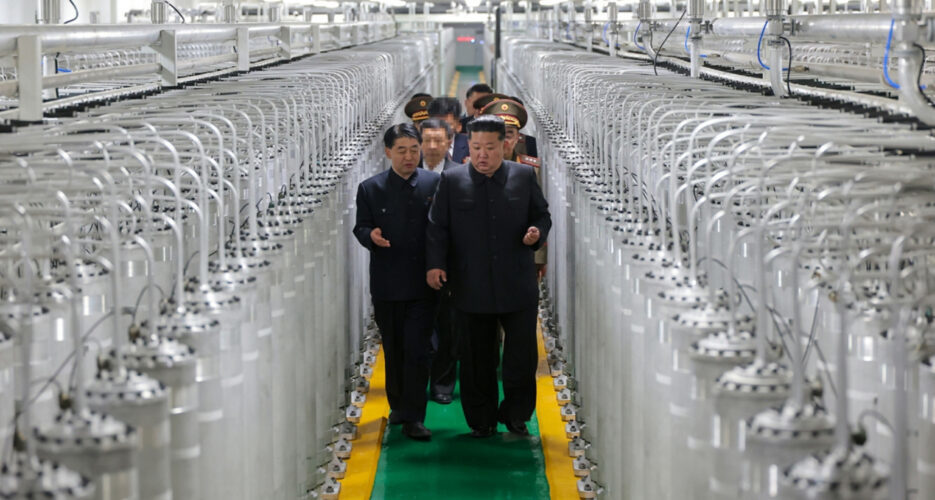
Kim Jong Un himself underscored the military logic of this expansion. During his June inspection of the new enrichment facilities, he posed for photographs beside rows of installed centrifuges and explicitly directed scientists to ramp up production of weapons-grade fissile material. His visible presence at the site signals that the leadership treats these additions not as industrial infrastructure projects but as direct contributions to strategic capabilities — a deliberate choice to personalize the program’s trajectory and bind it to his own authority.
Plutonium runs parallel to uranium
Complicating the picture further is Grossi’s warning that North Korea’s five-megawatt plutonium-producing reactor at Yongbyon appears likely still operational. While the recent satellite evidence centers on uranium enrichment, the dual-track nature of North Korea’s nuclear program means Washington and Seoul cannot treat HEU and plutonium pathways independently.
If both reactors are producing weapons-grade material simultaneously — which current evidence suggests they are — then the total fissile output from Yongbyon alone could support a significantly larger warhead stockpile than previous assessments indicated. The thirty-five-kilogram HEU addition is only part of the story. Open-source estimates place North Korea’s cumulative plutonium stockpile at roughly fifty to sixty kilograms, already sufficient for seven to ten additional warheads. When combined with the accelerating HEU stream, the fissile envelope supporting Pyongyang’s arsenal widens substantially every quarter.
Second-order effects on alliance dynamics
The immediate consequence falls on South Korea. A North Korean fissile inventory growing at this pace alters the threat calculus that underpins Seoul’s defense budgeting, force posture decisions, and alliance negotiations with Washington. Within months of the Yongbyon revelations, South Korean defense planners have begun stress-testing scenarios that assume a North Korean arsenal capable of saturating layered missile defenses — a threshold heretofore considered distant rather than imminent.
That assumption ripples outward. Seoul is likely to accelerate procurement of long-range strike capabilities, including South Korean-manufactured cruise missiles with ranges exceeding eight hundred kilometers, narrowing the gap with North Korean deep-strike assets. It may also renew pressure on Washington to reposition additional strategic assets — such as B-2 bombers and Truman-class carrier strike groups — into the western Pacific on a more permanent rotational basis, straining already contested deployment windows.
For Japan, the implications cut in the same direction. Tokyo has already moved toward acquiring counterstrike capability and expanding its own missile defense architecture. A North Korean HEU production curve that steepens further will make those investments seem prudent rather than provocative to a broader Japanese public, potentially normalizing capabilities that earlier administrations treated as crossing a red line.
For the United States, the expansion arrives at an awkward diplomatic moment. President Donald Trump reportedly floated the possibility of a summit with Kim Jong Un during his recent Asia tour. No meeting materialized. The timing suggests Kim is not feeling pressure to engage — and that the new enrichment capacity gives him precisely the kind of confidence to sit tight rather than negotiate away assets that are only increasing in value.
What comes next
Nothing in the reporting indicates North Korea will slow its enrichment campaign. The physical construction at Yongbyon continues past the point where external appearances suggest completion. If new centrifuges are being installed inside those freshly enclosed structures — as multiple analysts consider likely — then the thirty-five-kilogram annual addition may eventually prove an underestimate.
Seoul will need to account for a steadily larger North Korean arsenal without necessarily waiting for confirmation from Washington on whether extended deterrence commitments remain credible at current levels. Washington, meanwhile, faces the political reality that the path back to meaningful negotiation requires Pyongyang to view its fissile production as negotiable — an assumption that no longer holds.
The most probable near-term outcome is not dramatic escalation but persistent accumulation: North Korea continuing to squeeze incremental gains from Yongbyon while testing whether the international community will respond to each new piece of infrastructure with calibrated cost imposition or resigned acceptance. Whoever wins that marginal contest over the next eighteen months will define the baseline from which all future deterrence calculations on the peninsula must start.