Semiconductor Stocks Split: Why Nvidia's Downfall Is Other Chips' Gain
Nvidia sank as its CEO faced a spy scandal, but AMD, Broadcom, and others ripped higher — signaling a market reordering, not just a bounce. Valuations have collapsed even as AI profitability remains uncertain.
A Rebound With a Dividing Line
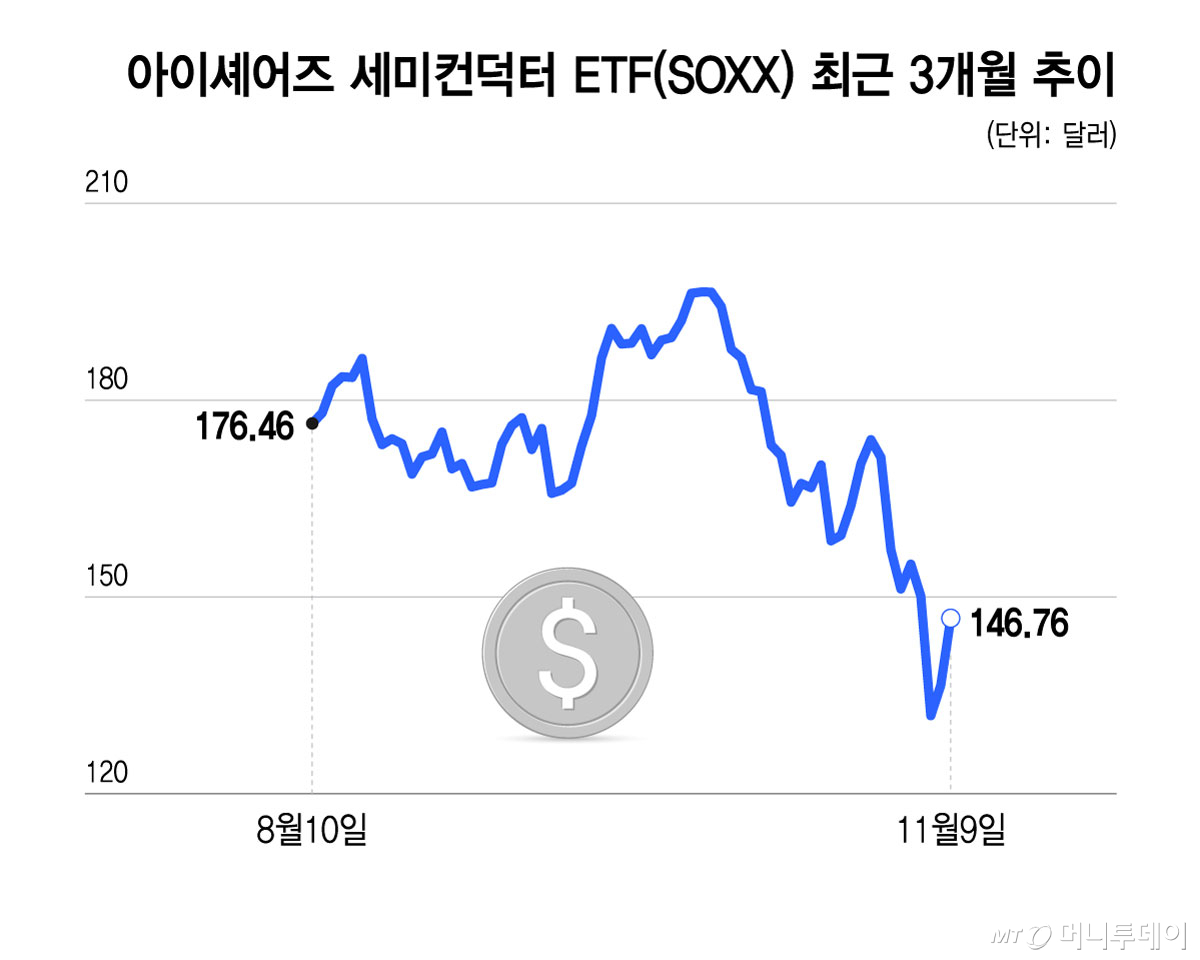
The iShares Semiconductor ETF (SOXX) surged 7.5 percent on November 9, recovering most of the 12.2 percent plunge the previous session. On paper, it looked like the kind of sharp snap-back that marks the end of a panic. The reality was messier.
Nvidia stock fell 4.3 percent on the same day AMD jumped 13.3 percent and Broadcom climbed 8.8 percent. Micron rose 6.6 percent; Intel gained 5.5 percent. Three rival chipmakers captured nearly all of Nvidia’s lost momentum while the market’s former king stumbled over allegations that its CEO, Jensen Huang, was having an affair with a Chinese national suspected of espionage.
That distribution pattern matters more than the headline rebound number. This was not a broad-based relief rally. It was a rerouting of capital away from a single name toward its peers — the kind of rotation that, in other sectors, signals the beginning of a longer shift in market structure.
Why the Market Split Happened Overnight
The core issue is simple: Huang’s scandal did not touch any other company’s fundamentals. AMD and Broadcom do not need to defend a CEO’s personal conduct. Their demand drivers — cloud expansion, custom silicon contracts, the slow diversification away from Nvidia-dependent architectures — are entirely separate. When a scandal hits the largest position in a sector ETF, the mechanical selling pressure concentrates on one stock while the rest of the basket bounces off oversold levels. That is exactly what played out.
The deeper implication, though, is that the market is using this moment to price in something it has been cautiously contemplating for months: Nvidia dominance is not permanent. Every major cloud provider is developing or sourcing alternative accelerators. Intel is pushing its Gaudi line. AMD’s MI-series chips are gaining traction. Broadcom designs custom silicon for Google. The scandal simply gave traders an excuse to accelerate a rotation that was already酝酿 — or at least to act decisively on it without waiting for a catalyst that made less noise.
Valuation: How Deep Has the Cut Really Been?
SOXX is up 46.2 percent year-to-date through November 9, but it has shed 21.3 percent over the past month and trails its June peak by roughly 33 percent. Even with the rebound, the sector carries some bruised valuation.
Cantor Fitzgerald analyst C.J. Muse called the dip “an early Christmas gift,” pointing to Nvidia trading at just nine times 2028 estimated earnings — a figure he considers deeply undervalued given its position in the AI accelerator market. He also flagged Sandisk, down more than 50 percent from its high, trading at roughly 2.6 times 2028 expected earnings with an projected $82 billion in free cash flow through that year. Morgan Stanley’s Stephen Byrd noted Sandisk’s surplus cash could fund buybacks covering more than half its outstanding shares by 2028, a move that mechanically lifts earnings per share.
Micron trades at about three times those same 2028 estimates. Cantor Fitzgerald sees room for accelerated buybacks once the CHIPS Act restrictions on share repurchases expire in December.
None of this guarantees a floor. Cheap valuations in a sector still grappling with whether AI spending will convert into proportional revenue can stay cheap for a long time.
The CapEx Question: Delayed, Not Dead
Morgan Stanley’sByrd offered a nuanced take on the AI capital expenditure controversy that followed the U.S. midterm election results. Rather than canceling data center construction, he argued, companies are more likely to push timelines from 2028 into 2029. A delay of that magnitude cuts no fewer strings — it eases near-term credit and funding pressures and gives the supply-demand imbalance in memory and logic chips time to partially correct. In his view, that dynamic is net positive for semiconductor cyclicals over the medium term.
Rob Arnott of SSgA Capital Management pushed back on optimism overall. Speaking to MarketWatch, he acknowledged that semiconductor stocks have soared more than 40 percent this year despite the recent drawdown, but warned that current prices already embed the assumption that everything will go perfectly. “The monetization from AI built using semiconductors is still difficult,” he said. “Profits have basically not yet materialized.”
That tension between infrastructure build-out and unproven revenue conversion is the sector’s central unresolved question. The scandal has nothing to do with it, but it has sharpened the focus on how much of today’s valuation is priced on conviction versus confirmed economics.
Technical Warning Signs
Jonathan Klingski, BTIG’s chief market technician, urged caution. The Philadelphia Semiconductor Index (SOX) closed below its 200-day moving average on November 7 — the first time since May of last year. Historically, when the index closes under that line for three consecutive months, subsequent 50-trading-day returns tend to run negative.
Klingski sees the index revisiting the 8,000–8,300 range as a prerequisite for resetting the longer-term trend, a level that would erase most of the parabolic rise that began in April. The SOX was trading around 10,034 at the time of writing. That gap leaves substantial technical ground to cover if the next phase of the cycle turns downward.
Who Wins, Who Loses, What Comes Next
Nvidia shareholders who bought above $130 this year are underwater. The scandal added fuel to an existing sell-off, but the fundamental thesis driving the stock higher — sustained AI demand — remains intact in the view of most bull-side analysts. Whether that thesis holds depends on whether hyperscalers actually convert their capex plans into proportional margin growth.
AMD and Broadcom are the immediate winners. Their outperformance relative to Nvidia in this session reflects both mechanical rotation and a broader conviction shift among investors willing to bet against a single-name concentration play. If the rerating continues, it changes the competitive landscape for new contracts and design wins.
Memory makers occupy an ambiguous middle ground. The delay argument favors them — slower deployment means less supply arriving ahead of demand. But weaker end-user spending if AI monetization disappoints would cut both ways.
For now, the sector is split between two camps: value hunters treating this selloff as a buying opportunity and technicians warning that the damage to longer-term averages has only begun. The truth probably lives somewhere between the two, which is usually where semiconductor cycles settle before confirming themselves.