NVIDIA's DLSS 5 Leak Exposes a Generational Chasm—And What It Means for the GPU Market
A leaked build of DLSS 5 from NBA 2K27 shows a stark performance divide: the RTX 50 loses 30–50 percent of its frames, while the unreleased RTX 60 barely notices. The numbers reveal NVIDIA's full commitment to neural rendering—and the growing distance between its current and next-generation hardware.
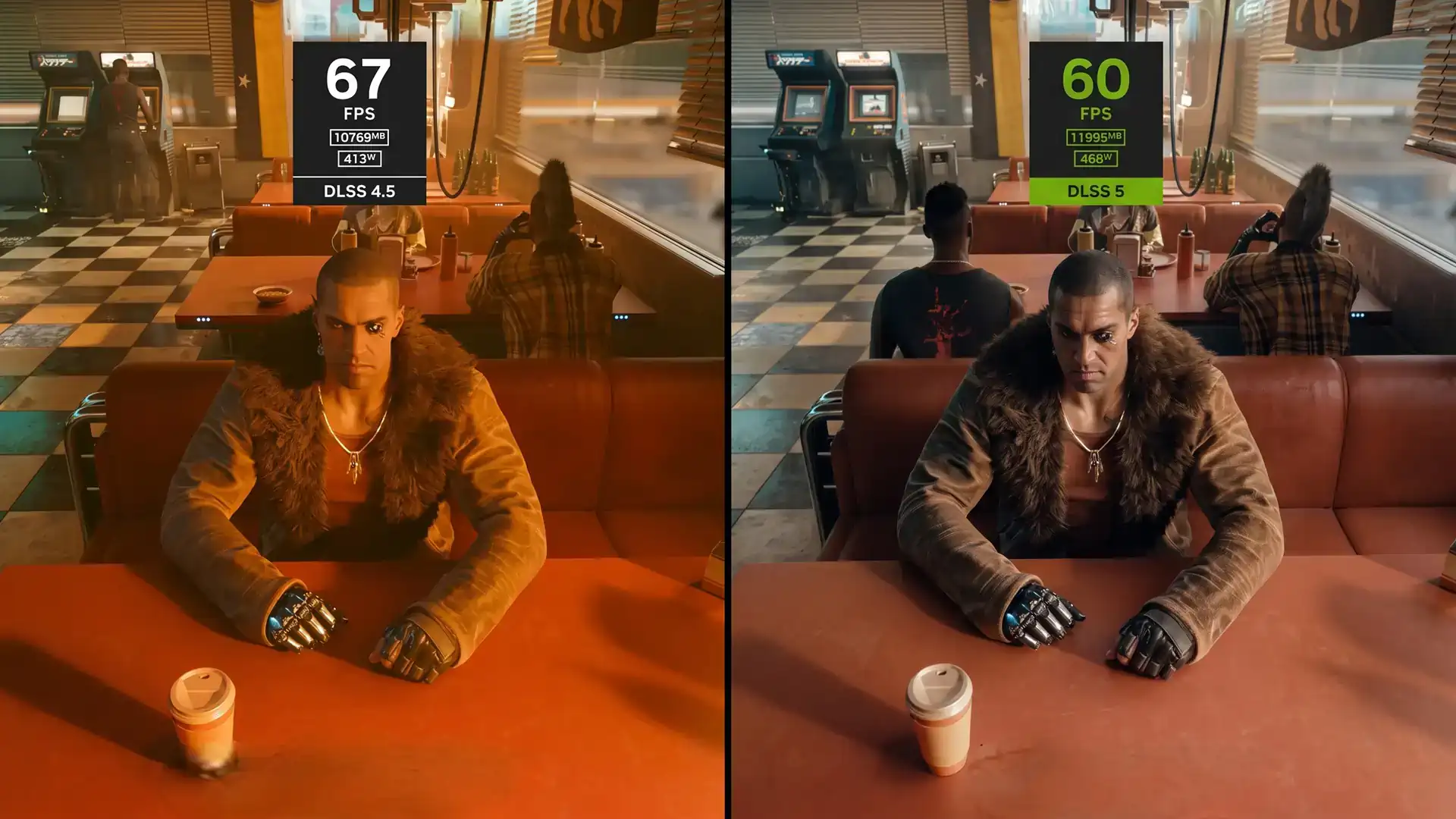
A Leak That Splits NVIDIA in Two
The first real-world look at DLSS 5 has arrived not from a press event or a keynote, but slipped through the update files of NBA 2K27. The leaked dynamic library—nvngx_dlssnr.dll—runs against Control and Final Fantasy VII Rebirth, and the results draw a hard line between two generations of NVIDIA hardware that have never been compared head-to-head on this feature before.
On the RTX 50 series, enabling DLSS 5 costs between 30 and 50 percent of frame rate. On the unreleased RTX 60, built on the Rubin microarchitecture, the hit is 10 to 15 percent. That gap is large enough to matter and precise enough to read as a design choice rather than an accident.
What the RTX 50 Is Actually Paying
NVIDIA itself has not officially confirmed these numbers. The leak came from a distribution build, and the drivers in that build are clearly not final. Several analysts pointed out that the RTX 50 frame-rate plunge is likely a symptom of immature optimization, not a permanent architectural ceiling. Without driver-level handshakes between the neural-rendering path and the tensor cores, the GPU is essentially being asked to run complex neural-network calculations on hardware that was never meant to carry that load solo. The tensor cores take the hit, the standard shader pipeline starves, and frames disappear.
That does not make the leak unimportant. It makes it a snapshot of what happens when a software-defined feature outpaces its hardware-specific integration. NVIDIA has been steering its entire GPU stack toward neural rendering for several generations. DLSS 5 is the most ambitious expression of that direction yet, and the early numbers show the transition period is costly for current owners.
The RTX 60 Was Designed for This
The RTX 60 tells a different story because it was built from scratch around a different assumption: neural computation should not compete with rasterization and ray tracing for the same silicon. Its sixth-generation tensor cores work alongside dedicated FP4 and FP2 hardware units, which isolates the neural-rendering pipeline from the rest of the graphics stack. The result is a clean separation that turns DLSS 5 from a resource grab into a parallel workload. The 10 to 15 percent frame loss is real, but it is far less damaging than the performance penalties seen on Blackwell, and it is offset by improvements in frame generation and ray-tracing throughput that Rubin adds natively.
In other words, the RTX 50 is trying to run next-generation rendering on hardware that was optimized for yesterday’s workloads. The RTX 60 treats neural rendering as a first-class citizen in the pipeline. That is why the same feature produces two completely different experiences across NVIDIA’s own product line.
Who This Hurts—and Who It Helps
The immediate losers are RTX 50 owners who were told, implicitly, that DLSS was a performance multiplier, not a performance variable. When a feature drops frames instead of raising them, the value proposition fractures. Early adopters of the Blackwell launch will feel this most acutely, especially if NVIDIA does not ship a driver update that meaningfully reclaims the lost cycles. No public timeline for such an update has been announced.
The beneficiaries are clearer. NVIDIA’s strategy now reads like a deliberate migration path: push neural rendering forward, accept short-term friction on the current generation, and let the next generation absorb the cost. The RTX 60 is positioned as the hardware that finally makes DLSS 5 feel native rather than experimental. If the 10 to 15 percent figure holds in a shipping driver, NVIDIA will have a clean narrative for its next launch cycle: older cards can run the feature at a steep penalty, newer cards can run it at a manageable one, and the gap between the two becomes a reason to upgrade.
That is aggressive. It also mirrors how major software platforms have handled backward compatibility before—offer the experience, acknowledge the friction on older hardware, and move fast enough that the next generation becomes the only sensible purchase.
AMD’s Position and the FSR Countermove
AMD has not commented publicly on the leak. Its current alternative, FSR, uses a different approach to upscaling that does not rely as heavily on tensor-core-bound neural inference in the same way. Whether that architecture gives AMD an advantage or a handicap under a DLSS 5 world depends on how aggressively NVIDIA’s neural-rendering stack tightens around its own silicon. If DLSS 5 becomes deeply coupled to Rubin-class hardware, AMD’s open-upscaling route may stay cross-platform but risk falling behind on raw efficiency. If NVIDIA keeps DLSS 5 accessible to older architectures through driver patches, AMD retains more competitive ground.
The leak does not resolve that tension. It amplifies it.
What Happens Next
Several questions remain unanswered and should shape how buyers and the industry read this moment.
First, will NVIDIA release a driver update that narrows the RTX 50 performance gap? There is no schedule. The source material notes that current Blackwell results cannot be treated as a reliable indicator of the technology’s long-term efficiency, which suggests the company is aware of the problem and still working toward a fix.
Second, what titles will ship with DLSS 5 at launch? The leak surfaces in NBA 2K27, but a single early build is not a representative sample. Games that lean hard into ray tracing and neural rendering will expose the architectural differences most clearly. Titles that do not will make the performance gap harder to measure outside synthetic benchmarks.
Third, how will the RTX 60 price compare to the RTX 50? If Rubin-class cards carry a significant premium for the neural-rendering upgrade, the upgrade path for current Blackwell owners becomes less attractive. If the pricing is modest, the performance separation reinforces NVIDIA’s argument that the next generation is worth the switch.
The Bigger Picture
This leak is not just about one feature in one game. It is a signal of where the GPU industry is heading: rendering pipelines that are increasingly defined by neural computation rather than traditional geometry and shading. NVIDIA is racing ahead on that path. The RTX 50 is paying a transition tax. The RTX 60 is designed to avoid it.
The numbers—30 to 50 percent versus 10 to 15 percent—are early, unofficial, and incomplete. But they are also the clearest view yet of what that transition looks like in practice. For anyone watching NVIDIA’s strategy, the takeaway is simple: the company is betting that neural rendering is the future, and it is willing to let the current generation suffer through the rough edges so the next generation can make it feel normal.