One Piece Just Announced Two Films—Here's Why That's a Big Deal
Toei announced two new One Piece theatrical films back-to-back at ONE PIECE DAY '26, locking in releases through 2029—a rare commitment that signals the franchise's global economy is far from peak.
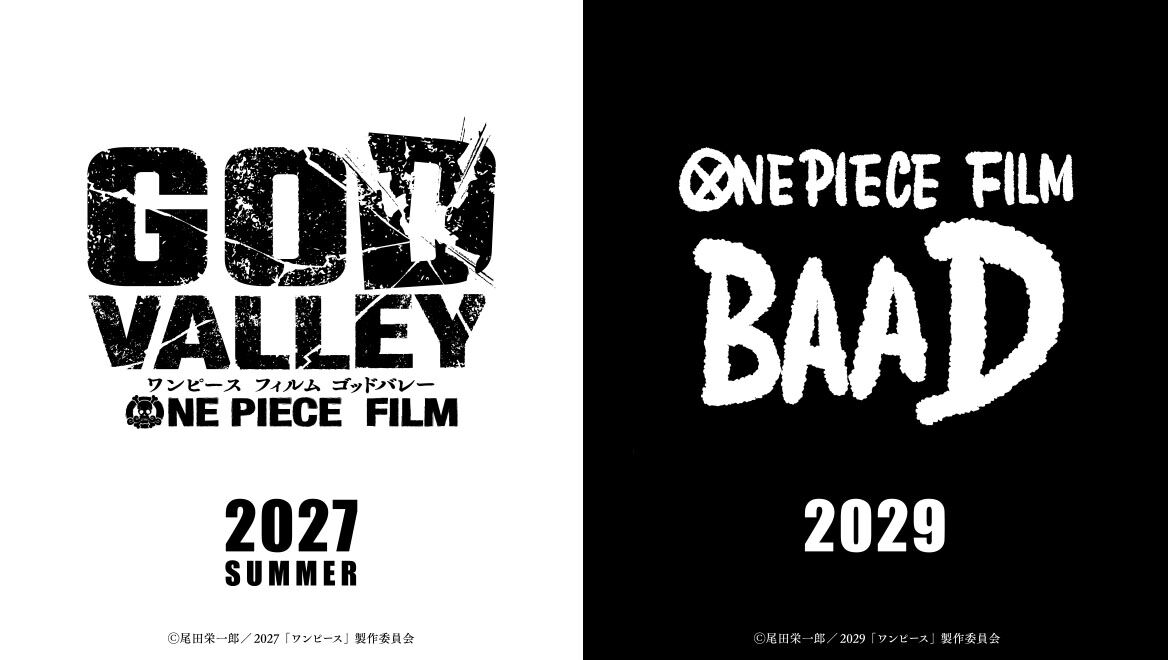
Two films. One announcement. A franchise at play.
At ONE PIECE DAY ‘26, held August 22–23 at Makuhari Messe, Toei Animation didn’t tease a single upcoming movie. It dropped two: ONE PIECE FILM GOD VALLEY, arriving summer 2027, and ONE PIECE FILM BAAD, slated for 2029. Both titles were unveiled simultaneously, each accompanied by a title card drawn by creator Eiichiro Oda himself.
This is not routine in the anime film pipeline. Studios typically announce one theatrical project at a time, if they announce at all. Confirming a second film before the first even opens is unusual for any franchise, and nearly unheard of in anime—where production cycles are notoriously constrained by TV scheduling and streaming obligations. Most anime films are greenlit within twelve to eighteen months of release, leaving little room for forward planning beyond the immediate slate. Toei flipped that timeline entirely.
What Toei is doing here is signal confidence that the One Piece film economy has outgrown the need for cautious rollouts.
The red flag behind the red release
The strategic logic starts with FILM RED (2022), which opened to 2.25 billion yen in its first three days—a series record—and ultimately grossed 20.33 billion yen across 14.74 million admitted viewers when an uncalled-for encore run was added. That output alone would have justified a direct sequel. Instead, Toei chose to look past it entirely and lock in two future projects, suggesting the strategy was never about capturing RED’s momentum but about structuring a multi-year cinematic arc independent of any single film’s performance.
Summer 2027 lands precisely on the manga’s 30th anniversary (July 22, 2027). Baad will sit inside the anime’s own 30th anniversary window beginning October 2029. This is calendar architecture, not accident.
The implication is straightforward: Toei is treating One Piece as a permanent theatrical brand, the way Marvel treats its slate. It’s laying down anchor dates now—three and five years out—so that global exhibitors, licensors, and merchandise partners can plan around them. In an industry where most anime films are greenlit months before release, this forward visibility is itself a competitive advantage. It allows licensing deals, tie-in product runs, and international marketing campaigns to be structured years in advance rather than reactively.
What the titles actually say
God Valley references one of the most consequential unadapted arcs in the entire manga—a brief but devastating backstory that ties together Gol D. Roger, Monkey D. Garp, and the emergence of the Revolutionary Army under Dragon. The God Valley incident occurred twenty-two years before the present story and effectively ended Roger’s dream of finding the One Piece while simultaneously radicalizing Dragon against the World Government. It is, in narrative terms, the flashpoint that makes the current era possible. A film centered on this material would be doing something no previous One Piece movie has attempted: telling a story that exists entirely outside the Straw Hat narrative and still carries enormous mythological weight. For Oda to design the title card himself signals that this is treated with canonical seriousness, not as another standalone side adventure.
Baad, as many fans have noted, appears to be a phonetic rendering of “Beast”—almost certainly pointing toward Kaido of the Beasts Pirates and the Wano Country arc. If confirmed, this would make FILM BAAD the first One Piece theatrical film built around the final major saga of the manga, giving it a natural dramatic ceiling and an emotional throughline that existing anime episodes have only partially covered. The Wano arc, after all, has been the most expensive and visually ambitious arc in the anime’s history, and a theatrical reimagining could justify levels of production scale the weekly broadcast format cannot sustain.
Who wins, who loses
Winners: Toei Animation, which now holds two guaranteed box-office events through 2029 with minimal current cash outlay. Global merchandise licensors, because a longer theatrical runway means longer retail legs. Fans outside Japan, who will get more screens and likely more marketing investment than any previous One Piece film cycle.
Loser (implicit): Any competing anime franchise trying to claim the summer blockbuster slot in 2027 and 2029. The calendar is now crowded with One Piece branding whether other studios like it or not. Demon Slayer and Jujutsu Kaisen films have dominated the Japanese theatrical landscape in recent years; Toei is now carving out territory that forces those franchises into head-to-head competition rather than operating in adjacent windows.
The more interesting question is what this means for the English-language market. Netflix’s One Piece live-action season rollout and the anime’s ongoing SimulDub on Crunchyroll have expanded the franchise’s non-manga audience significantly since 2022. Those viewers are younger, more globally distributed, and less dependent on Japanese theatrical windows. Toei now has two films to convert that expanding audience into ticket buyers—or to learn, via box office returns, whether the conversion rate actually exists.
There is a secondary effect worth tracking: the English-dub market may begin to shape release strategy. If the North American box office proves disproportionately strong for GOD VALLEY, Toei could adjust its distribution model for BAAD—pushing for wider simultaneous release or even a shortened gap between Japanese and international premiere dates. That hasn’t happened consistently for anime films, but the live-action show’s performance has already changed the conversation around what global One Piece audiences will support.
The unspoken risk
Dual commitment looks like confidence. It can also look like overreach. If GOD VALLEY underperforms relative to RED’s benchmark, the BAAD announcement becomes a liability rather than an asset—it locks in a date for a film whose financial rationale may have evaporated. Anime productions rarely go backward once public commitments are made, especially around anniversary milestones. Toei is essentially borrowing against future goodwill.
Whether that gamble pays off depends on two variables nobody can predict yet: what story GOD VALLEY tells and whether the post-RED fanbase has consolidated enough to sustain another theatrical event. The God Valley incident is narratively dense and morally complex—Garp arresting his grandson Ace’s father figure, Dragon witnessing state violence firsthand, Roger’s final failed expedition. Compressing that into a two-hour theatrical experience without alienating casual viewers is a genuine creative risk. And RED benefited from a built-in emotional hook (Uta, Shanks, Luffy’s sibling dynamics) that GOD VALLEY does not. The question is whether Oda’s title card and Toei’s commitment are enough to carry a story that operates entirely outside the crew’s experience.
The bigger picture
Six hundred million manga copies sold worldwide as of March 2026 is not a number that supports a single-film-at-a-time strategy. It supports a franchise operating at industrial scale. The two-film announcement is Toei’s acknowledgment that One Piece is no longer an anime property with occasional movies—it is a global entertainment platform with its own calendar, its own anniversaries, and its own box office gravity.
The real story isn’t that two films were announced. It’s that they were announced together, from a single stage, in a single press burst. That decision says everything about where Toei thinks the franchise stands—and where it plans to be three years from now. It also says something about what happens when a property outgrows the traditional anime release cycle and enters an era where the next chapter is always already scheduled.