Pope Leo's Cancer Victory and What It Means for the Vatican
Pope Leo XIV is cancer-free after lung surgery — a result that reshapes his papacy's trajectory and tests the limits of a pontiff's physical stamina on the world stage.
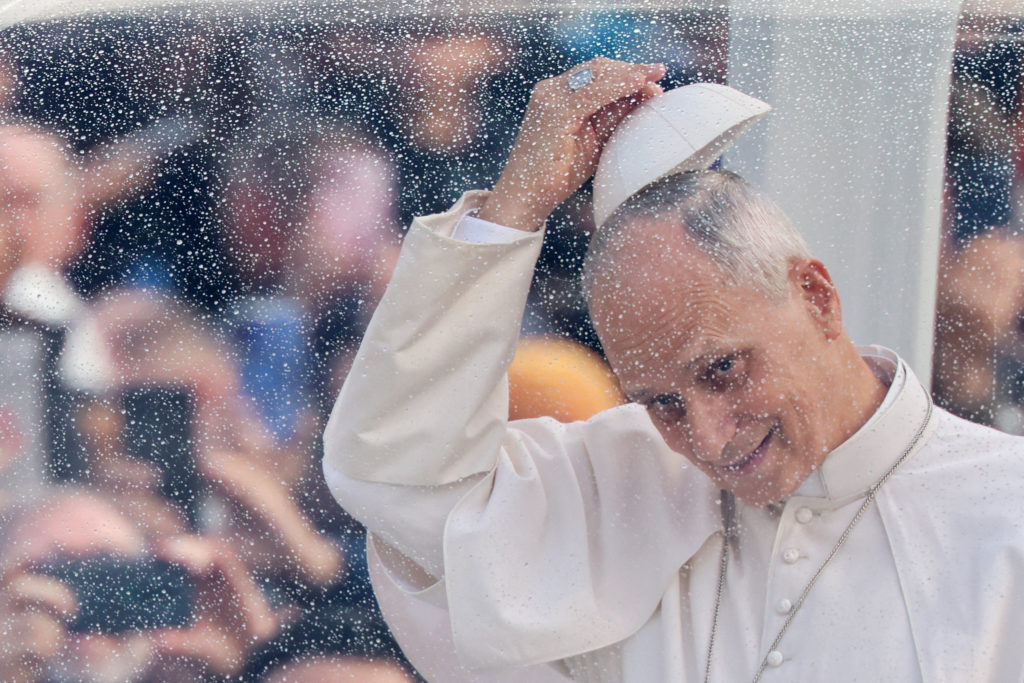
Pope Leo XIV has won his most consequential battle yet.
Not against heresy. Not against corruption. Against adenocarcinoma — the most common form of lung cancer — and it was caught early enough that surgery alone could defeat it.
The Vatican confirmed on Wednesday that follow-up tests showed the cancer was localized and required no further treatment. Leo, 71, had the lower lobe of his right lung removed last week. He left the hospital four days later, well ahead of the week-long stay officials had initially projected. His doctors called it a clean success. The pope called it “a sign of God’s mercy” when he addressed the crowd in St. Peter’s Square on Wednesday.
What happens next matters more than the diagnosis itself.
The surgical recovery that looked almost too smooth
Leo underwent the procedure on Oct. 14 at Rome’s Gemelli Hospital. Dr. Stefano Margaritora, the thoracic surgeon who performed the operation, said the nodule was discovered incidentally during a routine abdominal exam — not because the pope complained of symptoms. That detail matters. An incidental finding at this stage of lung cancer carries a significantly better prognosis than one detected after symptoms appear.
The pope carried on with business while recovering. He took a phone call with Russian President Vladimir Putin from his hospital bed. He appeared at the window overlooking St. Peter’s Square on Oct. 18 for the traditional Sunday blessing. He held a full general audience on Wednesday. At 71, recovering this quickly from major thoracic surgery is notable — and it suggests his physicians took no unnecessary risks with his schedule.
Margaritora stated there was “no clinical reason” to cancel Leo’s planned trip to South America: Uruguay, Argentina, and Peru, November 6 through 17. The itinerary includes a dozen flights, two helicopter rides, and high-altitude stops. The Vatican is not treating this recovery as a reason to scale back.
Why this changes the papacy’s trajectory
Seventeen months into his pontificate, Leo has already weathered the single most serious health crisis any pope in recent memory has faced. John Paul II lived with Parkinson’s and frailty for years before his death. Benedict XVI resigned under the shadow of declining health. Leo’s recovery — swift, public, and complete — reframes how the faithful and the world perceive his remaining years.
The symbolism is deliberate. Leo disclosed the nodule and the planned surgery during the Sunday blessing itself, an unusually transparent move for a pontiff. He did not hide the risk. He walked the crowd through it. That choice signals a papacy that refuses to perform invulnerability even while recovering from cancer surgery.
It also reframes the geopolitical calculus. A pope who appears physically resilient commands a different kind of attention in diplomacy. Leo’s call with Putin from a hospital bed was itself a statement: the papacy does not pause its engagement with authoritarian leaders because of a medical setback. If the trip to South America proceeds as planned, Leo will be the first pope to travel to Peru and Argentina simultaneously in the post-cancer era — a region where the Church faces intense pressure from evangelical growth and where Leo has already positioned himself as a champion of the poor.
The morale question for global Catholics
For the 1.3 billion Catholics worldwide, the news carries a weight that transcends medical statistics. A pope who conquers cancer becomes, for many, a living symbol of hope — and that symbolism is difficult to manage from a pastoral standpoint. Leo’s own framing of the event as “God’s mercy” invites that interpretation. Whether the Vatican intends it or not, the recovery strengthens the spiritual authority of the office in a way no encyclical could replicate.
But it also raises expectations. A cancer-free pope at 71 invites questions about how long he can sustain the physical demands of the role. The South America trip is the first real test. If Leo completes it without complication, the narrative shifts from survival to endurance. If he falters, the contrast becomes sharper and more troubling.
The Church in the Global South — where Catholicism is growing fastest — will watch closely. For communities that have prayed for Leo’s recovery, his strength is not abstract. It is tied to their own sense of belonging to a global institution that has not always prioritized their voices. A healthy pope who travels to their continent sends a message that cannot be easily dismissed.
What this means for the diplomatic front
The broader implication is harder to quantify but potentially significant. Leo has used his papacy to press for climate action, migration reform, and dialogue with authoritarian regimes. His physical stamina is the engine behind all of that. A pope who can travel, speak, and negotiate at length is a different diplomatic actor than one who requires frequent rest.
The Putin call is telling. Leo has not sidelined engagement with Moscow despite his health scare. That continuity matters to Kyiv, to Washington, and to the millions of Catholics in conflict zones who look to the Vatican as a neutral mediator. If the South America trip proceeds on schedule, it will be the strongest possible signal that Leo’s papacy will not be defined by fragility.
The doctors say the cancer is gone. The question now is whether the Vatican can channel that victory into something durable — a papacy that looks less like a struggle for survival and more like a second act with momentum.