Posco's 58-Year Strike Break Could Reshape Global Steel Supply
Posco's union is launching its first strike since the company's founding in 1968, demanding a compensation package that would nearly devour the firm's entire annual operating profit. The disruption threatens to ripple through Toyota, Hyundai, and global shipyards already running lean on Korean steel.
The Crack in the Iron Wall
Posco’s labor union has declared it will begin a 48-hour partial strike on September 9, shattering 58 years of uninterrupted labor peace since the company was founded in 1968. This is not a routine contract dispute. The union’s demand — roughly 1.4 trillion won ($960 million USD) in additional compensation — is so large that if granted, it would consume nearly all of Posco’s operating profit for the year. The standoff is not just a domestic labor story. It is a structural shock to one of the most concentrated steel supply chains in the world.
What the Numbers Actually Mean
The union, led by newly elected chairman Kim Sung-ho, is demanding a 7.1 percent base wage increase, a 600 percent bonus hike, 50 employee stock units, and a 200 percent holiday bonus. Applied to the average annual per-worker compensation calculated from last year’s base pay of approximately 4.56 million won per month, the package works out to roughly 6.11 million won in additional annual value per employee — 7.77 million won in base wage increases, 27.38 million won in bonuses, 9.13 million won in holiday payments, and 16.83 million won in stock units.
Multiply that by Posco’s 17,600 workforce and the direct cash-and-equity payout alone reaches 1.75 trillion won. Add an estimated 20 to 30 percent for indirect labor cost increases — pension obligations, insurance, and welfare — and the total resource requirement lands between 1.29 trillion and 1.40 trillion won.
Posco’s operating profit for the first half of this year was 751.1 billion won, down 33 percent year over year. The company’s full-year operating profit forecast sits at 1.5 trillion won. In plain terms: meeting the union’s demands would effectively wipe out a year of profitability. The company offered a 2.0 percent base increase and a one-time 350,000 won performance bonus — a gap so wide that three rounds of mediation at the Central Labor Relations Commission ended without agreement.
The Timing Is Not Coincidental
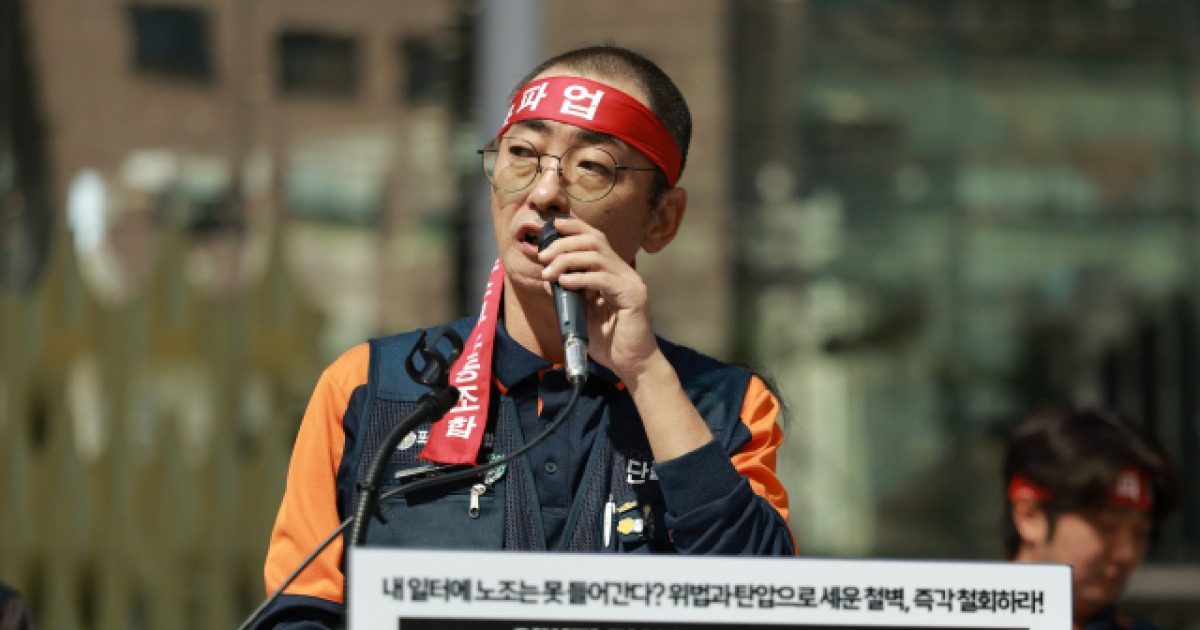
Kim Sung-ho cut his hair publicly at a rally outside Posco Center in Gangnam on September 8, a theatrical gesture signaling that this union is not backing down. But the hardline posture may also be driven by internal politics. The current union executive committee is serving out its final term. A leadership election is scheduled for early October, and analysts familiar with Korean labor dynamics say the incumbent leadership may be calculating that appearing tough during negotiations will strengthen its position at the ballot box.
That does not mean the grievances are fabricated. Posco workers have watched profitability erode since the company posted a peak operating profit of 6.7 trillion won in 2021. The steel business has been squeezed by Chinese export surges and rising tariff barriers from the United States and European Union. Many frontline employees feel they have absorbed years of cost containment while management has not shared the pain equally.
Who Actually Gets Hit First
The immediate impact of a 48-hour partial strike will be contained. Posco has stated that core production processes at its Gwangyang and Pohang complexes will continue operating under existing collective bargaining agreements that designate them as essential services. The first strike will involve only about 100 workers across two specific lines — the skip processing line at Gwangyang and the 3ZRM rolling line at Pohang.
But Posco has warned that if negotiations do not advance, a second partial strike is planned for September 16 lasting 120 hours, followed by the possibility of a full shutdown in October. Each escalation narrows the time windows for suppliers, buyers, and logistics planners to adjust.
The second-order effects are where this story gets global. Posco supplies high-grade automotive and shipbuilding steel to some of the largest manufacturers in East Asia. Toyota Motor Corp., Hyundai Motor Co., and Kia Corp. all source significant volumes of specialized steel from Posco for body panels, structural components, and engine manufacturing. Shipbuilders Samsung Heavy Industries, Hyundai Heavy Industries, and Hanwha Ocean depend on Posco’s plate steel for vessel construction. These relationships are not easily substitutable in the short term.
Automakers in Japan and South Korea already operate with inventory buffers measured in days, not weeks, for many specialty steel inputs. A prolonged Posco disruption would force procurement teams to scramble for alternative supply — primarily from Japanese steelmakers Nippon Steel and JFE Steel, or from European producers such as voestalpine and ArcelorMittal. Neither supplier base has excess capacity to absorb a sudden surge in Korean demand without raising prices or reallocating shipments from other customers.
The Shipbuilding Angle Nobody Is Discussing
Shipbuilders are perhaps more exposed than automakers. Modern vessel construction requires large volumes of high-tensile structural steel that Posco produces in limited quantities at its Gwangyang facility. Shipbuilding contracts are signed months or years in advance with fixed pricing. If steel deliveries are delayed, shipyards face liquidated damages, missed milestones, and potential reputational damage with buyers who include major container lines and oil tankers operators. South Korea’s shipbuilding industry is already facing intense competition from Chinese yards that have been gaining market share through state-supported financing and lower labor costs. A steel supply disruption would hand Chinese competitors a window they would be quick to exploit.
What Happens Next
Posco has activated its emergency response protocols and expects the initial partial strike to cause limited production disruption. The real question is whether the union will escalate beyond October’s leadership election results become clear. If Kim Sung-ho retains the chairmanship, the hardline trajectory is likely to continue. If a more conciliatory candidate wins, there may be room for a negotiated settlement that splits the difference — perhaps a 4 to 5 percent base increase combined with a profit-sharing mechanism tied to future operating performance.
The longer-term implications extend well beyond this contract cycle. Posco’s 58-year no-strike record was never just a cultural artifact. It was a competitive advantage that gave Korean automakers and shipbuilders a reliable, high-quality steel source that rivals could not easily replicate. If that tradition fractures, it signals a broader shift in Korean industrial relations — one where even the most prestigious companies are no longer insulated from labor unrest. For global buyers who priced that stability into their supply chain models, the recalibration will be expensive.
The union says it does not want a strike. The company says it cannot afford the demand. Both sides are now testing how much pain the other can absorb — and the rest of the steel-dependent world is watching closely.